

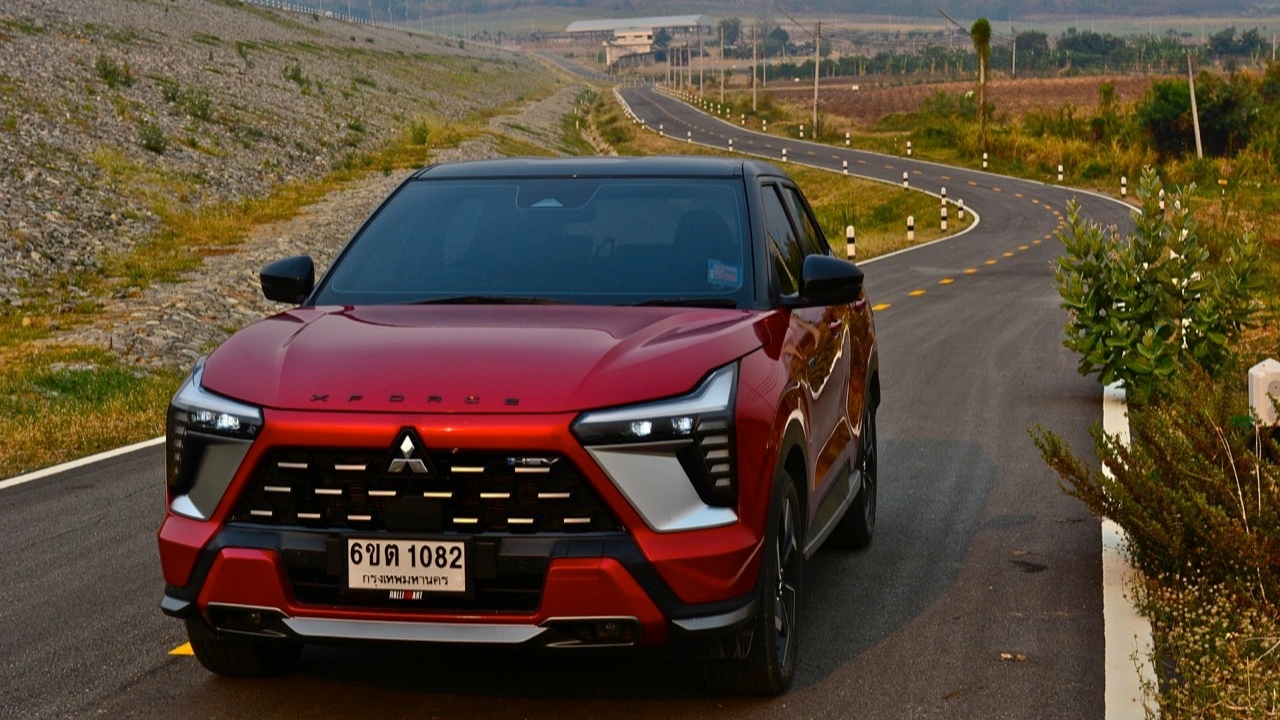
The Mitsubishi X Force HEV was developed specifically for the ASEAN automotive market, focusing on high-tech features, agility, and practical performance. It is a versatile 5-seat crossover SUV, competing with models like the Corolla Cross, Honda HR-V, and Subaru XV. It blends utility and reliability, especially in safety and stability systems, with SUV-like spaciousness and the renowned off-road capabilities characteristic of Mitsubishi Motors.


Xforce HEV IGNITE priced at 899,000 baht.
Xforce HEV ULTIMATE priced at 1,039,000 baht.
Xforce HEV ULTIMATE X priced at 1,089,000 baht (test unit).
Exterior body colors.
Pearl White Diamond.
Blade Silver Metallic.
Graphite Grey Metallic.
Jet Black Mica.
Energetic Yellow.
Red Metallic (test unit).


On close inspection, despite its large front, the Xforce features a modern crossover design that resembles European SUVs more than typical Japanese models of 2025. The grille integrates seamlessly with the front bumper, with LED headlights and LED daytime running lights. The black plastic grille is trimmed with silver chrome edges. The front bumper has sharp angles and depth with the grille. LED fog lights are positioned at the lower corners of the bumper. The hood bears the 'Xforce' lettering, marking the ULTIMATE X trim. This test unit is priced at 1,089,000 baht, excluding ongoing Mitsubishi promotions to boost sales.


The side body emphasizes the wheel arches with black plastic cladding, raised front and rear mudguards, and a character line along the lower door edges connecting to the cladding on the lower door panels. Door handles match the body color. It features a shark fin antenna and a Hybrid EV badge atop the front door panel. The 18-inch alloy wheels have a black and silver turbine design, fitted with Bridgestone Alenza tires sized 225/50R18 95V. Dimensions are 4,390 mm long, 1,810 mm wide, and 1,660 mm tall, with a 2,650 mm wheelbase and a weight of 1,245 kg. The weight is fairly light due to the small hybrid battery. Ground clearance is 183 mm, suitable for crossover use including driving through 30 cm floodwaters or on dirt roads with ease.


The fuel tank capacity is 42 liters, relatively small. Filling 1,000 baht nearly fills the tank to 43 liters. With careful driving, fuel efficiency is 17 km per liter. Using the 43-liter tank size, the theoretical maximum driving range is 731 kilometers. However, practical factors apply: when the fuel warning light activates, about 5–8 liters remain as reserve to protect the fuel pump, so safe range is roughly 600–640 kilometers. Traffic conditions affect fuel consumption—city traffic reduces efficiency from 17 km/l. Driving habits also influence fuel economy; in testing, frequent acceleration and high speeds on straight and curved roads reduced maximum range below the theoretical estimate.


The rear features LED taillights with a distinctive downward-angled design. The tailgate is power-operated with sensors. The rear bumper is well-designed to add depth and sharpness, seamlessly connecting with the tailgate. No part appears disproportionate on the Mitsubishi Xforce’s exterior, especially the slope angle of the front and large rear pillars, combined with the two-tone body paint, which enhances its modern look.


The Mitsubishi Xforce HEV shares its engine with the Xpander HEV but has been modified for its different vehicle type. The inline four-cylinder 1.6-liter 4A92 engine features MIVEC variable valve timing, tuned for compatibility with seven main drive modes to deliver the HEV e:Motion hybrid experience. The gasoline engine produces 107 hp at 6,000 rpm and 134 Nm torque at 4,500 rpm. The electric motor delivers 116 hp and 255 Nm torque. It uses a small 1.1 kWh lithium-ion battery and a 2-Speed Transaxle automatic transmission driving the front wheels. Mitsubishi claims the Xforce can achieve fuel efficiency up to 24.4 km per liter.
Driving modes include Normal, Wet, Gravel, Mud, and Tarmac. The front suspension is MacPherson strut with coil springs and stabilizer bar; the rear is a torsion beam rigid axle. Both front and rear wheels have disc brakes.
Rear bumper decoration set.
Side door decoration set.
18-inch dual-tone alloy wheels.
Bridgestone ALENZA tires sized 225/50 R18.
Electric Parking Brake (EPB) system with Auto Brake Hold.
LED headlights.
Automatic headlight on/off system.
LED taillights with Smoke Chrome tinted lenses.
Power-operated tailgate.
Hands-free tailgate operation with kick sensor.
Interior cabin colors: Black and Mocha brown.
Interior trim uses White Melange Fabric.
Seats are leather-covered with Anti-Temperature Rise heat-reduction treatment.
Rear seats split 60:40.
Rear seats recline in eight positions.
8-inch full digital instrument cluster.
12.3-inch touchscreen central display.
Supports wireless Apple CarPlay and Android Auto.
YAMAHA Premium Sound surround audio system.
Eight speaker positions.
Wireless phone charger.
Dual-zone automatic climate control.
Nanoe X air purification system.
Rear passenger air vents.
Cool box storage compartment capable of chilling beverages.
Ambient lighting inside the cabin.
ABS, EBD, and BA braking systems.
Hill Start Assist (HSA).
Active Stability Control (ASC).
Active Yaw Control (AYC).
DIAMOND SENSE driver assistance system.
Blind Spot Warning (BSW).
Rear Cross Traffic Alert (RCTA).
Forward Collision Mitigation (FCM).
Automatic High Beam (AHB).
Adaptive Cruise Control (ACC).
Lead Car Departure Notification (LCDN).
360-degree surround view camera.
Six airbags (front, side, and curtain).
Tire Pressure Monitoring System (TPMS).


The two-tone interior uses light colors on the dashboard console, combining grey fabric with contrasting plastics. The power-adjustable leather driver’s seat is comfortable and ergonomically designed. Controls, especially the central display and gear selector, are easy to reach and operate. Front seating space is ample, and the rear seats can be adjusted 40:20:40 or reclined in eight stages for comfortable long trips. Rear legroom is sufficient; roofline and height design prevent rear passengers from feeling cramped, better suited for two adults rather than three. Mitsubishi states the synthetic leather uses Heat Guard technology to reflect and reduce heat from sunlight. There is no panoramic sunroof, eliminating issues with water leaks over time, though some customers may miss this feature.


Another highlight Mitsubishi offers is the Yamaha audio system, a leading Japanese brand also used in my home setup (Yamaha DSP A1 AV). The Xforce includes a dynamic Yamaha Premium Sound system with eight speakers. The door panels, console, and other parts are reinforced to handle bass output without unwanted vibrations or noise when playing loud music. Front tweeters are located in the A-pillars, with additional Yamaha speakers embedded in the lower door panels to create depth, clarity, and richness. The sound system offers four preset equalizer modes for balancing different music types. Listening tests reveal that Yamaha’s natural sound suits classical, jazz, and acoustic instrumental music best, though modern pop can also be enjoyed.


The 12.3-inch central touchscreen is responsive with sharp visuals and versatile functions, integrating infotainment, connectivity, vehicle settings, and hybrid drive information. It supports wireless connections for portable devices. The multi-widget display divides into three sections to show multiple data points simultaneously. An appreciated feature is the instrument cluster’s aviation-style indicators, showing altitude, tilt angle, and direction. The infotainment system supports Apple CarPlay, Android Auto, and Weblink. The cabin also includes the Nanoe-X air purification system and ambient lighting on the console and front door panels.


Mitsubishi’s new three-spoke leather-wrapped steering wheel offers a firm grip and a suitable size, resembling the Xpander’s wheel. The right spoke contains switches for Adaptive Cruise Control, while the left controls the instrument cluster display, audio volume, phone call handling, and infotainment functions.


The interior is reasonably spacious given the vehicle’s modest size, with ample storage options. The top Ultimate X trim includes the Yamaha Premium Sound system with eight speakers, dual-tone Black and Mocha cabin colors, White Melange Fabric accents, leather seats with heat-reduction treatment, rear seats split 60:40 and reclinable in eight positions, an 8-inch full digital instrument cluster, 12.3-inch touchscreen supporting wireless Apple CarPlay/Android Auto, wireless phone charging, dual-zone automatic climate control, Nanoe-X air quality system, rear air vents, a cool box storage compartment, and ambient lighting—offering a comprehensive equipment package.


The advantage of the full hybrid system in both models is its quietness, smooth operation, and strong acceleration in EV PRIORITY and TARMAC modes. These features are especially useful in real-world driving, such as low-speed urban environments, improving fuel efficiency in traffic jams and reducing greenhouse gas emissions compared to purely gasoline-powered vehicles.


Seven Drive Modes.
The Mitsubishi Xforce HEV offers seven driving modes designed to meet diverse driving conditions, covering nearly all road types. The seven modes are:
CHARGE MODE: Regenerates electrical energy to recharge the battery faster while driving. EV PRIORITY MODE: Uses electric motor power exclusively, running 100% on battery energy. NORMAL MODE: Standard driving mode for everyday road conditions.
WET MODE: Designed for slippery road conditions, such as during rain.
GRAVEL MODE: For driving on rough or unpaved gravel roads.
TARMAC MODE: Optimized for paved asphalt roads. MUD MODE: For driving on muddy, dirt roads.
AYC (Active Yaw Control) enhances vehicle stability and cornering balance. It controls the inner and outer wheels during turns to work in harmony, maintaining vehicle balance and enabling confident cornering. The system intervenes to steer the vehicle back on course if it begins to lose stability.


The Xforce HEV ULTIMATE X performs well on long trips, especially with stable handling at high speeds and tight corners. The AYC system manages weight transfer and driving balance, preventing loss of control. The Wet mode is effective in rainy conditions, aiding driving over water-covered roads. Adaptive Cruise Control reduces driver fatigue on long drives by maintaining distance and speed relative to the vehicle ahead, though reactivation is required when the lead car moves.


The MITSUBISHI e:MOTION latest generation hybrid system has been tuned for improved engine response, offering satisfactory acceleration and fuel efficiency. Despite testing high-speed stability, fuel consumption remained around 16.8 to 17.2 km per liter. Mitsubishi claims an average fuel economy of 24.4 km per liter for the Xforce. On real roads, obeying speed limits, it achieved about 17 km per liter along hilly and winding routes near Huai Mae Ta Kheng Reservoir in Kanchanaburi.


I tested the seven available Drive Modes and the Active Yaw Control (AYC) system, trying each mode suited for paved roads—normal, sport, EV, and wet modes—according to driving conditions. The suspension and damping provide a comfortable ride on long trips without harsh impacts or body roll. The chassis balance, especially the suspension, carries a RallyART influence. The electric power steering has a variable-weight ratio that, while not as sharp as some competitors, performs well. The suspension and tires are well matched for Thai road conditions. The AYC system effectively manages traction and cornering balance, providing smooth stability without requiring excessive steering corrections.


The front suspension is MacPherson strut with coil springs and stabilizer bar; the rear is a torsion beam rigid axle. Disc brakes are fitted on all four wheels. The AYC (Active Yaw Control) system manages driving and balance in corners, enhancing vehicle stability. It controls inner and outer wheel operation during turns to maintain balance and confidence, intervening to pull the car back on track if it begins to lose control.


Active Yaw Control (AYC) is Mitsubishi Motors’ signature drivetrain technology developed from World Rally Championship (WRC) experience. It controls the yaw moment (rotational force about the vertical axis) to improve cornering precision and stability. It works by creating a "torque difference" between the left and right rear wheels (torque vectoring). Sensors detect wheel speeds, steering angle, G-force, and brake pressure, sending data to the ECU, which analyzes whether the vehicle is understeering or oversteering. During cornering, the system applies more torque to the outer wheel than the inner wheel, helping "pull" the front into the turn, reducing understeer, and maintaining balance on exit by preventing excessive oversteer.


The AYC system differs between four-wheel-drive and two-wheel-drive vehicles. In the Lancer Evolution (S-AYC), it focuses on high-performance driving, allowing 4WD vehicles to corner like rear-wheel-drive cars and reducing front tire load. In current models like the Xpander Cross and Xforce, it operates as a brake-based AYC system emphasizing safety and vehicle control on slippery roads or sudden maneuvers, stabilizing taller vehicles at speed. Comparing to rowing a boat, AYC is like paddling harder on one side to turn sharply without extra steering effort.


The top trim Xforce HEV ULTIMATE X, priced at 1,089,000 baht, has an attractive design with a sufficiently spacious interior. The rear seats recline slightly and include a central cup holder. The instrument cluster and central touchscreen have sharp displays and respond quickly to touch without lag. The driver’s seat is power-adjustable leather, though the passenger seat is manual. The vehicle features a power tailgate, dynamic Yamaha Premium Sound system, and numerous safety and driver assistance features, offering good value for its price point.


The engine and CVT transmission feel somewhat stretched and loose, typical of hybrid CVTs with electric motor assist, but the suspension grips well, and long-distance fuel consumption is reasonably efficient. At this price level, Mitsubishi includes many features. For those familiar with the Xpander HEV, driving the Xforce provides a distinct experience. This crossover handles well on dirt roads with its specialized driving modes, outperforming competitors at higher speeds on gravel or dirt. A future test will verify if the claimed 24 km per liter fuel efficiency is achievable, which would be notably economical.