

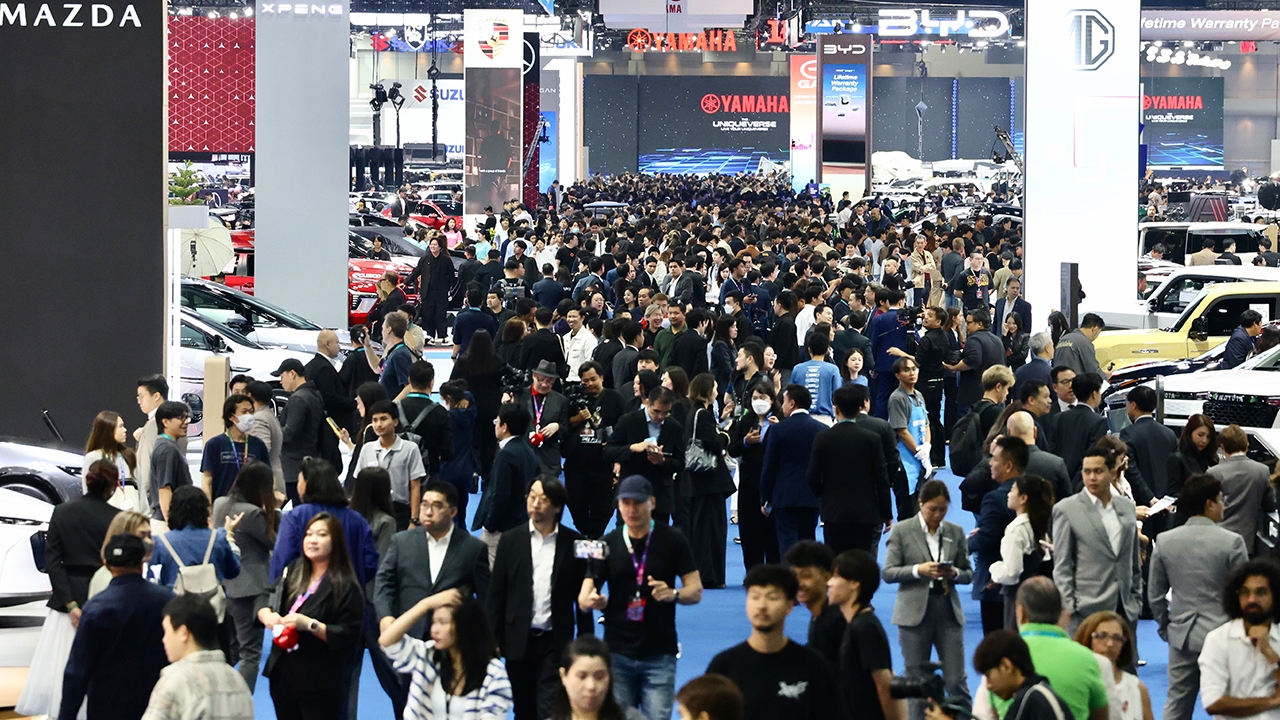
Motor Show 2026 bookings have surpassed 130,000 vehicles. Although reservations soared, data from SCB EIC highlights an interesting perspective that only about 70% of these cars will be actually delivered.
The 2026 Motor Show set a record for the highest number of bookings at 130,000 units, reflecting the growing role of Chinese car manufacturers who continue to increase their market share in Thailand. This surge is driven by rising interest in electric vehicles (EVs), accelerated by fuel price hikes resulting from conflicts in the Middle East. At the same time, Thai consumers' car-buying behavior is also evolving.
Consumers are shifting focus toward value and comprehensive technology features rather than brand loyalty. Additionally, since EVs are often chosen as the second or subsequent household vehicle, this encourages openness to new models, boosting interest in newer manufacturers who have recently entered the Thai market.
. SCB EIC views that about 70% of the bookings made at Motor Show 2026 will actually be delivered. The economic benefits to Thailand are expected to be limited because most sales come from imported vehicles. The details are as follows.

The excitement at the Motor Show reflects only a portion of demand in Thailand's automotive market. Moreover, the booking figures cannot yet be translated directly into actual economic value. The annual Motor Show serves as an indicator of purchasing power activity and interest in modern automotive technology.
However, visitors and those placing bookings are mainly concentrated in Bangkok and its vicinity, focusing on passenger cars or family vehicles. The record-high bookings suggest
that some Thai consumers are increasingly interested in alternative energy vehicles. What follows to watch is how this excitement translates into real economic activity, which can be assessed through three main points:
Although bookings at Motor Show 2026 were very lively, there is no guarantee that all will convert to sales, because the numbers do not yet account for
- Loan approval rates by financial institutions, which consider borrowers’ financial qualifications, future economic conditions affecting repayment ability, and the collateral value of the vehicles.
- Cancellation rates by consumers themselves, which may result from new, more attractive model launches, uncertainty about purchasing power, or long delivery times.
SCB EIC estimates actual vehicle deliveries will reach about 91,000 units, or 70% of total bookings (slightly lower than the historical average delivery rate of about 75%–80% during 2022–2025). This delivery volume represents roughly 14% of Thailand’s projected domestic vehicle sales in 2026 of 617,000 units, with most deliveries expected by July 2026.
Breaking down by vehicle type, the delivery rate for electric vehicles tends to be lower than for internal combustion engine (ICE) cars. Financial institutions remain cautious in lending for EVs, often requiring higher down payments and shorter loan terms to mitigate risks from price competition and uncertainties about some manufacturers’ stability.
Additionally, EVs—especially imported ones—typically have longer delivery lead times, increasing the chance that consumers may change their minds while waiting. In contrast, ICE vehicles benefit from consumer and lender familiarity,
as well as more readily available stock and production networks, enabling faster and more reliable credit approval and delivery processes.

Launching new EV models to spark consumer interest is an effective strategy, reflected by approximately one-third of bookings at Motor Show 2026 coming from manufacturers new to the Thai market, importing vehicles for less than two years. This approach means Thailand’s EV market remains heavily reliant on imports.
In 2025, Thailand imported no fewer than 60,000 EV units for domestic sale, even though domestic EV production has expanded dramatically to about 70,000 units (an 800% year-over-year increase).
However, compared to total demand—both domestic and export—of 130,000 units, domestic production supply is still insufficient and cannot fully meet consumer needs.
While domestic car sales are likely to recover, supported by the EV trend, the economic value-added benefits for Thailand may be limited because
1. The proportion of imported vehicles remains high,
2. The local content used in Thai EV production is relatively low, averaging about 40%, whereas internal combustion and hybrid vehicles use local content up to around 80% of total production value.
As vehicles that create high domestic value are replaced by increasingly popular EVs, accelerating investment to establish EV production bases must be coupled with strict targets and monitoring of local content usage.
Additionally, creating a level playing field is essential for legacy automakers to compete and adapt fairly during this transition, supporting sustainable growth of Thailand’s automotive industry across all dimensions.

SCB EIC projects that the cumulative number of EVs on Thailand’s roads will rise to 430,000 by 2026, accounting for up to one-quarter of all domestic vehicle sales.
However, it is crucial to consider supply chain readiness to meet this rapid demand growth, focusing on three key areas:
3.1 Domestic production of EV parts and components. Although Thailand has over 4,000 automotive parts manufacturers nationwide, only a few large firms have entered the EV supply chain. Consequently, the country still depends heavily on imported critical components and parts for EVs,
such as batteries, motors, electrical control systems, and various body parts. This reliance on imports causes longer lead times for parts procurement compared to ICE and hybrid vehicles, which have more comprehensive domestic supply networks, resulting in higher hidden costs for consumers over time.
Therefore, developing Thailand’s EV ecosystem should emphasize upgrading domestic parts manufacturers through support measures for technology enhancement, knowledge transfer, and production standards improvement, increasing their opportunities to join global EV supply chains.
3.2 Charging infrastructure. As of 2025, Thailand has over 4,600 public charging stations nationwide, with a ratio of about one station per 20 EVs. This ratio is relatively crowded compared to countries like China, Singapore, and Vietnam, which have roughly 10–15 EVs per station.
This indicates that public charging expansion may lag behind the rapid increase in EV numbers, although most EV users rely primarily on home charging.
Nevertheless, limitations in public infrastructure are likely to become more apparent during peak demand periods, such as long holidays or festivals, potentially impacting user experience.
Hence, accelerating public charging network expansion requires government investment incentives alongside improving private sector service efficiency, such as fast charging and smart charging systems, to effectively meet rising demand long term.
3.3 EV insurance. EV insurance represents a long-term cost burden for consumers. Currently, EV insurance premiums are relatively high with limited insurer options. For mass-market EVs priced below 8 million baht, average first-class insurance premiums are about 26,000 baht per year,
nearly double those for ICE and hybrid vehicles. This is mainly due to insurers’ concerns about collateral value and high repair costs.
Premium reductions and increased insurer participation can occur if comprehensive and predictable data are available for risk assessment, including repair costs, repair timeframes, and claim frequency.
Furthermore, improving domestic parts and repair center readiness, along with developing insurance products tailored to EV-specific risks, will help reduce uncertainty and promote competition in the insurance market over the long term.