

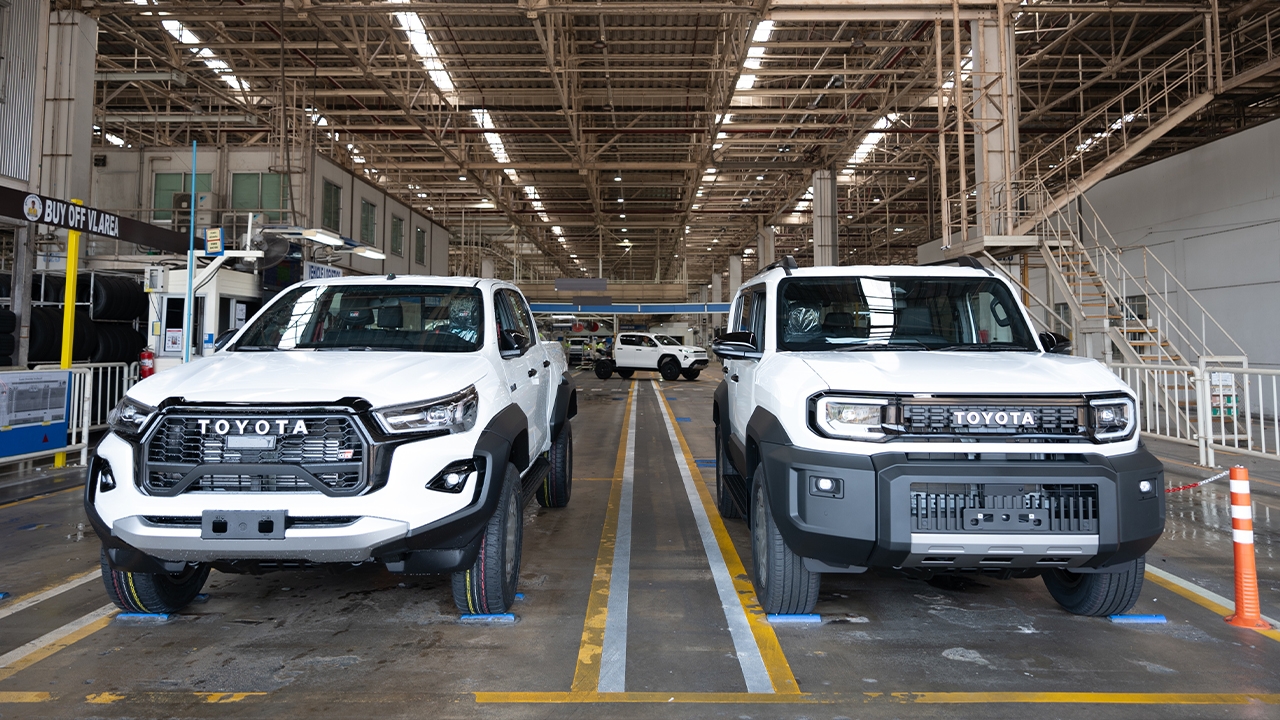
Toyota Motor Thailand has opened the Ban Pho vehicle assembly plant, producing HILUX pickups, including LAND CRUISER FJ and FORTUNER models, as well as the electric Hilux Travo-e pickup truck.
Mr. Somkid Praditkamjachai, Senior Vice President of Toyota Motor Thailand Co., Ltd., stated that Toyota has continuously committed to developing knowledge and personnel skills.
He added that the company has raised production standards alongside building trust, transparency, and sustainability. Toyota is ready to deliver high-quality products worldwide. Products from the Ban Pho plant, such as the HILUX, have been well-received by customers domestically and globally, reflecting Toyota's international production standards.

He expressed pride in growing alongside Thai society and the opportunity to strengthen Thailand's industry and economy.
The company's third vehicle assembly plant is located in Ban Pho district, Chachoengsao province, covering over 1,500 rai. Production began on 12 January 2007, initially with an annual capacity of 100,000 units, assembling Hilux pickups for domestic and export markets. The Ban Pho plant is recognized as one of the top five sustainable Toyota factories worldwide.

With advanced technology and production processes under the Toyota Production System (TPS), the plant has six main production lines. It also employs digital technology like the E-KANBAN system for real-time inventory and transportation management, ensuring continuous production, cost reduction, enhanced efficiency, and optimal resource use.

This globally recognized system ensures high quality, reasonable cost, and short lead times, based on two main pillars:
Additionally, Toyota inspects all production stages using the POKAYOKE system, an automated method to detect abnormalities or errors.

The stamping plant produces body parts by forming small and large components using advanced technology, achieving a production capacity of up to 2,380 pieces per hour. The stamping plant maintains excellent quality control with a focus on quality throughout all processes.
The body welding plant uses computer-controlled robotic systems to weld body frames, ensuring maximum accuracy and precision while reducing energy consumption efficiently.
The painting plant Toyota was the first manufacturer in Thailand to use advanced vehicle painting technology with water-based solvents, which are environmentally friendly as they reduce volatile organic compounds affecting respiratory health.

The injection molding plant has three main processes: rapid plastic part injection exceeding normal machine speeds, foam production for vehicle consoles, and skilled manual painting of parts.
The vehicle assembly plant assembles internal vehicle components such as air conditioning systems, seats, seat belts, and external parts like bumpers, headlights, engines, wheels, and suspension components. These are installed on vehicles that have passed prior processes and undergo testing and quality inspection before delivery to customers.

Quality inspection system To ensure the highest quality, Toyota Motor Thailand applies quality control and inspection technology at every production stage, divided into two systems as follows:
a. In-process quality inspection: Quality checks at each workstation prevent defective products from progressing further, a core principle of TPS. If abnormalities or deviations from standards occur, production stops at that point for immediate correction to deliver quality parts to the next stage.
b. Final quality inspection: To meet standard vehicle quality, a thorough and meticulous final inspection is conducted by skilled employees. This covers component assembly, system settings, and real driving tests on a test track to meet global standards and ensure maximum customer satisfaction.

The Ban Pho plant has been selected as one of the top five sustainable Toyota factories worldwide, reflecting its commitment to growth with world-class production quality and environmentally friendly manufacturing technology.
The WATERBORNE PAINTING SYSTEM uses water as a solvent, matching the quality of paint mixed with thinner while reducing environmental impact.
The regenerative thermal oxidizer is a high-temperature incinerator that reduces volatile compounds causing air pollution.
The plant's design incorporates natural energy use with translucent roofing to minimize artificial lighting.
Energy-saving technologies in production include:

- SERVO MOTORS that control machine movement and electricity usage precisely.
- KARAKURI system uses simple mechanical conveyors based on physics principles like gravity, leverage, and pulleys to ease heavy part handling.
- Regenerative Lifters capture energy from part movements and convert it to electricity.
- Flexible Friction Dolly conveyors adapt to production needs, using energy efficiently.
- Water management includes wastewater treatment for recycling within the plant and RO systems producing clean water as an alternative to regular tap water.

- Renewable energy from solar cells and rooftop panels replaces conventional energy use in the factory.
Toyota also prioritizes environmental care through its Biodiversity Learning Center, raising awareness for natural resource conservation, alongside a large solar farm project producing clean energy and significantly reducing carbon dioxide emissions.
Toyota Motor Thailand Co., Ltd., established on 5 October 1962 with registered capital of 7.52 billion baht, is Thailand's largest vehicle manufacturer. As of March 2026, it has an average annual production capacity of around 770,000 units and serves as a vital global manufacturing base for Toyota's network.

It ranks second in total production among Toyota plants worldwide outside Japan, operating three modern, environmentally friendly assembly plants producing both passenger and commercial vehicles under the internationally recognized Toyota Production System (TPS) known for efficiency, quality, and top manufacturing standards.
As of April 2026, the company employs 13,207 people, covering production and distribution with over 450 showrooms and service centers nationwide as of March 2026, demonstrating robust capacity to serve customers across Thailand.

Located in Samut Prakan province, established in 1964, this is the main production base for pickups and commercial vehicles, including Hilux Revo and Hilux Champ models. It employs 3,937 production staff and 1,387 marketing and administrative personnel, with an average annual export volume of 136,639 units and total investment of 63 billion baht.

Located in Chachoengsao province, established in 1996, it currently serves as the production base for electric vehicles (xEV) under the Multi-Pathway strategy. The production line is highly flexible, switching between sedans and SUVs, as well as ICE and hybrid models.
Vehicles produced here include Yaris Ativ, Yaris Hatchback, Yaris Cross, Corolla Altis, Corolla Cross, and Camry, with 4,334 employees. Annual export volume is 113,820 units, and total investment amounts to 107 billion baht.

Located in Chachoengsao province, established in 2007, this is Toyota Thailand's largest facility, serving as the IMV production base and housing a 63-rai Biodiversity Learning Center featuring wetlands and forest ecosystems.
It currently produces Hilux Revo, Hilux Travo, Hilux Travo-e, Fortuner, and Land Cruiser FJ models, employing 3,549 workers, exporting 126,014 vehicles annually, with total investment at 91 billion baht.