

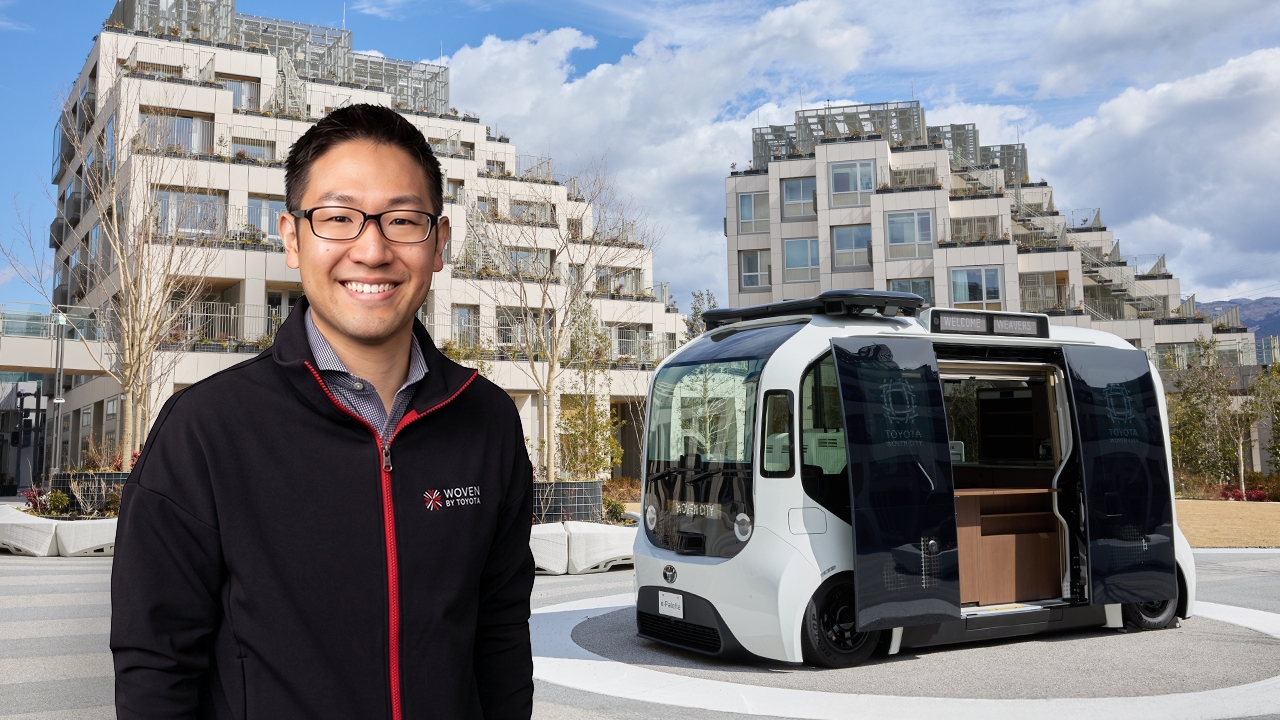
A look inside Woven City, Toyota’s futuristic city that transcends its role as a car manufacturer to become a prototype innovation hub where people can live and experiment in real life, set to change the world, along with unveiling strategic plans. "Kakezan Mobility" Multiplying the power of cross-industry partnerships to create the future travel ecosystem.
Daisuke Toyoda, Senior Vice President of Woven by Toyota and eldest son of Akio Toyoda, Chairman of Toyota’s Board, welcomed a media delegation which Thairath Online was among three Thai media representatives invitedto visit Woven City Phase 1, witness the launch of Phase 2, and observe innovators collaborating on real-world transportation solutions.

Woven City marks a significant step for Toyota’s full transition from car manufacturer to a Mobility Company. This project is not just about technology development but about weaving together people, systems, and innovations to create a connected, safe, and sustainable future society for all.
Woven City consists of
Key participants in the city include
Together, they collaboratively develop and test new forms of mobility in real life.

The innovations and trials in Woven City developed by Toyota in partnership include:
Delivery Robots, such as robotic systems that place goods on trays, which receive items from trucks through underground tunnels, then transport them via rails under Woven City directly to individual residences or labs.
Human Support Robots, notably the Robot Guide Navi, a versatile cart equipped with communication systems, capable of diverse tasks from transporting vegetables in rural areas to towing car-sharing vehicles to customers' desired locations and delivering various items.
This truly supportive robot aims for household proliferation, with demonstrations conducted to ensure safety and reliability.

Electric Vertical Take-Off and Landing Aircraft (EVTOL) presented via a simulator developed by Joby, offering users a novel experience.
Swake, a three-wheeled electric standing scooter resembling a Ninebot but advanced with self-balancing capabilities without a kickstand; currently a prototype tested within Woven City.

UCC Coffee, which conducts research on coffee’s effects on the brain, using four cameras hidden behind counters to capture customers’ eye movements and facial expressions while they work, read, or relax.
DAIKIN, developing an air system to combat allergies, specifically targeting pollen allergies common in Japan. Tests in Woven City showed 90% pollen filtration efficiency, significant allergy symptom reduction, less medication use, and fewer instances of itchy eyes or tearing in children.
After touring Woven City’s first phase, the next day we visited Phase 2 and attended the equally engaging KAKEZAN 2026 event. The Thairath Online team brings you these detailed insights.

Mr. Takeshima Kenta Nakata from Toyota’s Business Unit explained that they have converted the Higashi-Fuji factory into the Inventor's Garage. This factory once employed around 7,000 people and produced over 7.52 million vehicles, including models like the Toyota Sports 800, the luxury Century, commercial vehicles like Japan Taxi, and the popular Corolla.

"Originally, the factory was scheduled for demolition and rebuilding, but in 2018, then-President Akio Toyoda visited. While employees worried about job losses, he pledged that this factory would remain a sacred site for Toyota vehicle production for another 50 years, leaving a deep impression. This decision preserved not only the physical site but also its philosophy and spirit, allowing former employees to return and visit," he said.

Thus, the Inventor's Garage project preserves this historic factory space, repurposing it as a center for developing new products and services by inventors.
Currently, over 30 inventor companies have been selected and interviewed to design internal spaces including labs, production rooms, testing areas, event spaces, and lounges, aiming to foster rapid and efficient technology testing in real environments.

Recognizing that mobility development cannot be done alone, Toyota invites diverse partners—from energy firms and IT companies to startups—to combine their expertise.
Simply put, they multiply their strengths under the Kakezan Mobility concept, where "Kakezan" means multiplication, enabling the creation of a more complete and robust Mobility Ecosystem.
What benefits arise from adopting the Kakezan Mobility approach?
Mobility × Safety → safer travel,
Mobility × Healthcare → improved access to health services,
Mobility × Social Inclusion → expanded opportunities for everyone.
This approach extends innovation to address broader societal issues. For example, in 2015, Toyota launched mobility projects in multiple countries tackling local challenges. In Thailand, data was used to alleviate traffic congestion in key areas like Sathorn and Rama IV roads. Another project, TRUST (Thailand Road User Safety through Technology), leverages data to enhance road safety.

The Arene Platform by Toyota, a software platform for developing intelligent vehicle software created by Woven by Toyota. Arene aims to transform vehicles into Software-Defined Vehicles (SDVs) that operate and improve primarily via software, laying the foundation for safety technologies, connectivity, and future innovations.
The Arene Platform will debut officially in the All-New 2026 Toyota RAV4, marking Toyota’s first full step into the Software-Defined Vehicle era.

Toyota Tsusho, is quietly developing technology to convert household food waste into biogas energy for powering appliances and electric vehicles, supplying energy to Woven City.
Toyota Financial Services Corporation, which manages Toyota’s global automotive financing, is innovating new sales and finance models based on verified real-world travel data.

DAIICHIKOSHO, a commercial karaoke and restaurant operator, is creating more flexible karaoke experiences through real-world demonstrations.
Akio Toyoda AI, developed in collaboration with Akio Toyoda, Toyota’s Chairman, is an AI model reflecting his unique leadership and decision-making style, designed to promote AI adoption.

Daisuke Toyoda. Over time, I feel that Kakezan—or various forms of collaboration—have begun to take shape. I sense growing momentum to take action and move toward new goals, which is what makes me most pleased and impressed about hosting KAKEZAN 2026.
Learn more about Woven City