

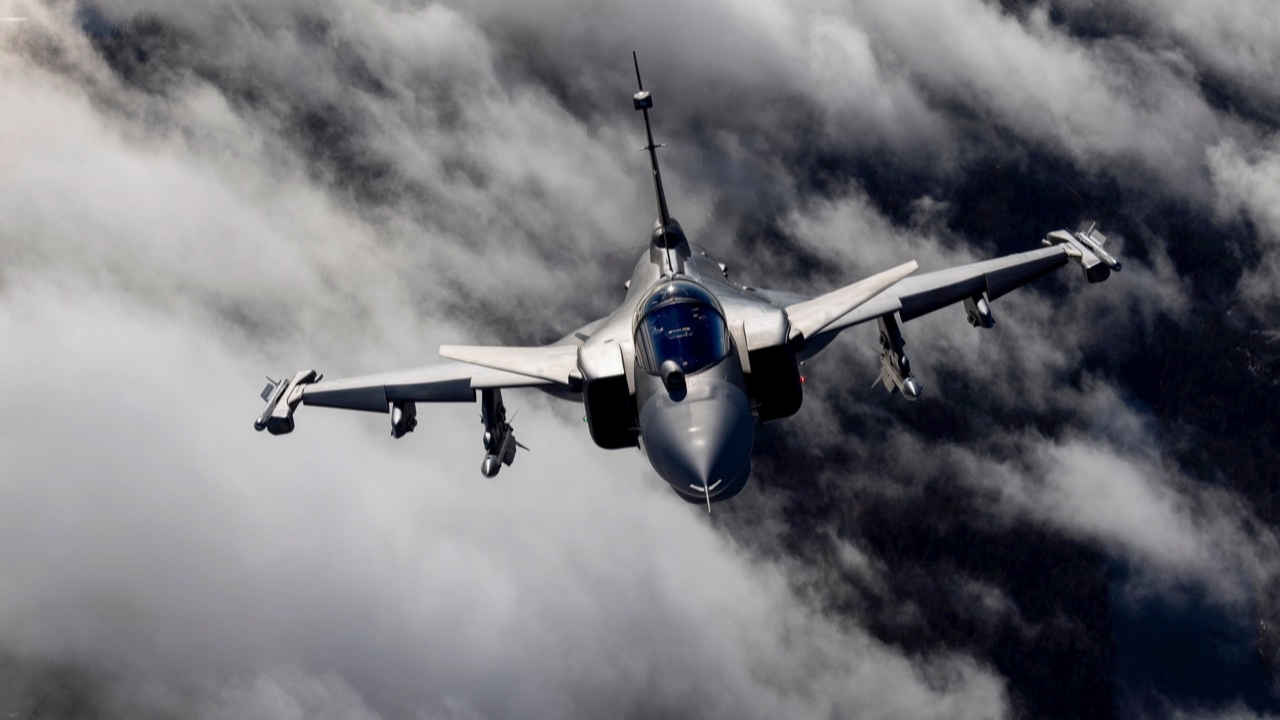
Thailand's Royal Air Force's new generation fighter jet procurement project has moved to the next phase with the first Saab Gripen E/F for Thailand officially entering production at Saab's factory in Linköping, Sweden. This reflects a key advancement in the project to enhance the air force's capabilities for the coming era.

Air Chief Marshal Seksan Kantha, Commander-in-Chief of the Air Force, together with the Thai–Swedish joint project management committee, traveled to Sweden to personally monitor the project's progress. They held meetings with the Swedish Defence Materiel Administration, Sweden's defense equipment procurement agency, and discussed future cooperation and planning for further aircraft acquisitions.
The first batch of four Gripen E/F aircraft for Thailand falls under the “Brupasanti 1” project, signed in 2025 with a budget of approximately 19.5 billion baht. Deliveries are scheduled for around 2029, followed by a second phase to acquire an additional four aircraft, bringing the total fleet to 12 to replace the long-serving F-16A/B jets stationed at Wing 1 in Nakhon Ratchasima province.

The Gripen E/F is a modern fighter developed to support modern network-centric warfare, featuring the latest AESA radar system, advanced electronic warfare capabilities, and real-time data link connectivity. This will significantly enhance Thailand's future air operational capabilities.

The start of production also marks an important milestone in the defense industrial cooperation between Thailand and Sweden, which extends beyond aircraft procurement to include technology development, training, and knowledge transfer in aviation and modern weapons systems.

The JAS-39 Gripen E/F fighter jet selected by the Royal Thai Air Force to replace the F-16s of Squadron 102 represents a major leap from the familiar C/D models, with notable features as follows.
Engine and structural design.
Equipped with a new engine (GE F414G), the same engine used by the F/A-18E/F Super Hornet, delivering a maximum thrust of approximately 98 kN (22,000 lbf), a 25% increase over previous models. This allows for supercruise (supersonic flight without afterburner) and supports higher payload capacity.
Maximum speed exceeds 2,450 kilometers per hour (supersonic flight without afterburner).
Range extends beyond 1,500 kilometers.

Powered by the General Electric F414 engine.
Radar: Raven ES-05 AESA (Active Electronically Scanned Array) radar provides precise target detection even against low radar cross-section targets.
Infrared Search and Track (IRST) sensor enables silent target detection without radar emission.
Weapons stations: 10 external hardpoints supporting a variety of guided missiles and bombs.
Larger airframe: slightly longer fuselage and repositioned main landing gear to the wing roots, increasing internal fuel capacity by up to 40%, significantly extending operational range compared to C/D models.
Hardpoints increased to 10 (up from 8), allowing greater simultaneous carriage of weapons and external fuel tanks.
Detection and electronic systems (The Brain).

Raven ES-05 AESA radar mounted on a swashplate allows ±100-degree scan angle (wider than fixed radars), enabling the aircraft to fire weapons and evade while maintaining target lock.
IRST (Skyward-G) sensor mounted in front of the cockpit allows passive target tracking without radar emission, reducing the chance of enemy detection.
Electronic Warfare (Arexis): a highly effective integrated 360-degree electronic warfare system capable of generating precise digital radio frequency memory (DRFM) jamming decoys to disrupt enemy radars.

Cockpit and interfaces (HMI).
Wide Area Display (WAD): a large single color touchscreen (19 x 8 inches) replaces multiple separate screens, allowing pilots to customize information layout like using a large tablet in the cockpit.
Targo II HMD: new helmet-mounted display linked to weapons and sensors, enabling pilots to see flight data and lock targets simply by looking.
AI Assistance (Centaur): an assistant system that processes and filters data to reduce pilot workload during intense combat situations.

Weapons capabilities.
Meteor BVRAAM: supports use of beyond-visual-range air-to-air missiles with the world's widest "No Escape Zone."
Multi-Role Capability: designed for rapid mission changes (Air-to-Air, Air-to-Surface, Reconnaissance) with refueling and re-arming taking only 10-15 minutes using minimal ground crew.


Progress in Thailand.
The Royal Thai Air Force officially selected the Gripen E/F in late August 2024. The budget received cabinet approval in 2025 to procure the first phase of four aircraft (out of a total planned 12) to maintain air defense capabilities. Selecting the E/F model equips the Thai Air Force with technology comparable to top-tier 4.5 generation fighters worldwide and ensures full integration with existing Link T systems and SAAB 340 Erieye early warning aircraft.