

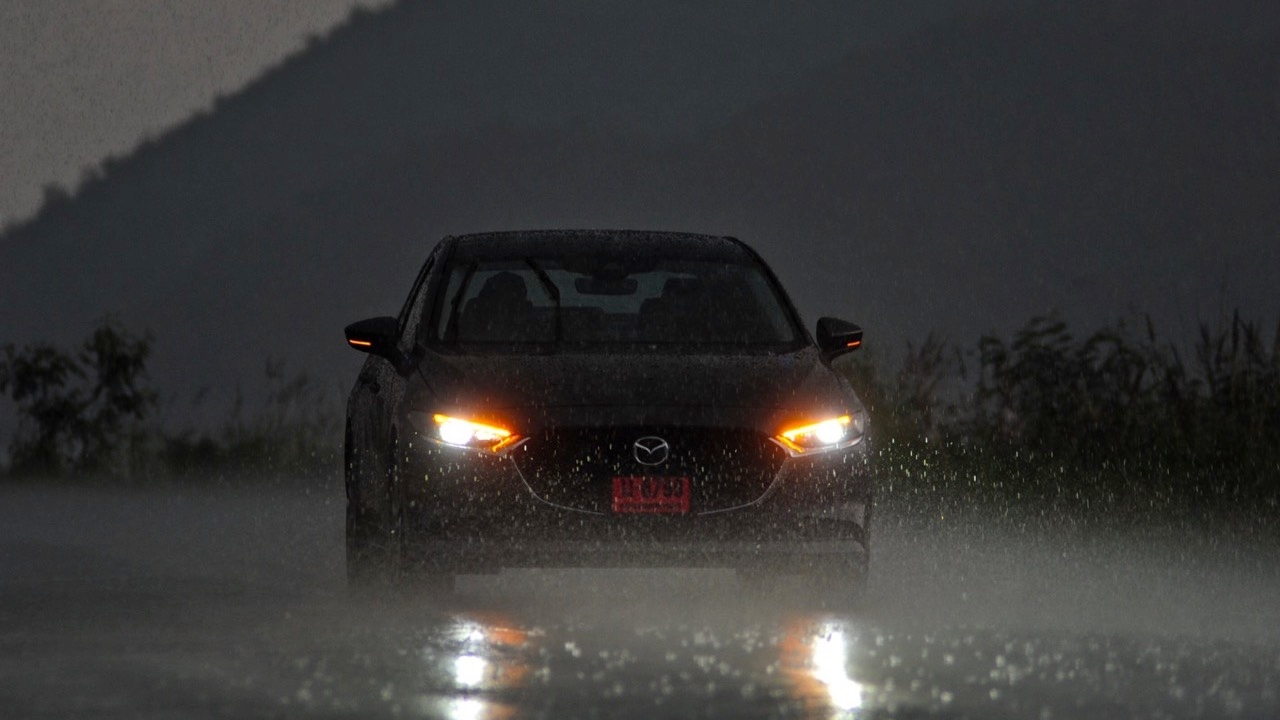
As the weather shifts from the ending hot season into the rainy season with almost daily heavy rainfall, avoiding accidents during the rainy period relies on both driving skill and vehicle readiness, especially the tires. A common question is how much to reduce speed when driving on wet, slippery roads in the rain. Generally, you should reduce your speed to about two-thirds of what you would drive on dry roads. Proper speed reduction improves tire grip on the road surface. Slowing down also allows more time to respond or avoid potential accidents ahead. Additionally, driving slower during heavy rain helps reduce hydroplaning—when tires ride on water instead of the road, causing loss of traction and skidding. High speeds make correction difficult. Many accidents occur due to driving too fast in the rain. Whenever hydroplaning happens, the driver loses directional control.


If you’re driving smoothly but suddenly hit a puddle that causes hydroplaning or skidding, don’t panic. Although it’s easy to say, it’s hard to do because severe skidding can shock drivers into freezing. Avoid slamming the brakes as this can cause the wheels to lock suddenly, worsening the skid or causing the car to spin uncontrollably. Instead, release the accelerator, gently steer to maintain control, and gradually reduce speed. Only then should you apply the brakes. This approach helps maintain consistent tire-road grip. Driving slower from the start in rainy conditions reduces the chance of hydroplaning. Suitable speed during heavy rain with standing water should not exceed 80 kilometers per hour for vehicles with tires in good condition.


As the vehicle slows, the tires regain road grip, allowing you to steer as intended. Theoretically, at 45 kilometers per hour, part of the tire maintains contact with the road, but at speeds above 90 kilometers per hour, tires may lose grip and hydroplane on standing water patches. This applies to front-wheel drive, rear-wheel drive, and four-wheel drive vehicles alike. Driving too fast in heavy rain with water accumulation on the road means the tire tread can’t evacuate water quickly enough. When wheels ride on water rather than the road surface, control is lost suddenly and severely, making it difficult to steer back on course.
Driving during rain on wet and slippery roads is highly risky because the tire’s grip on the road surface decreases by more than 50%. There is also an increased risk of hydroplaning, which causes loss of vehicle control.
Here are engineering-based driving and vehicle control techniques to safely handle wet, slippery roads.
Use an appropriate speed by reducing your usual speed by 20 to 30%. Safe speeds on wet roads should not exceed 80 to 90 kilometers per hour (or lower depending on visibility) to allow tires enough time to channel water out from the tread. Driving too fast causes tires to lift onto the water surface, resulting in loss of grip.
Maintain double the normal following distance. On dry roads, the two-second rule applies, but on wet roads, increase this to 4–5 seconds or keep at least 50–100 meters distance. Braking distances on slippery roads increase to at least twice normal.
Turn on low beam headlights so other drivers can clearly see your vehicle. Do not use hazard lights while driving, as they confuse following drivers and prevent use of turn signals for direction indication.
Steering, accelerator, and brake control techniques: hold the steering wheel firmly and smoothly with both hands at the 9 and 3 o’clock positions. Avoid sudden or sharp steering inputs, as abrupt changes reduce lateral tire grip and cause skidding.
Apply the accelerator smoothly to maintain steady speed. Avoid aggressive acceleration that causes wheel spin and sudden lifting of the accelerator in curves, which shifts weight forward excessively, lightening the rear and causing oversteer.
Correct use of brakes (ABS system).
If your vehicle has ABS, which is standard in modern cars, in an emergency press the brake pedal fully and hold it. Do not pump the brakes. The system automatically modulates brake pressure to prevent wheel lock-up, allowing you to steer around obstacles.
Avoid sudden braking on solid road markings, pedestrian crossings, or metal manhole covers, as these surfaces are significantly more slippery than regular asphalt.
How to handle situations when losing vehicle control.
If the vehicle starts to skid, the most important action is to remain calm and follow vehicle control physics principles.
Case 1: Hydroplaning — The steering feels unusually light and the car does not respond to steering inputs. This happens when speed is too high for the tires to clear water, causing the car to ride on a water layer.
To correct, avoid braking or steering sharply. Keep the steering wheel steady and slowly release the accelerator. Let water resistance and engine braking gradually reduce speed. Once the tires regain contact with the road, control will return.
Understeer (front wheels lose grip).
Symptoms: when turning into a curve, the front of the car continues straight instead of following the curve. Common in front-wheel drive cars or when cornering too aggressively.
Correction: ease off the accelerator and avoid increasing steering angle, as more steering can worsen front wheel grip loss. Slightly straighten the steering to realign the front wheels and regain traction, then gently steer along the curve.
Oversteer (rear wheels lose grip).
Symptoms: the rear end swings out, and the vehicle threatens to spin. Common with rear-wheel drive cars or sudden weight shifts in curves.
Correction: gently ease off the accelerator (avoid sudden braking) and counter-steer—turn the steering wheel in the direction of the rear swing. For example, if the rear slides right, steer right smoothly and quickly to realign the car with the road. Once straightened, quickly return the steering wheel to neutral to avoid a pendulum effect (fish-tailing).
Things to avoid and precautions.
Turn off Cruise Control in the rain. Do not use automatic speed hold because if hydroplaning occurs, the system may misinterpret the speed drop and increase throttle, causing the vehicle to spin.
Avoid driving in the far right lane, which often accumulates water near the median barrier. Hitting a puddle at speed with one side’s tires can pull the car toward the barrier. Watch tire tracks from the vehicle ahead and try to drive within those tracks, as they have already displaced some water, improving your tires’ road contact.

Also, for heavily loaded vehicles like pickup trucks, distribute weight evenly before traveling in the rainy season. Ensure tires are in good condition, brakes, wipers, and lighting systems are fully operational. If caught in a severe storm with poor visibility, find a safe place to park away from the shoulder or stop at a gas station rather than on the roadside, which is dangerous. Do not use emergency flashers while moving, as they confuse other drivers, especially at intersections.

In rain, increase following distance because slippery roads increase braking distance. Reducing speed and maintaining a safe gap helps avoid rear-end collisions caused by skidding. It also provides time and space to brake or maneuver around hazards. Dark or heavily tinted windshield films worsen visibility in rain, especially near dusk, increasing accident risk. Avoid dark tint on front windshields to maintain good visibility; even high-quality films reduce visibility in wet conditions.

Reminder: prepare for rainy driving by checking equipment such as tires, wipers, brakes, lighting, mobile phone battery, and emergency contact numbers.
Do not reduce tire pressure to increase road grip. This practice does not improve traction but causes rapid tire wear, high temperatures in the tire sidewall, and risk of blowouts.
Drive at appropriate speeds and exercise extra caution. Remember that excessive speed increases accident risk due to longer braking distances and potential skidding during braking.
Maintain greater following distances, accurately calculating stopping distances with water and slipperiness as variables. Always prioritize safety.
Avoid overtaking unless necessary, and if not overtaking, yield to faster vehicles to pass safely.
Mastering proper braking techniques suited to conditions helps prevent accidents during rain.
Be cautious of water splashing pedestrians. Understand and respect others sharing the road.