

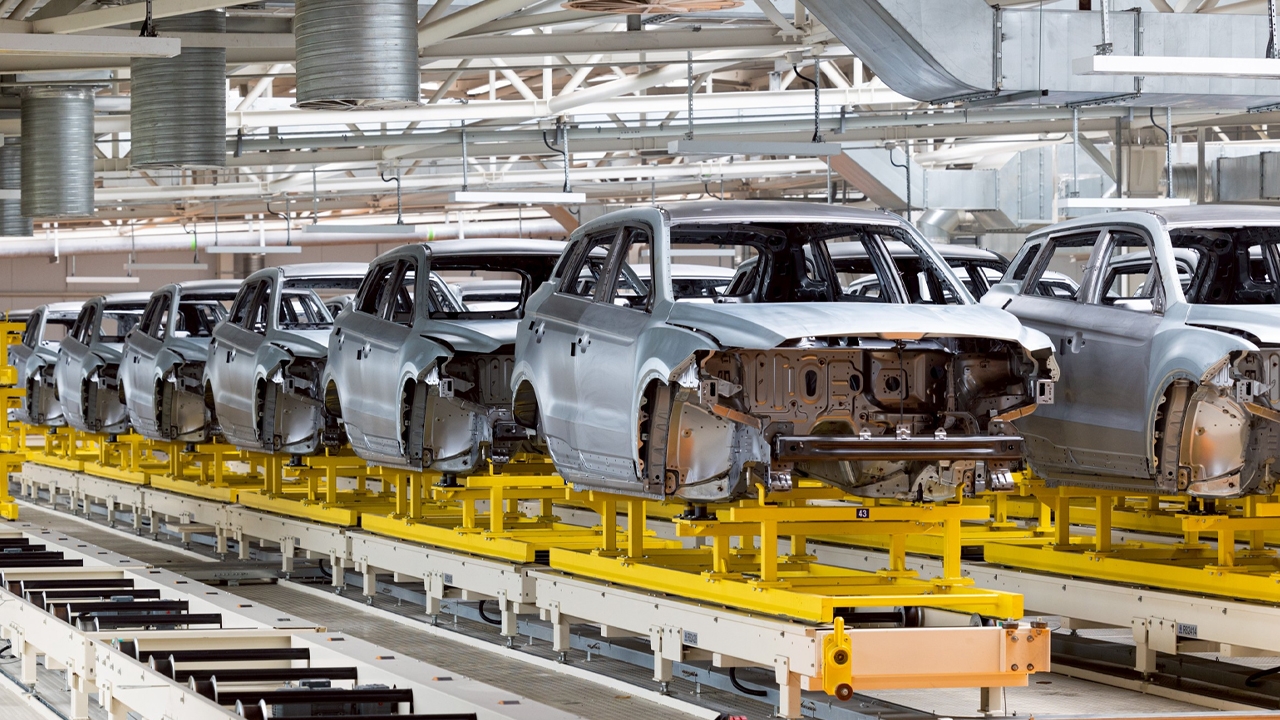
The automotive sector faces a storm as the Middle East war impacts Thailand's vehicle production and exports, dropping to the lowest levels in five years due to worsening conditions.
Mr. Surapong Paisitpattanapong, advisor and spokesperson for the Automotive Industry Group at the Federation of Thai Industries (FTI), said the automotive sector is concerned that vehicle export volumes may fall short of the target of 950,000 units if the Middle East conflict persists and expands, affecting the global economy and Thailand's trading partners.
Earlier this year, the FTI set the 2026 target for Thailand's automotive industry at a total production of 1.5 million vehicles, with 950,000 units for export and 550,000 units for domestic sales.
In April 2026, total vehicle production was 103,794 units, down 22.20% from March 2026 and 0.44% from April 2025. The decline was due to a 1.70% drop in domestic production, especially passenger cars including internal combustion and electric vehicles, which fell 16.77% compared to April last year.
However, reduced pickup truck exports to the Middle East, caused by the war and closure of the Strait of Hormuz, may prevent reaching export targets if the conflict extends beyond three months. From January to April 2026, total vehicle production reached 473,545 units, a 4% increase from the same period in 2025.
Domestic vehicle sales in April 2026 totaled 48,394 units, down 19.16% from March but up 2.54% from April 2025. The increase was driven by electric vehicle deliveries, which accounted for over half of bookings at the Bangkok International Motor Show in late March to early April, amid rising oil prices caused by the Strait of Hormuz closure, as well as new model launches and a truck manufacturer relocating production.

Pickup truck sales still dropped 9.7% compared to the same month last year due to tighter credit from financial institutions amid slow domestic industrial production growth. Investment and employment remain concerns, weakening consumer purchasing power. The global economy faces risks from international conflicts and trade wars.
Nevertheless, with 2.8% GDP growth in Q1 2026 and investment approvals by the Board of Investment, the economy may grow faster if these investments proceed this year. Additionally, the government's 400 billion baht borrowing aimed at reducing energy imports and boosting investment could increase employment in Thailand.
"A major concern is the rising costs of parts citing the Middle East war, which could further reduce vehicle sales and production. We urge parts and vehicle manufacturers to consider the current weak purchasing power for a while. Passenger cars and passenger utility vehicles totaled 33,654 units, representing 69.54% of total sales, up 9.07% from the same month last year," he said.
From January to April 2026, vehicle sales totaled 230,477 units, a 15.02% increase from 2025. Passenger cars and passenger utility vehicles accounted for 157,099 units, or 68.16% of total sales, up 23.91% compared to the same period last year.
Mr. Surapong added that in April 2026, exports reached 60,190 units, down 25.13% from the previous month and 8.43% from April 2025. The decline was mainly due to a drop of 11,053 units (91.76%) in exports to the Middle East market, with only 993 units shipped, caused by the US-Israel-Iran conflict leading to the closure of the Strait of Hormuz, as well as decreases in Europe, Central America, and South America markets.
However, vehicle exports rose in Asia, Australia, and Oceania, which have significant market shares of 26.36% and 31.23%, respectively, as well as in Africa and North America, mitigating the overall export decline. In April 2026, the total export value of complete vehicles, engines, other parts, auto parts, motorcycles, and motorcycle parts was 67.91 billion baht, down 5.60% from 2025. From January to April 2026, the export value of vehicles, engines, and parts totaled 267.90 billion baht, a 6.16% decrease compared to the same period in 2025.