

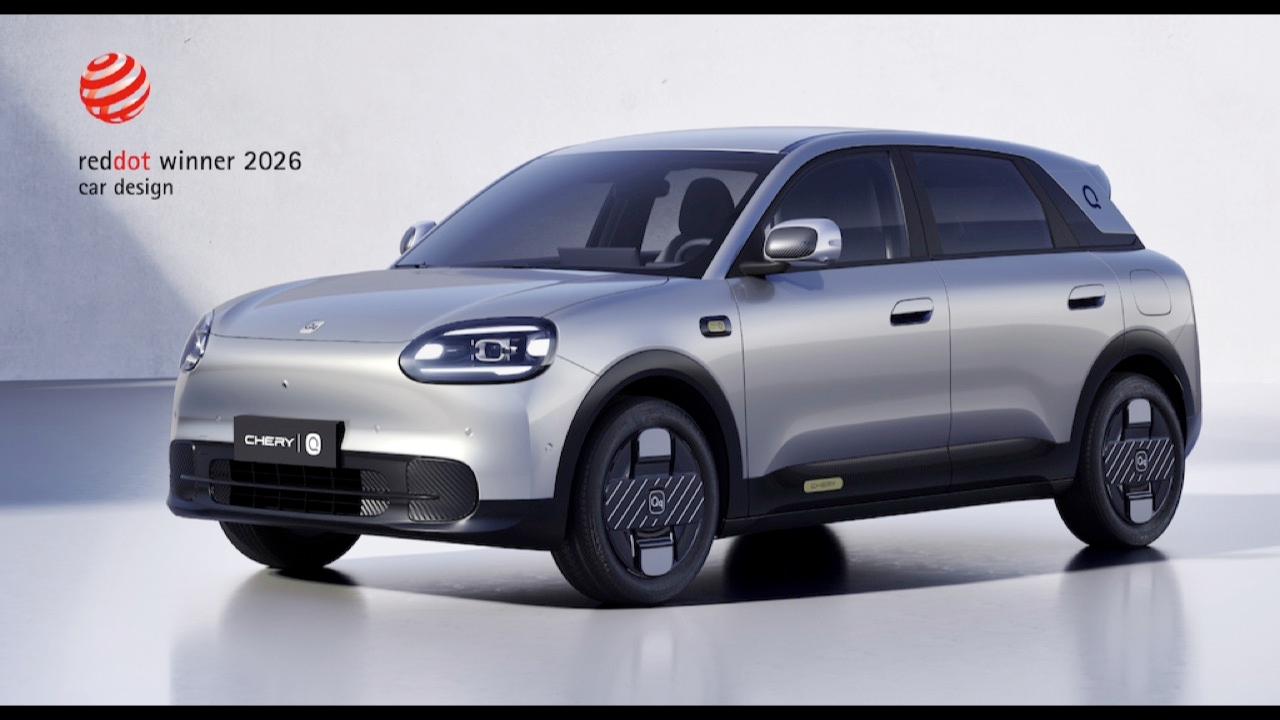
Chery Q electric carThe latest model from CHERY has received overwhelming response from consumers worldwide, recently setting a record with over 50,000 reservations in China on its launch day. This clearly reflects the strong interest and confidence customers have in this new vehicle, marking another success that underscores positive reception in the Chinese market.

Jim Lee, Managing Director of Chery Thailand, said, “The response to the Chery Q in Thailand has far exceeded expectations, especially at the 47th Bangkok International Motor Show, where we attracted a large number of customers. Currently, nearly 3,000 reservations have been made. After the event, interest and bookings continue to grow steadily, demonstrating Thai consumers’ confidence in the CHERY brand and our new product.”

The Chery Q received an international product design award from the 2026 German Red Dot Product Design Award in April 2026, under the Red Dot Award: Product Design category. This is one of the most prestigious industrial design awards, confirming global recognition for its industrial design excellence.

A key feature of the Chery Q is its rear-wheel drive with a long wheelbase of 2.7 meters, offering more driving stability and interior space than typical city cars. The Chery Q is a 100% electric small car (A-Segment) focused on agility and urban use. Though compact in size, it stands out with a long wheelbase to expand cabin space. Its dimensions are length 4,195 mm, width 1,811 mm, height 1,569 mm, and wheelbase 2,700 mm, which is long relative to the car’s overall size, providing a spacious interior, 375 liters of cargo space, expandable to 1,450 liters with seats folded.

The electric motor and drivetrain are configured as rear-wheel drive (RWD), available in two power levels: Standard with 58 kW (78 hp) and 90 Nm torque; High-Power with 90 kW (121 hp) and 115 Nm torque. The vehicle uses durable Lithium Iron Phosphate (LFP) batteries in two capacities: 29.48 kWh for a maximum range of 310 km and 41.28 kWh for up to 420 km, both measured under CLTC standards.

DC Fast Charging supports quick charging from 30% to 80% in about 28 minutes. AC charging via Wallbox is also supported, with charging time depending on battery capacity and charger power.
The top speed ranges from approximately 150 to 170 km/h, with maximum driving ranges of 310 to 420 km (CLTC). It features a 15.6-inch central display. Official pricing in Thailand has not been announced but is expected to be between 400,000 and 500,000 baht, positioning it competitively in the small EV market alongside entry-level models like the BYD Dolphin.

The suspension and brakes are tuned for smoothness and road grip typical of rear-wheel drive cars. The suspension uses independent MacPherson struts with coil springs on both front and rear. Since the motor is placed on the rear axle, the chassis structure, called LFS (Lightweight Frame Structure), is made of aluminum and designed for independent suspension on both sides to secure the motor assembly and allow wheel movement independently for better shock absorption. Having independent rear suspension in such a small car is an engineering highlight for Chery, offering better shock absorption than competitors using solid rear axles. The braking system includes four-wheel disc brakes with an electronic parking brake (EPB) and Auto Brake Hold.


The Chery Q is built on the LFS Platform, with the main body structure made from over 93% aviation-grade aluminum alloy, making the car exceptionally lightweight (curb weight around 975 to just over 1,000 kilograms) while maintaining high strength, torsional rigidity, and rust resistance throughout its lifespan. Most vehicles priced in the 400,000-500,000 baht range still use traditional steel unibody structures to control costs.
With rear-wheel drive layout, the electric motor is mounted on the rear axle, meaning the front wheels handle steering only. This avoids torque steer (pulling left or right under acceleration) and achieves balanced front-to-rear weight distribution, similar to sports cars. Its competitor, the BYD Dolphin, uses front-wheel drive (FWD), which can cause understeer or wheel slip more easily due to the electric motor’s instant torque.
The Chery Q uses fully independent MacPherson strut suspension front and rear. This independent left-right setup prevents vibrations from road bumps or uneven surfaces from transferring across the axle, resulting in smoother shock absorption in urban driving. In contrast, most competitors still use semi-independent torsion beam rear suspensions, where bumps on one side affect the other side, causing more body roll and a harsher ride.
Designed as a 5-door, 4-seat car with a minimalist boxy style, the Chery Q’s short overall length and narrow turning radius of 4.55 meters make it agile in tight alleys, easy to park, and convenient for U-turns in Bangkok. Competitors tend to be longer (around 4 meters or more), offering more cargo space without folding seats but less nimble maneuvering and parking in tight urban spaces.
The Chery Q is not focused on maximizing cabin size for the price like the BYD Dolphin but emphasizes engineering quality in body structure and driving experience. It suits buyers seeking a second or third family car who want a small vehicle with lightweight, strong chassis, rear-wheel drive fun, smooth suspension, and easy city maneuvering, while still providing practical daily driving range (310-420 km CLTC).
CHERY is offering a special campaign for those reserving the Chery Q, including a 20,000 baht discount and a lifetime warranty on the high-voltage battery, drive motor, and motor control system, providing long-term confidence for users. Interested customers can inquire about the campaign through official dealers and experience the Chery Q at the Chery Happiness On Tour events nationwide.