

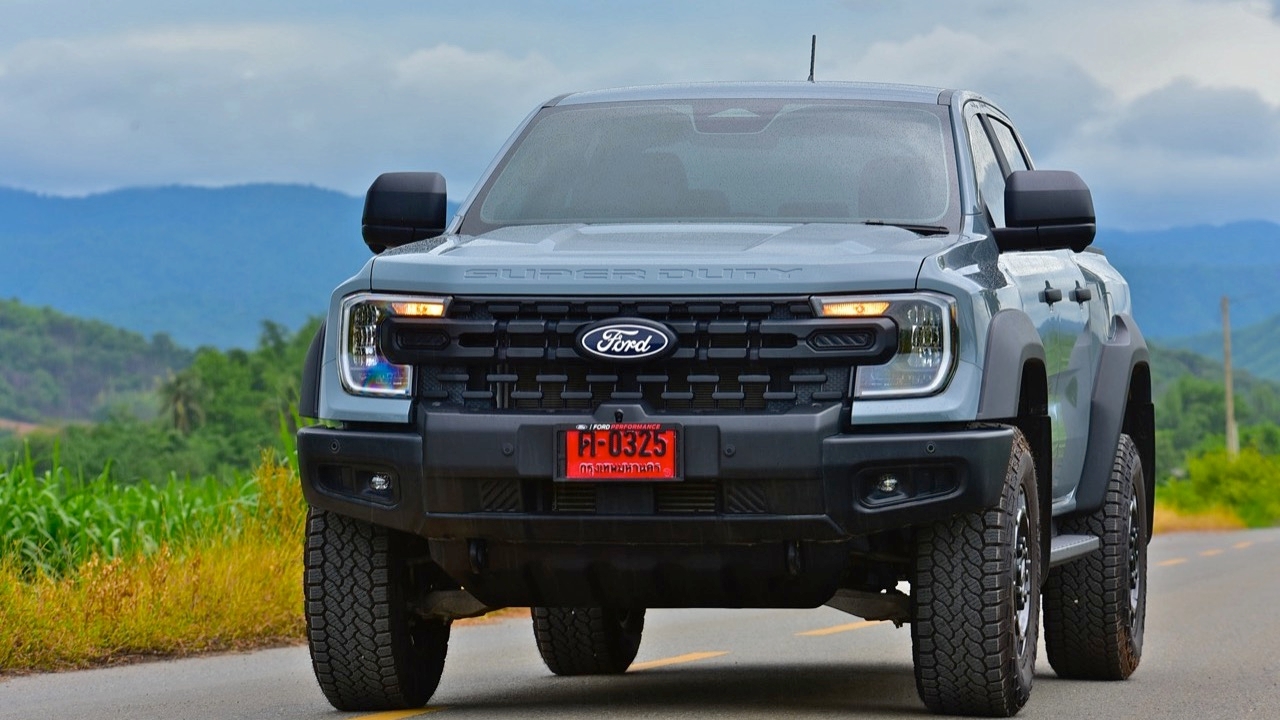
Although pickup truck sales in Thailand have dropped sharply over the past 2-3 years, the Thai pickup market continues to progress, especially with well-known brands like Ford offering various high-performance models, notably the Ranger Super Duty. This represents a significant segment shift for Ford Global, introducing a completely redesigned 1-ton Ranger pickup with comprehensive engineering upgrades. The key highlight is the entirely reworked chassis and drivetrain. The Ranger Super Duty aims to fill the gap between mid-size pickups and the larger F-Series Super Duty trucks (such as the F-250/F-350). This project was developed to meet the needs of hardcore heavy-duty users, those requiring full pickup capability in remote areas, or who must tow trailers weighing over 4.5 tons.
The 2026 Ford Ranger Super Duty is priced at 1,599,000 baht (Double Cab 3.0L V6 Turbo 4WD 10AT model).


Design & EngineeringThe development of the Ranger Super Duty is not merely a modified Ranger Wildtrak or Raptor; it involves a complete overhaul of all systems to enhance strength, durability, and off-road survivability. The chassis and structure have special upgrades, including reinforcement with high-strength steel at key stress points to withstand torsion and heavy loads beyond typical 1-ton pickups.


The suspension and rear axle are upgraded to heavy-duty standards. The suspension system has been completely re-tuned with larger and stronger ball joints, rubber bushings, and shock absorbers. The rear axle is designed to handle immense compressive and tensile forces for maximum stability while towing.

Exterior design has been beefed up with a thicker, more muscular appearance. The grille and wheel arches have been widened to accommodate a broader track. It also includes upfitter switches and a surround-view camera system designed to assist with trailer towing. The core engine remains a strong 3.0-liter V6 turbo diesel delivering high low-end torque, paired with a 10-speed automatic transmission with a newly tuned torque converter for improved heat resistance and long towing durability.

The Ranger Super Duty was created to serve customers seeking heavy-duty towing and payload capacity but desiring a more maneuverable vehicle than a full-size pickup.
Towing capacity is targeted at 4,500 kilograms (4.5 tons), exceeding the typical 3.5-ton towing capacity of standard pickups. This supports towing large boats, caravans, or trailers carrying race cars or livestock.


An increased Gross Vehicle Mass (GVM) and Gross Combined Mass (GCM) allows carrying heavy loads in the bed while towing simultaneously without structural damage.
The vehicle targets specialized commercial sectors such as mining, forestry, rescue units, utility construction, or government agencies requiring heavy equipment transport into rugged terrain.
Terrain & Regional Suitability
The Ranger Super Duty is designed to meet the demands of specific terrains and regions as follows:
Suitability for Thailand, Australia, and Africa (primary development regions): This vehicle excels in harsh and remote areas, such as Australia's Outback or grasslands and mining regions in Africa. Users must carry extra fuel, water, survival gear, and heavy tools, often traveling hundreds of kilometers across semi-off-road terrain where typical pickups suffer chassis cracks or suspension failure over time.
Towing culture: About 80% of customers in these regions tow caravans or horse trailers. Having a vehicle smaller than an F-250 but capable of similar towing loads perfectly suits their lifestyle.

Suitability for Thailand: In Thailand, the Ranger Super Duty is a niche vehicle with unique advantages and limitations. Its strengths include towing boats and adventure equipment, appealing to wealthy jet ski enthusiasts, small yacht towing, or towing camper vans in national parks (e.g., Khao Yai, Kanchanaburi). Thailand's steep terrain benefits from the V6’s torque and Super Duty suspension, making hill driving safer than with typical pickups.
Suitable for rescue and mobile service vehicles: ideal for conversion to rescue trucks, small fire engines, or mobile maintenance units for electric or water utilities that need to carry heavy toolboxes through flooded or muddy areas.

Limitations in urban areas: The thick chassis and heavy-duty suspension, optimized for heavy loads, can feel stiff and harsh when driving empty in congested cities like Bangkok. The vehicle's maneuverability is less agile compared to standard models. The Ranger Super Duty is not designed for mass-market sales but as a top-tier workhorse and an enthusiast’s toy for pushing beyond typical 1-ton pickups without paying for expensive full-size American left-hand-drive trucks.


Technical specifications of the 2026 Ford Ranger Super Duty: This heavy-duty upgraded pickup bridges mid-size and full-size American-style pickups. The body is wider and taller than standard Rangers to improve stability and off-road capability. It measures 5,470 mm in length, longer than the standard 5,370 mm model; width is 2,032 mm, similar to the Ranger Raptor; height ranges from 1,977 to 1,985 mm depending on cab style (Single Cab, Super Cab, Double Cab). The track width is 1,710 mm, with a ground clearance of 299 mm, 80 mm higher than standard. Water wading depth is 850 mm. The chassis is reinforced with thicker steel and special cross members, increasing the vehicle’s curb weight by over 300 kilograms compared to standard models. Curb weights are 2,518 kg (Single Cab), 2,615 kg (Super Cab), and 2,675 kg (Double Cab). Maximum payload is 1,982 kg for Single Cab and approximately 1,825 kg for Double Cab. The Gross Vehicle Mass (GVM) is 4,500 kg, and the Gross Combined Mass (GCM) is 8,000 kg. Gross Axle Weight Ratings (GAWR) are 1,900 kg front and 2,800 kg rear.


Large fuel tank capacity: The 130-liter tank (protected by a thick steel skid plate underneath) compensates for increased fuel consumption during heavy towing. This model claims a maximum braked trailer towing capacity of 4,500 kg (4.5 tons). Carrying combined loads of 7 to 8 tons requires high engine output, inevitably reducing fuel economy. The large tank helps maintain driving range over long distances in remote areas.


Main target groups include construction, mining, large-scale agriculture, and long-distance touring in remote areas where fuel stations are scarce. The large fuel tank eliminates worries about carrying extra fuel containers, which are hazardous and consume valuable bed space. Real-world testing with heavy loads shows an average fuel consumption of about 13.7 liters per 100 km (approximately 7.3 km per liter). The 130-liter tank allows nearly 950 km of range per fill.


Suspension, wheels, tires, and brakes: All drivetrain components are upgraded to heavy-duty specific parts for mechanical durability. Front suspension is double wishbone with coil springs, upgraded with thicker control arms, springs, and steering components to better absorb heavy impacts. Rear suspension features a solid axle with multi-leaf springs designed for 1.8 to 1.9 tons of load capacity. Controlled by a heavy-duty rear axle with front and rear electronic locking differentials. Wheels are 18-inch steel rims with 8-stud hubs (standard pickups use 6 studs) to better distribute torque and withstand heavy axle loads. Tires are 33-inch General Grabber All-Terrain Light Truck (LT) tires, size 275/70 R18, with thick sidewalls for puncture resistance and off-road traction.

Braking system: Upgraded large four-wheel disc brakes with calipers designed to handle combined vehicle and trailer weights up to 8,000 kg. Safety aids include Reverse Brake Assist and Pro Trailer Backup Assist. Tow and recovery points are structurally mounted directly to the reinforced chassis rather than suspension points. Front features dual heavy-duty recovery hooks embedded in a frame-mounted steel bumper. Rear includes dual recovery hooks integrated into the rear bumper structure. The factory-installed 4.5-ton tow bar and hitch support 70 mm tow balls, with electrical connectors for trailer lighting and a Smart Hitch system working with onboard digital scales to accurately measure tongue weight on the rear axle.


3.0L V6 Turbo Diesel Engine, 4WD Full-Time
The 3.0-liter V6 turbo diesel engine supports diesel B20 and higher. It has a 2,993 cc displacement, 84.0 mm bore, 90.0 mm stroke, and firing order 1-4 2-5 3-6. Compression ratio is 16.0:1. It uses dual overhead camshafts. Maximum power output is 250 horsepower at 3,250 rpm, with peak torque of 600 Nm between 1,750-2,250 rpm. The transmission is a 10-speed automatic with electronic shift (E-Shifter) and electronic parking brake. It meets EURO-5 emission standards. Front suspension is double wishbone with coil springs; rear suspension is leaf spring with multi-leaf packs. Brakes are ventilated disc front and rear.

The 10-speed automatic transmission in Ford Super Duty pickups exists in two categories: full-size American F-Series Super Duty and the newly introduced 1-ton Ford Ranger Super Duty in Thailand.
Both use a 10-speed transmission developed jointly by Ford and GM, often called the "Michigan transmission" due to its main production facility in Michigan, USA. The transmissions are rated differently by torque capacity to match engine output in each vehicle segment.

The 10-speed automatic employs a planetary gearset architecture with four planetary gear sets and six clutch packs (four rotating and two stationary). Its engineering highlight is a triple-clutch assembly on the intermediate shaft, allowing 10 gear ratios in a transmission case roughly the size and weight of an older 6-speed unit. Ford divides these transmissions into variants by torque rating.
The 10R80 transmission (used in the Ranger Super Duty 3.0L V6 Turbo diesel) is rated for a maximum torque of 800 Nm. In the Ranger Super Duty, it pairs with the 250 hp V6 diesel producing 600 Nm torque. It uses an electronic e-Shifter with no mechanical cable, enhancing shift precision in full-time 4WD and off-road modes.
The 10R140 TorqShift (used in F-Series Super Duty like F-250/F-350) is designed for massive torque loads up to 1,400 Nm to handle the 6.7L Power Stroke V8 turbo diesel. Structurally it has thicker gears, larger bearings, and a more complex cooling bypass system to endure towing over 10 tons.

Gear Ratios
A key feature of this 10-speed transmission is its wide gear ratio spread of 7.39, allowing very low first gear for maximum towing torque and three overdrive gears at the top for fuel efficiency at highway speeds.
Gear ratios at each position:
Detailed gear ratio breakdown: The 10-speed transmission has a total spread of 7.39, with individual ratios as follows.
Gear 1 (4.615:1) and Gear 2 (2.919:1) are set very low for high torque output at low speeds, ideal for pulling heavy loads or starting on steep inclines.
Gears 3 (2.132:1), 4 (1.773:1), and 5 (1.519:1) cover low to mid-speed ranges with closely spaced ratios to maintain smooth torque delivery and prevent engine rpm drops.
Gears 6 (1.277:1) and 7 (1.000:1) move into cruising speeds, with Gear 7 being direct drive (1:1) for efficient power transfer.
Gears 8 (0.851:1), 9 (0.687:1), and 10 (0.632:1) are overdrive gears that lower engine rpm significantly at highway speeds to maximize fuel economy and reduce engine wear.
Reverse gear (R) ratio is -4.695:1, similar to first gear for strong torque when backing up heavy trailers or loads.
The closely spaced ratios mean shifts reduce engine rpm by only about 20%, allowing the transmission control module (TCM) to keep the engine in its power band continuously, similar to a CVT but with the durability and response of a mechanical gearset.
A key technical feature is Skip-Shift and lubrication technology. The 10-speed transmission can skip gears based on accelerator input, load, and incline; for example, starting in first gear then skipping to third, fifth, and seventh to reduce jerk and save fuel. In Tow/Haul mode, it shifts sequentially from 1 to 10 to maintain consistent torque.
The higher-rated 10R140 transmission features a larger oil filter and an anodized clutch drum to enhance durability under heavy-duty conditions, extending maintenance intervals. The Ranger Super Duty’s transmission cooling system and torque converter control software have been tuned to match a new final drive ratio of 3.73, ensuring reliable towing capacity of 4,500 kg (GVM 4,500 kg / GCM 8,000 kg).
Ford Ranger Super Duty’s 3.0L V6 turbo diesel 4WD uses an advanced full-time four-wheel-drive system, offering more flexibility than typical part-time 4WD pickups. This system is adopted from the rugged Ford Bronco and is not the traditional manual switch system.


The Super Duty’s transfer case uses an electronically controlled multi-plate clutch to distribute torque combined with a two-speed transfer case. The modes operate as follows:
4A mode (Four-Wheel Drive Auto): This on-demand 4WD mode monitors wheel speed, steering angle, and throttle input. Under normal dry road conditions, 100% torque is sent to the rear wheels for fuel efficiency. If rear wheels slip, the electric clutch engages within milliseconds to transfer 1-50% torque to the front wheels automatically. This mode suits dry, wet, or curved roads, allowing front and rear wheels to rotate at different speeds to prevent drivetrain binding, improving stability and safety in heavy rain.
4H mode (Four-Wheel Drive High)
In 4H, the system locks front and rear driveshafts mechanically/electronically, creating a fixed 50:50 torque split for higher-speed 4WD.
This mode suits low-traction surfaces like off-road trails, gravel, sand, or shallow mud, allowing reasonable speeds. However, it should not be used on dry asphalt or concrete as locked shafts cause binding when cornering, increasing tire wear and risk of drivetrain damage.


4L mode (Four-Wheel Drive Low)4L locks front and rear driveshafts like 4H but adds a low-range gear reduction (about 2.5 to 3 times), increasing torque at low speeds for severe off-roading.This mode transfers the engine’s 600 Nm torque through the low-range gears to all four wheels, enabling slow, powerful crawling over rocks, deep mud, sand, steep inclines, or heavy towing up slopes. Engaging or disengaging 4L requires the vehicle to be stopped, in neutral gear, before selecting the mode.


Besides 4A, 4H, and 4L, the Super Duty has enhanced features over the standard Ranger, including front and rear locking differentials (most pickups only have rear lock), preventing wheel spin on rough terrain. Trail Turn Assist automatically brakes the inside rear wheel during tight off-road turns, significantly reducing turning radius and improving maneuverability in narrow trails.


Interior details: The Ranger Super Duty is positioned between a heavy-duty work truck and a premium pickup for comfortable travel. Interior design blends durable materials with modern conveniences. The infotainment system uses Ford Global’s latest technology focusing on fast processing and towing features. A 12-inch vertical touchscreen runs SYNC 4A, supporting wireless Apple CarPlay and Android Auto. Although connection can be slow initially, it is stable without drops or reconnection needs. The menu includes a Towing Checklist safety feature and trailer brake controls accessible from the instrument cluster.


The 12.4-inch digital instrument cluster behind the steering wheel offers customizable graphics by driving mode, including a dedicated Super Duty display showing transmission temperature, trailer tire pressure (Trailer TPMS), and vehicle tilt angle. Six factory-installed upfitter switches are located on the overhead console, with pre-wired fuses ready for accessories like LED light bars, electric winches, or air compressors without cutting main wiring.


Dual-zone automatic climate control features an upgraded compressor for rapid cooling even in hot environments like construction sites or deserts. The cabin has a high-standard air filtration system capturing dust, soot, smoke, and chemical odors to keep the interior clean. Physical buttons remain for climate and volume controls below the touchscreen, allowing intuitive use without looking or while wearing thick gloves.


Front seats are newly designed to support long work shifts and extended travel. The top trim offers Max Recline seats that fold nearly flat (almost 180 degrees) for resting during breaks at worksites. Seat materials range from heavy-duty woven fabric resistant to tears and stains (for work-oriented trims) to premium easy-clean genuine leather.


Comfort features include 10-way power-adjustable driver’s seat with ventilation blowing cool air through the seat and backrest—ideal for hot climates. Rear cabin space in Double Cab models is reconfigured for versatility. The second-row seats fold 60:40; the cushion flips up to create a flat load floor to store expensive tools or valuables away from weather exposure. Under-seat storage compartments with lockable lids provide secure space for small equipment, cables, or important tools. Additional amenities include rear passenger air vents, USB-A and USB-C charging ports, and a 230V AC (400W) household power outlet on the central roof console to charge power tools or laptops for mobile work.


Long-distance driving to Si Sawat district, Kanchanaburi province, tested the Ford Ranger Super Duty’s performance on both paved and off-road conditions, experiencing the electric power steering, 10-speed transmission, and robust chassis reminiscent of a tank. The Super Duty shares size and dimensions with the Ranger Raptor but differs in drivetrain, engine, suspension, and four-wheel-drive systems. Manufactured primarily in Thailand at Ford’s Rayong plant, it is exported worldwide. Initially, only the Raptor was considered a high-performance pickup, but the more affordable Wildtrak X also offers strong performance, making it a good choice for buyers seeking value without paying Raptor prices.


The driving experience is like sitting in a large vehicle with a higher seating position than standard 4WD pickups. The reinforced rear suspension supports heavier loads but feels somewhat stiff when empty. This heavy-duty payload capacity, the highest in Thailand’s pickup segment, requires a suspension as firm as rock, which appeals to hardcore users demanding full capability. The Super Duty is well-suited to Thai road conditions, especially remote and rugged routes that become muddy and challenging during rainy seasons—conditions that would be difficult for lesser trucks but manageable with this upgraded model.


At legal highway speeds of 100-120 km/h, the electric rack-and-pinion steering motor delivers well-balanced steering weight—not too heavy or light—preserving good road feel. The increased vehicle weight does not negatively affect high-speed cornering. However, drivers must allow longer braking distances due to the heavier 2.6-ton curb weight. Noise insulation is excellent; at 100 km/h, wind and tire noise intrusion is noticeably less than in typical pickups. The V6 3.0-liter engine produces sufficient torque for heavy loads, towing trailers, or overtaking slower vehicles. Yet, due to the 300 kg heavier weight, acceleration and 0-100 km/h times lag behind Wildtrak and Raptor models.


Fuel consumption under normal driving at 80-90 km/h is about 7.3 km/liter. Filling the 130-liter tank costs roughly 5,800 baht, which may be a concern for faster drivers who could see consumption drop to around 6 km/liter. The diesel engine is quiet and smooth, similar to V6 3.0-liter diesels in Everest and some Ranger models, with engine noise becoming prominent only under full throttle. The 10-speed automatic shifts smoothly and fluidly, optimized for Super Duty with off-road low gears and selectable 4A/4H/4L four-wheel-drive modes adapting to terrain. Without heavy loads or trailers, the Ranger Super Duty drives well, though cornering requires speed management to maintain balance.


The vehicle’s large dimensions and elevated driver position provide excellent visibility and a commanding presence, resembling the Ranger Raptor’s rugged style and performance. The smooth V6 3.0-liter engine delivers massive 600 Nm torque, sufficient for heavy hauling and towing, but the 2.6-ton curb weight (300 kg heavier than Wildtrak and Raptor) means acceleration and overtaking are less brisk.
Engine operation is notably quiet and refined, with roaring sounds only evident during kickdown acceleration.
The 10-speed transmission is intelligently tuned for the Super Duty’s character, offering smoother, more seamless shifts on road and perfect integration with the four-wheel-drive system for low-speed off-road driving.
The electric power steering is precise with well-balanced weight, giving good feedback at cruising speeds (100-120 km/h). The rack-and-pinion motor is impressively calibrated, neither too light nor too heavy, facilitating control of the large vehicle through curves.
The suspension is rock-solid but stiff when unladen. Designed to support the highest payload in Thailand’s pickup segment (up to nearly 2 tons payload and 4.5 tons GVM), the rear leaf springs are very firm. When driving empty, the rear suspension feels distinctly harsh and bouncy, but this tradeoff ensures maximum durability for heavy-duty off-road work.
Cornering requires careful speed management to match the curve conditions, as the rear end feels light without cargo.
Braking distance must be increased due to the vehicle’s large mass of 2.6 tons, a critical consideration for drivers at high speeds.
Noise insulation is surprisingly good for a rugged pickup. At 100 km/h, wind and road noise are significantly lower than typical pickups.
Fuel consumption and efficiency
Fuel consumption is heavy as expected for its size. Normal driving at 80-90 km/h yields about 7.3 km/liter, but aggressive driving can easily drop consumption to around 6 km/liter.
The huge 130-liter fuel tank supports this thirst and long-distance towing. Filling the tank fully costs about 5,800 baht.


Off-road capability and appropriate usage conditions: The Ranger Super Duty is designed for rugged terrain and rainy seasons, making it highly suitable for Thai roads, especially muddy construction sites or remote areas. Its advanced four-wheel-drive system with selectable 4A/4H/4L modes allows empty vehicle passage over tough obstacles with confidence and durability.


In conclusion, the Ford Ranger Super Duty is not a soft, sporty pickup like the Raptor but a heavy-duty work machine that is quiet, has excellent steering, and a strong, durable chassis. It offers ample torque and can handle extreme conditions, ideal for users needing a rugged vehicle for forest access, construction, heavy hauling, or serious towing. The trade-off includes a stiff suspension when empty and higher diesel fuel costs due to the large tank and V6 engine. For most users, the Wildtrak X or standard 4WD Ranger models suffice. Heavy trailer towing of this magnitude is better left to customers in Australia. For Thai users, simply using it for farm or forest travel and off-road recreation is already impressive.