

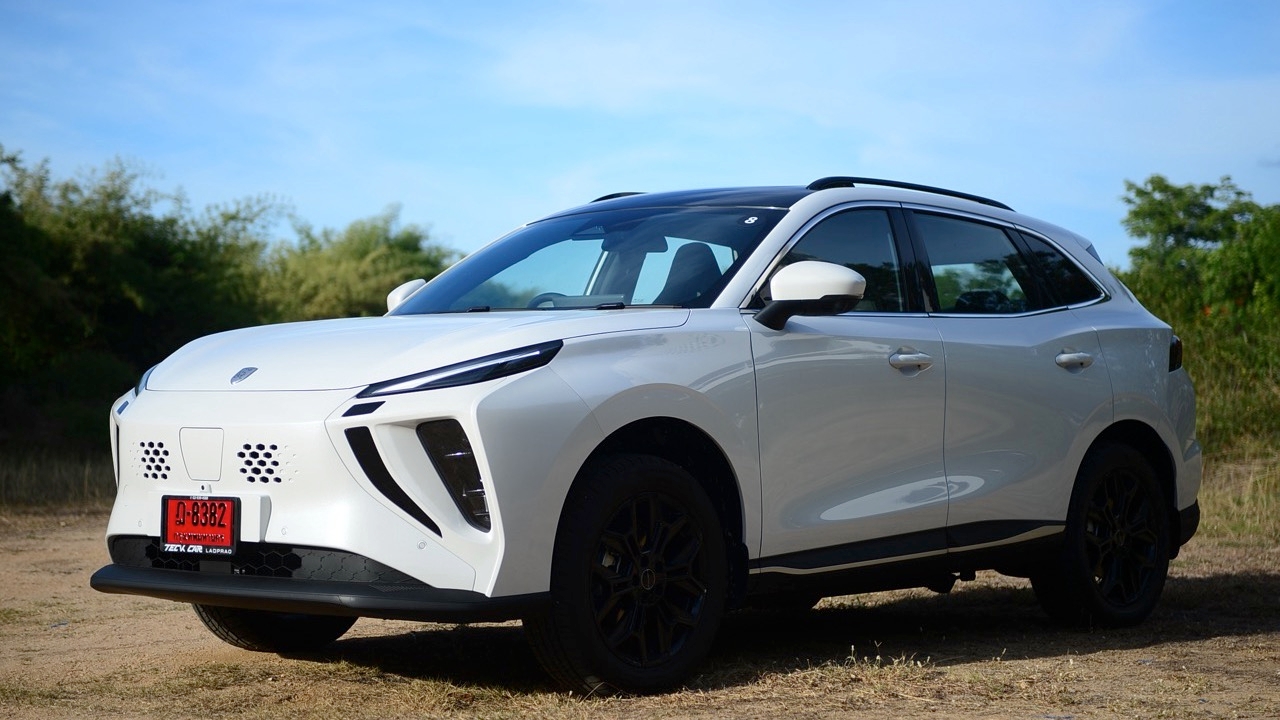
If you like REEV vehicles that offer unique space on the road, the Forthing Friday with its pearl white body reflecting sunlight contrasted by glossy black wheels looks well balanced. Its side proportions are decent, but from the perspective of refinement and establishing brand identity, the front design seems overly detailed to the point of imbalance. The honeycomb grille and the fuel filler flap clearly reveal the platform-sharing strategy to reduce costs. At this price point, 2026 consumers generally expect smoother bodywork and cleaner surface finishes.


The exterior appearance presents a sporty crossover flair with a dynamic and flashy style. Looking around the whole car, the Forthing Friday does not have a boxy, conservative SUV shape but adopts a dynamic and sporty design clearly targeting younger buyers. The front grille is semi-closed; the upper part is a solid panel matching the body color in line with electric vehicle trends, while the lower section features a large black honeycomb mesh air intake to cool the generator engine in the REEV version. Small hexagonal vents beside the license plate are relatively tiny compared to the large white space on the front bumper, making the front look somewhat awkward or like an engineering patch added later. The two-tier headlights have slender upper DRL strips that complement the hood lines, while the main lower headlamp units are quite large and flanked by black plastic strips shaped like sickles, aiming to add aggressiveness but overall making the front appear bulky and heavy.


The split headlights consist of a top layer with slim, sharp turn signals and daytime running lights extending along the hood edge, while the main LED projector lights are housed separately in lower bumper recesses shaped like vertical boomerangs. Reflective highlights depend on the exterior color. The lower bumper adds a sporty tuning vibe. The side profile shows a coupe SUV proportion with a gently sloping roofline towards the rear, executed with good balance. Chrome trim around the upper window edges adds a touch of luxury, and the solid black C-pillar creates a sleeker, elongated visual effect.

Glossy black alloy wheels contrast with the pearl white body. The multi-spoke design is complex, though it's a pity the actual car lacks reflective trim on the lower edge as shown in foreign brochures, making the side view appear simpler compared to the futuristic front with sharp lines around the front fender sweeping diagonally to the rear doors, giving the car a muscular, dimensional look rather than flat.


The floating roof slopes gently downward towards the rear for aerodynamics. The C-pillar is wrapped in glossy black trim to create a floating roof effect, separating it visually from the body. Side skirts have contrasting colors with black trim along the lower edges around the car, signaling its SUV character, complemented by reflective trim matching the front bumper.


At the rear, the taillight features a long LED light bar connecting left and right sides, a modern style. At night, this forms a distinct graphic line. The rear diffuser and exhaust area of the bumper are designed with sporty fins. In the REEV model, the real exhaust tips are discreetly hidden underneath to maintain a clean electric vehicle look.
Forthing Friday is an SUV from the Forthing brand (part of Dongfeng) officially priced in Thailand as follows:
100% Electric Vehicle (BEV) version
Luxury version priced at 699,900 baht
Exclusive version priced at 789,900 baht
Extended range version (REEV – 1.5-liter gasoline engine generator + electric motor)
Luxury version priced at 789,900 baht
Exclusive version priced at 859,900 baht (test unit)


Technical and body specifications of the FORTHING FRIDAY RHD REEV right-hand drive range-extended electric vehicle launched in Thailand include detailed dimensions placing it in the mid-size SUV category: length 4,600 mm, width 1,860 mm, height 1,680 mm, wheelbase 2,715 mm, kerb weight 1,820 kg, and cargo capacity of 480 liters expandable to 1,480 liters with rear seats folded.

The range extender engine serves as a generator producing electricity for the battery or motor and does not drive the wheels directly. It is a naturally aspirated 1.5-liter inline-4 gasoline engine producing 101 horsepower (75 kW) at 6,000 rpm and 130 Nm torque at 4,000 rpm, with a 43-liter fuel tank.
The main propulsion is purely electric via a permanent magnet synchronous motor driving the front wheels, producing 163 horsepower and 240 Nm torque. The transmission is a single-speed automatic typical of full electric vehicles, with driving modes including Eco, Normal, and Sport.
The battery is lithium-ion phosphate (LFP) with a capacity of 31.94 kWh. Charging supports AC input at 6.6 kW and DC fast charging up to 60 kW.
The pure electric (EV) mode driving range is at least 200 kilometers per full charge (NEDC standard). The combined maximum range, using both a full fuel tank (43 liters) and full battery charge, can reach up to 1,100 kilometers, a key advantage of the REEV system eliminating charging station concerns on long trips.


The chassis includes a front independent MacPherson strut suspension with lateral stabilizer bar and a rear torsion beam. Brakes are ventilated discs up front and solid discs at the rear. Glossy black sport-style alloy wheels are fitted with 235/55 R19 tires with medium sidewalls providing good shock absorption and smooth ride quality. This REEV model addresses long-distance travel concerns about charging cables while delivering the smooth, quiet, and torque-rich feel of a 100% electric vehicle.


Brand communication and marketing for Dongfeng and Forthing in Thailand face challenges, with frequent distributor changes causing unclear and inconsistent brand messaging. The planned local assembly plant in 2027 is a milestone to watch closely to see if production can start as scheduled.

Regarding why the 100% electric BEV version still has a fuel filler flap from the REEV model, automotive engineering clearly points to cost reduction and platform sharing strategies.
Use of the same body stamping dies
In vehicle manufacturing, the most costly component is often the stamping dies for body panels, costing hundreds of millions of baht. To maximize commercial viability, the factory designs a single exterior body shell shared across internal combustion engine (ICE), REEV hybrid, and BEV models. Consequently, the side body is stamped with the fuel filler opening from the start. Instead of welding this shut, which would affect paint quality and surface finish, a plastic cover matching the shape is installed. In BEV models, this area is sealed inside or converted to an AC/DC charging port location.
Chinese automakers commonly use multi-energy platforms, supporting both fuel tanks and battery packs. The Forthing Friday is developed in ICE, REEV, and BEV versions. Keeping fuel filler flaps on both sides (one side for charging, the other for fuel in REEV) but sealing or converting the BEV side helps avoid costly assembly line changes or body architecture redesigns, thus controlling unit costs and pricing competitiveness. However, the car’s price (859,900 baht) is not cheap.
Sharing parts to cut costs may seem awkward or visually unrefined to consumers, but engineers see leaving the fuel flap in place and sealing it internally as a money-saving measure that helps keep vehicle prices as low as possible.


Comparing the Forthing Friday with the NETA X reveals typical Chinese EV design DNA from 2-3 years ago, as many Chinese automakers share suppliers and design trends. The sporty exterior overlaps design cues found in newer NETA, Changan, and some BYD models. The closed front grille and thin daytime running light strips resemble a squinting eye motif similar to NETA or Geely/Zeekr EVs, giving a sporty, futuristic look. The large boomerang-shaped lower headlights integrated into the bumper might confuse casual observers between NETA X or some European crossovers like Peugeot. The coupe-style sloping roofline and blacked-out C-pillar floating roof effect are common trends used by almost all Chinese SUV brands to attract younger buyers.
Externally, the over-detailing with sharp lines, orange/reflective trim on lower edges, and the faux fuel filler opening creates a "mix & match" impression borrowing successes from other brands but lacking a clear, original brand identity.


Interior design: bright but functionally generic and part-shared. Upon entering, the cabin feels reminiscent of premium compact or mainstream Chinese EVs like the NETA X. The dual floating screens—a small driver instrument panel and a larger center infotainment display—are a common layout copied across modern Chinese vehicles. While futuristic, the downside is a uniform interior appearance across brands.


The three circular air vents in the center and sides are styled like jet engine turbines with chrome plating, adding a premium feel and contrasting with the angular screens. This turbine vent design draws inspiration from new Mercedes-Benz models, differing from recent NETA designs that favor straight, hidden vents like Tesla. Soft-touch synthetic leather with matching contrast stitching covers most console surfaces. The center console is a raised floating bridge separating driver and passenger sides, decorated with carbon fiber or piano black finishes.

A key feature is the compact electronic gear shifter resembling a clear crystal, reflecting ambient lighting at night for a luxurious look beyond its segment. Behind the shifter are cup holders, a wireless charging pad, and flush function buttons on the console. Below the floating bridge is a large open storage space for bags or tissues, following typical electric vehicle design.


The steering wheel is a leather-wrapped D-shape multifunction unit offering a sporty, racecar feel with a flat bottom to free legroom. The front bucket seats have integrated headrests with high side bolsters for body support during cornering. Upholstery is perforated synthetic leather with two-tone accents brightening the cabin. The center console and materials use soft-touch finishes meeting current Chinese standards, though some buttons and plastics feel thin and less durable long-term. Overall, the Forthing Friday REEV blends popular market features into one, with sharp, sleek body proportions and advanced displays resembling BYD or Changan, combined with some European luxury touches. However, it lacks a strong brand identity recognizable even at night, unlike Chinese brands BYD or GWM, which have established distinct signatures. Forthing remains caught in a trend-following cycle without its own design signature.


The Forthing Friday RHD REEV drivetrain architecture distinctly differs from typical hybrids or plug-in hybrids, as it essentially drives like a 100% electric vehicle carrying its own generator box at all times.


The tested REEV version delivers motor response emphasizing smooth torque transfer.Driving feel closely resembles a pure EV. The steering has good weight across speeds, ensuring confident control. However, suspension and dynamics differ from the BEV version since the 1.5-liter gasoline engine does not drive the wheels. Instead, all power is managed by the 163-horsepower, 240 Nm front-wheel electric motor through a single-speed automatic gearbox typical of EVs. Initial acceleration and low-speed response are smooth with no gear shifts or jerks, unlike the more powerful Changan S05 REEV. The Forthing Friday RHD REEV prioritizes gentle, smooth city driving and reasonable agility. Compared to the BEV's 204 horsepower and 340 Nm torque, the REEV is less powerful. Mid-to-high speed overtaking acceleration (80-120 km/h) flows smoothly and calmly, fitting a family car style rather than aggressive EV performance.


Understanding the generator engine behavior is key to adapting to driving the Forthing Friday RHD REEV. In EV mode with a full 31.94 kWh LFP battery, the car runs quietly on electric power for about 200 km (NEDC). When the battery depletes to a set level, the 1.5-liter engine starts to generate electricity. Drivers will notice the engine RPM does not correlate with vehicle speed — for example, idling at a light or gentle takeoff while the engine revs high to charge the battery, a normal REEV trait though initially disconcerting. During sustained high-speed driving (e.g., 120-140 km/h uphill), the naturally aspirated 102-horsepower engine works hard to keep up with motor demand, and engine noise may intrude noticeably into the cabin.


For long-distance travel, weight distribution is reasonable. The suspension is somewhat firm. Replacing the large BEV battery with a medium-sized 31.94 kWh pack plus a 1.5-liter engine and 43-liter fuel tank at front and rear brings the front-to-rear balance closer to conventional ICE cars. Understeer or oversteer during sharp cornering is manageable and natural. The front MacPherson strut and rear torsion beam suspension feel tight but slightly bouncy on rough roads. The ride comfort is adequate for long trips, though the seats are firm and not very comfortable. The 235/55 R19 tires with medium sidewalls absorb bumps well per Chinese SUV standards but are not sporty or sharp in handling.

Fuel consumption of the Forthing Friday REEV when the battery is depleted and the 1.5-liter engine runs solely to generate electricity averages about 18.5 km per liter (approx. 5.4 liters per 100 km) under combined driving conditions specified by the manufacturer. This figure applies at steady speeds of 80-90 km/h.During long-distance driving at stable speeds between 80-90 km/h — the most efficient speed range for nearly all cars — actual fuel consumption can improve beyond the average.It is approximately 19 to 21 km per liter.
Why does the REEV system achieve good numbers at low speeds? The motor's electricity consumption is moderate: at 80-90 km/h, aerodynamic drag is not as high as at 110-120 km/h, so the electric motor does not need peak power. Consequently, the 1.5-liter engine can run at a stable, efficient RPM with maximum thermal efficiency to supply electricity smoothly.

The system includes regenerative braking at these speeds; when the accelerator is released or decelerating due to traffic, the motor acts as a generator, feeding electricity back into the battery, reducing the engine's workload. If the battery is fully depleted and the car relies purely on fuel, cruising steadily at 80-90 km/h on the highway can yield around 20 km per liter (+/- depending on traffic and load), comparable to compact hybrid SUVs in the market.

If you expect aggressive, powerful EV-like acceleration, the Forthing Friday REEV does not fully deliver that. Its performance is designed for smooth, steady long-distance driving with quiet, agile EV-like feel combined with long range exceeding 1,000 kilometers per tank at low speeds. It suits those wanting an EV driving experience without the hassle of competing for charging stations on countryside trips. However, as mentioned, a stronger brand identity is needed to confidently support the model. Currently, it feels hesitant rather than a full 100% statement.