

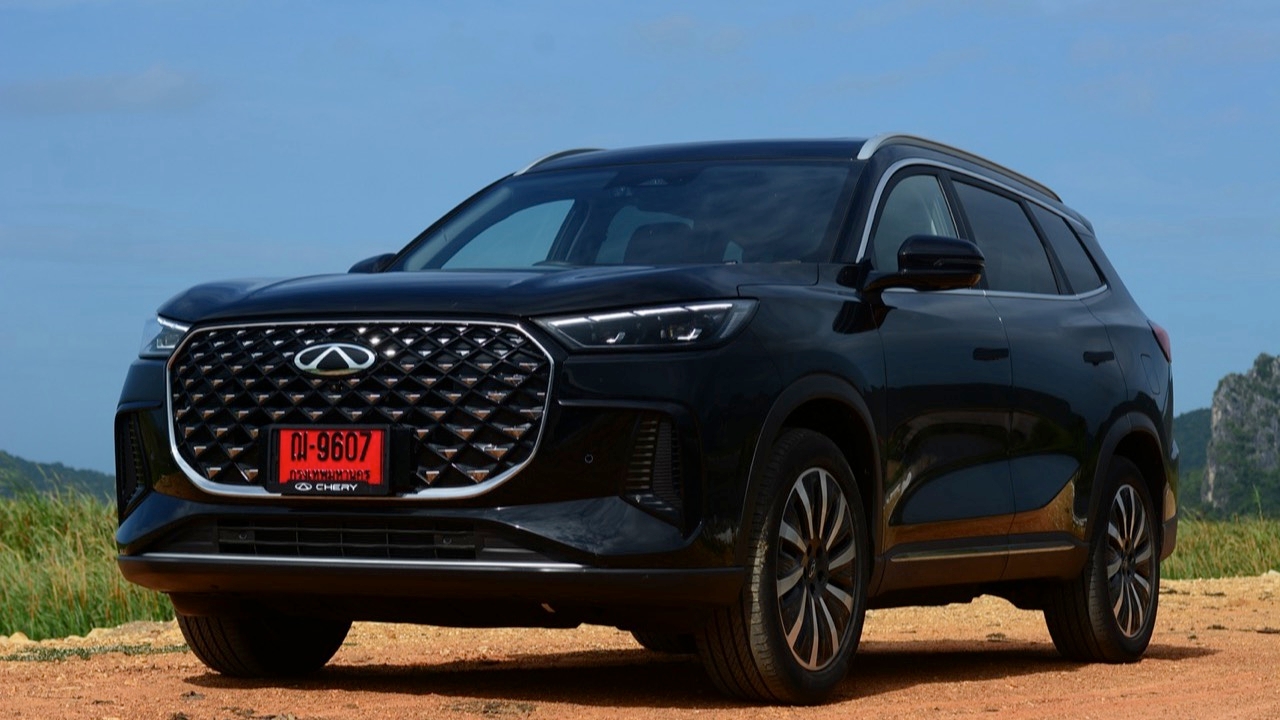
The Chery Tiggo 8 PHEV AWD, another Chinese SUV model introduced to Thailand, presents a straightforward debut. While its design is acceptable and the price attractive, the Tiggo 8 retains elements of an older 2021 model, which has hampered sales. Buyers looking for a crossover may find themselves confused by the rapidly expanding range of Chinese vehicles and brands in Thailand’s new car market. Nowadays, China offers numerous new models and brands. Notably, Jaecoo and Omoda, Chery's smaller sister brands, share market share and appear on nearly every street corner. If you haven’t noticed and mistake one for a Range Rover, it’s likely a Jaecoo 5EV or boxy Jaecoo 6 or 6T available in REEV and BEV versions. The assembly of British luxury Range Rovers in China has also benefited the giant Chery significantly. The Tiggo 8’s design cleverly mimics European cars, becoming a high-level design. In fact, its front resembles an Audi, especially the luxurious grille. The body isn’t very large, but the shape and taillight style echo vehicles from 2021, when Chinese cars first entered the Thai market.


Chery owns both Omoda and Jaecoo, two brands aggressively targeting Thailand with competitive pricing, performance, and styling (including vehicle design and usage). Chery launched under its own name in Thailand, pricing itself close to its smaller sister brand Jaecoo (considered a lower-tier vehicle) but sharing most technology and components. The name 'Chery' is a deliberate misspelling of 'cheery'—the brand focuses on delivering driving happiness to customers. Its logo resembles Infiniti’s, which may look appealing in some markets. Some upscale Chinese brands have successfully attracted BMW and Audi customers, causing these German brands’ sales in Thailand to drop and prompting strategy adjustments. The top-tier Chery Tiggo 8 PHEV AWD is priced competitively, increasing its chances in the market. The model reviewed here is the 7-seat Tiggo 8 PHEV AWD Elite, officially priced at 949,000 baht for the two-wheel drive and 1,069,000 baht for the four-wheel drive version, imported from Indonesia.


The Tiggo 8 PHEV AWD is a mid-size crossover SUV with three rows and seven seats. Its dimensions are 4,725 millimeters in length, 1,860 millimeters in width, and 1,747 millimeters in height, with a wheelbase of 2,710 millimeters. Ground clearance ranges from 170 to 180 millimeters. It has a fuel tank capacity of 60 liters, suitable for long trips. The trunk space is 193 liters with all three rows up and can expand to a maximum of 1,930 liters when all rear seats are folded flat.


The interior finishing of the Tiggo 8 PHEV AWD, including the front console and driver’s area,is designed to look modern and clean.The multifunction leather-wrapped steering wheel features a D-shape with a flat bottom, accented by shiny chrome silver trim on the spokes and a CHERY logo in the center. Controls for audio and instrument cluster screens are conveniently placed on the left and right spokes. The dual floating screens are the centerpiece, comprising a large digital instrument cluster for the driver and a central infotainment screen, seamlessly connected as a single floating panel above the dashboard.


The dashboard is covered in soft-touch black material, contrasted by a long brushed metal trim that runs across the console, enhancing luxury. Ambient lighting is subtly hidden beneath the trim.The center console is designed tall and connects seamlessly to the dashboard. A touch control panel for the air conditioning system is located below the central air vents, reducing the number of traditional buttons.


Drive mode controls are push-button style with a diamond-cut rotary knob. The electronic parking brake (EPB) and Auto Brake Hold buttons sit on a brushed metal trim panel matching the dashboard, alongside cup holders.


Seating and upholstery focus on passenger comfort. The seats are covered in high-quality black leather with a soft texture and diamond-cut stitching on the backrests and bolsters, enhancing luxury and ventilation. The front seats are electrically adjustable, with the driver’s seat offering multi-directional adjustments and lumbar support. The aviation-style headrests are wide and supportive. Both front seats have built-in ventilation. The rear seats are spacious with separate air vents and USB charging ports. Door panels continue the dashboard’s design, featuring soft leather, brushed metal trim, and 3D patterns, with metal door handles and luxury speaker grilles. Window and mirror controls are ergonomically placed.
Ambient lighting enhances the cabin atmosphere at night, extending from the front console to the door panels. The large panoramic sunroof opens and closes electrically, adding openness and luxury, with an electric sunshade. The interior finishing of the Tiggo 8 PHEV AWD reflects an effort to elevate the Chery brand to premium status through the use of quality soft-touch leather materials, diamond-cut stitching, brushed metal accents, dual-screen technology, and touch controls.


Engine, electric motors, and performance: The Tiggo 8 PHEV’s powertrain integrates a combustion engine with dual electric motors through a specialized 3-speed Dedicated Hybrid Transmission (DHT) that intelligently adapts across nine driving modes. The engine is a 1.5-liter inline 4-cylinder DOHC 16-valve turbocharged unit producing 156 horsepower and 215-230 Nm of torque. The dual electric motors provide a combined 201 horsepower and 310 Nm torque. The total system output reaches 326 horsepower and 545 Nm of torque, ample to carry the 7-seat body comfortably. The all-wheel-drive (AWD) system is on-demand 4WD, able to switch to two-wheel drive in economy mode. Performance figures include 0-100 km/h acceleration in 6.8 seconds and a top speed limited to 180 km/h.


Battery and charging: The battery is lithium iron phosphate (LFP) type with multi-layer protection against shocks and high temperatures. Capacity ranges from 18.3 to 19.27 kWh depending on the variant. Normal AC charging supports up to 6.6 kW via Type 2 connector, taking about 3 hours for full charge from zero. Fast DC charging supports up to approximately 40 kW, charging from 30% to 80% in about 19 minutes. The vehicle supports V2L (Vehicle-to-Load) functionality, supplying up to 3.3 kW of power to external devices, appealing to camping enthusiasts.


Regarding driving range, the pure electric (EV) range is about 75 to 90 kilometers, suitable for short trips or city driving without using fuel. The total range combining full fuel tank and charged battery can approach nearly 1,000 kilometers. Official specs claim up to 1,200 km, but actual range depends heavily on driving habits. Average fuel consumption in hybrid mode is claimed at 1.3 liters per 100 km (approximately 76.9 km per liter) when frequently charging the battery. In battery-save mode, fuel consumption rises to around 5.2 to 5.9 liters per 100 km (16.9 to 19.2 km per liter). Real-world highway testing between Bangkok and Pranburi showed 14.1 km per liter, indicating reasonable fuel economy. Driving slower improves efficiency further.


Suspension, wheels, tires, brakes, and weight: The front suspension is independent MacPherson strut with coil springs and anti-roll bar. The rear uses independent multi-link suspension. The setup prioritizes a firm yet smooth ride to absorb shocks for rear passengers, enhancing long-distance comfort. Braking is handled by ventilated disc brakes in front and solid discs at the rear. The alloy wheels are sporty 19-inch with 235/50 R19 tires. The vehicle’s curb weight is approximately 1,916 kilograms.
Safety and ADAS systems.
This Tiggo 8 model is built on a platform with 5-star safety ratings from both Euro NCAP and ANCAP.
Passive safety features:
Airbags in 8 to 10 positions, including driver’s knee airbags and a front center airbag between the front seats.
Advanced Driver Assistance Systems (ADAS) include 19 main functions.
Adaptive Cruise Control combined with Traffic Jam Assist for stop-and-go traffic conditions.
Forward Collision Warning with Autonomous Emergency Braking.
Lane Keeping Assist with Lane Departure Warning and corrective steering.
Blind Spot Detection and rear cross-traffic alert systems.
A 540-degree panoramic camera system combining 360-degree surround view with a 180-degree transparent chassis view underneath, aiding in precise obstacle clearance on rough terrain.


Compared to the two-wheel-drive FWD model, the Tiggo 8 PHEV AWD offers better stability, tidier headlights, a prominent grille, and sharper lines. Its powertrain is stronger, though the design dates back 4-5 years, appearing simpler than newer sister brands like Omoda or Jaecoo, which look fresher and sportier. Chinese brands are rapidly evolving products after entering Thailand, favoring quick showroom launches and later refinements over traditional development. The Sony speakers provide surround sound audible through the rearview mirror, which oddly seems designed more for viewing rear passengers than cars behind. While the rearview mirror offers limited rear visibility, the comprehensive, high-resolution 540-degree camera system operates smoothly and quickly, exceeding practical needs but with some charm. This standard feature is well executed.


The Chery vehicle has several quirks. It has minor flaws that more expensive European competitors avoid but compensates with generally satisfactory quality. Materials feel luxurious, making a strong first impression, with smooth external door handles that might be tricky to operate when carrying children. The interior door panels feature patterns, and the gear selector is moved to a stalk, freeing up storage but requiring a learning curve to find the windshield wiper controls initially. It has more USB ports than smaller models—both USB-A and USB-C in front and rear—and a wireless charging pad near the dashboard, which is a positive.


Cargo volume is 117 liters with all seats in place, expanding to 494 liters in five-seat mode and up to 1,930 liters with all rear seats folded except the front row. The initial figure is quite small compared to well-known European competitors, potentially limiting Tiggo’s suitability for long family trips. Adults can squeeze into the third row but may find it uncomfortable and the ingress and egress inconvenient. The right side of the car has a more flexible opening, but in Thailand’s right-hand drive environment, this is the curbside less commonly used for school drop-offs.
The CSH (Chery Super Hybrid) uses a smaller electric motor and 18.4 kWh battery paired with a smaller 1.5-liter engine, delivering 201 horsepower to the front axle and accelerating from 0-100 km/h in 8.5 seconds. The top speed is limited to 170 km/h. These figures are not remarkable, but the ability to seat seven adults is noteworthy. The third row can accommodate adults, though snugly. Cargo space with all passengers seated and all three rows folded is limited to 117 liters. Spacious cargo and comfortable seven-seat accommodation require trade-offs. Overall, this vehicle occupies a unique position, priced lower than the 7-seat Honda CR-V.
The Tiggo 8 PHEV AWD is a reasonably priced three-row Chery with some limitations. It appears to be the brand's most reliable flagship, offering seven seats and comprehensive equipment. The interior materials and atmosphere are quite premium for a price below comparable Japanese competitors. It is not unpleasant to drive, feeling agile and refined enough in hybrid mode for urban use. However, minor flaws remain in various functional aspects. The rear cargo space is narrow at only 117 liters with all seven seats in use, and the price just over one million baht warrants careful consideration.


The best word to describe the basic gasoline engine’s operation is 'calm.' It does not rush the vehicle forward. While not bad, there is an unusual noise when revving high, and no manual mode or paddle shifters are provided. This means relying on Chery’s transmission logic when overtaking quickly, accompanied by a sharp roaring from the rear as if asking, 'Are we there yet?' For buyers seeking a basic, affordable car, this may not be a concern. The experience is more luxurious and refined than a used car.
The Tiggo 8 PHEV AWD can be charged via plug-in, achieving a total driving range of around 1,000 kilometers in testing. The driving style involved sustained high speeds, yielding 830 kilometers range and pure electric driving for 70 kilometers. The test route covered more than 580 kilometers round-trip between Bangkok and Pranburi. It is a comfortable, smooth, and quite usable vehicle. Continental tires perform well, providing noticeably better grip and smoothness than typical Chinese tires. The motor’s transmission is smooth, allowing quick acceleration with easy wheel spin. The electric power steering is tuned to standard expectations, transferring weight adequately with speed without feeling overly light. Noise insulation is typical of Chinese combustion vehicles, with wind, tire noise at high speed, and engine noise at high revs. Quieter operation would require a fully electric vehicle.


Beware of the aggressive driving mode in this plug-in hybrid. It activates with a throttle response so sensitive that it can cause wheel spin dramatically. If you press the accelerator hard when exiting a corner, the traction control intervenes abruptly and forcefully, similar to a nightclub bouncer in Ratchada. Overall, driving and handling are decent, nothing extraordinary. The car may be a bit jumpy on repetitive rough surfaces; the suspension recovers from one bump while encountering the next, but this is not overly problematic.
Advantages
Good value and affordable price: The 1,069,000 baht price for the AWD variant is reasonable, undercutting Japanese rivals like the Honda CR-V in the same class.
Interior finish exceeding expectations: The cabin feels luxurious with high-grade soft-touch materials, diamond-cut stitched leather seats, aviation-style headrests, and ventilated front seats.
Powerful drivetrain and performance: The combination of a 1.5-liter turbo engine and dual electric motors produces a combined 326 horsepower and 545 Nm torque, accelerating 0-100 km/h in 6.8 seconds. The power comfortably supports the seven-seat body with smooth acceleration and possible wheel spin.
Flexible driving range: EV mode provides an actual electric range of 70-90 kilometers. With a full fuel tank and battery, the vehicle can travel 830 to 1,000 kilometers depending on driving habits.
Satisfactory fuel consumption in hybrid mode: When battery is low and running battery-save mode, fuel consumption is about 16.9 to 19.2 km/l. Continuous high-speed testing yielded 13 to 14.1 km/l, which is not excessive.
Supports DC fast charging: The LFP battery accepts up to 40 kW DC fast charging, reaching 30% to 80% in 19 minutes. The V2L system supplies up to 3.3 kW to external devices, ideal for camping.
Safety systems and surround cameras: The vehicle is built on a 5-star safety platform (Euro NCAP / ANCAP) and packed with 19 ADAS functions including a high-resolution 540-degree camera system that processes images smoothly and allows quick image rotation.
Smooth suspension and tire grip: The suspension is tuned for firm yet smooth absorption focusing on rear passenger comfort for long trips. Continental tires deliver noticeably better smoothness and grip than typical Chinese tires.
Disadvantages
The design still carries a dated feel: The front and rear styling, including taillights, reflect a 2021 design, appearing too simple compared to fresher, sportier sister brands like Omoda and Jaecoo.
Very limited rear cargo space with all seats up: With all three rows in use, trunk space shrinks to just 117 to 193 liters, less than European competitors and potentially limiting for family trips requiring luggage space.
Third-row seats are uncomfortable and hard to access: Adults can fit but will be cramped. The folding mechanism to access the third row is on the right side, which is not the usual curbside in Thailand’s right-hand drive traffic, complicating ingress and egress.
Rearview mirror offers odd visibility: The mirror’s view feels distant and better suited for monitoring rear passengers than effectively observing vehicles behind.
Engine response and noise during overtaking: The gasoline engine operates calmly without a manual or paddle shift mode, relying on transmission logic for overtaking, accompanied by sharp engine noise at high revs and noticeable wind and tire noise at speed.
Overly aggressive driving mode and sharp traction control: In sport/aggressive mode, throttle response is too sensitive, easily causing wheel slip on hard acceleration out of corners. Traction control intervenes abruptly and harshly, disrupting driving flow.
Suspension reacts nervously to continuous rough roads: While generally smooth, on repeated undulating or rough surfaces, the suspension cannot recover quickly enough between impacts, causing the vehicle to feel jumpy or unsettled.