

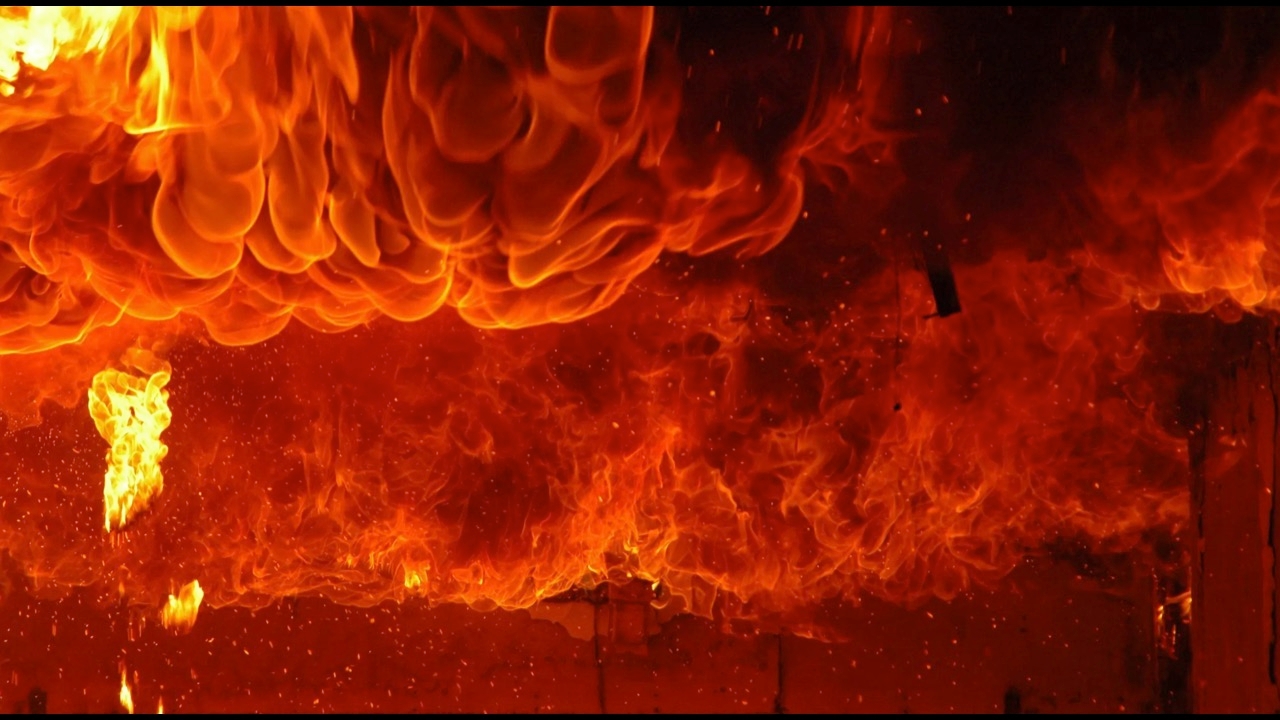
Flashover, the phenomenon of simultaneous intense fire, is among the most dangerous and frightening fire events, especially in building or enclosed space fires. It involves a physical and chemical turning point where a localized fire abruptly escalates into a severe, room-wide blaze within seconds. Simply put, it is the moment when everything in the room ignites intensely at once, even though the flames do not directly touch the burning objects.


The mechanism of Flashover involves the fire's growth process, which can be scientifically divided into stages leading up to Flashover.
1. Heat accumulation and gas layer formation
When a fire starts in one spot, such as on a sofa or pile of books, heat, smoke, and toxic gases from combustion rise to the ceiling because they are less dense than the cooler air. Upon reaching the ceiling, the heat spreads sideways, filling the ceiling area and creating a thick layer of hot gases and smoke that accumulates above.
2. Release of fuel gases due to heat
As the hot gas layer near the ceiling continues to heat up, reaching temperatures above 500–600 degrees Celsius, intense thermal radiation begins to emit downward. This heat radiation affects all objects below, such as tables, chairs, curtains, and mattresses, causing their surfaces to undergo pyrolysis—a heat-induced decomposition that releases flammable gases into the room's air, even though the main flames have not yet reached these objects.
3. Critical flashover point
When the room’s temperature rises to a critical level, combined with intense thermal radiation reaching about 20 kilowatts per square meter (20 kW/m2), the flammable gases evaporated from all objects, together with the high ambient temperature, cause all materials in the room to ignite instantly. This occurs without direct flame contact, turning the entire room into a massive furnace within fractions of a second.

Warning signs before Flashover
How can this be recognized? For firefighters or occupants, these warning signs are the final limits signaling immediate evacuation, as Flashover is imminent within moments. These signs include smoke at eye level; a thick, black smoke layer at the ceiling descending toward the floor, indicating maximum heat accumulation; flame tongues flickering within the black smoke layer near the ceiling, resembling smoke burning itself; intense radiant heat felt as unbearable even when crouching low; and windows turning black from soot and shaking due to pressure from the intense heat inside.

Impacts, dangers, and survival rates
Survival rate is nearly zero when Flashover occurs. The room temperature suddenly soars above 600–1,000 degrees Celsius, oxygen is depleted and replaced by dense toxic gases. Standard firefighting gear cannot endure this heat. Structural damage occurs rapidly as the extreme heat weakens steel, concrete, and walls, potentially causing collapse. The fire also spreads quickly beyond the room.


The immense pressure from Flashover forces flames and hot gases to burst out through doors, windows, or openings into corridors or adjacent rooms, rapidly expanding the fire. Scientifically, Flashover marks the boundary between interior search and rescue and shifting to exterior defensive operations, as entering after Flashover poses life-threatening risks.
We extend our condolences to those injured and deceased in the Ladprao brewery fire incident.