

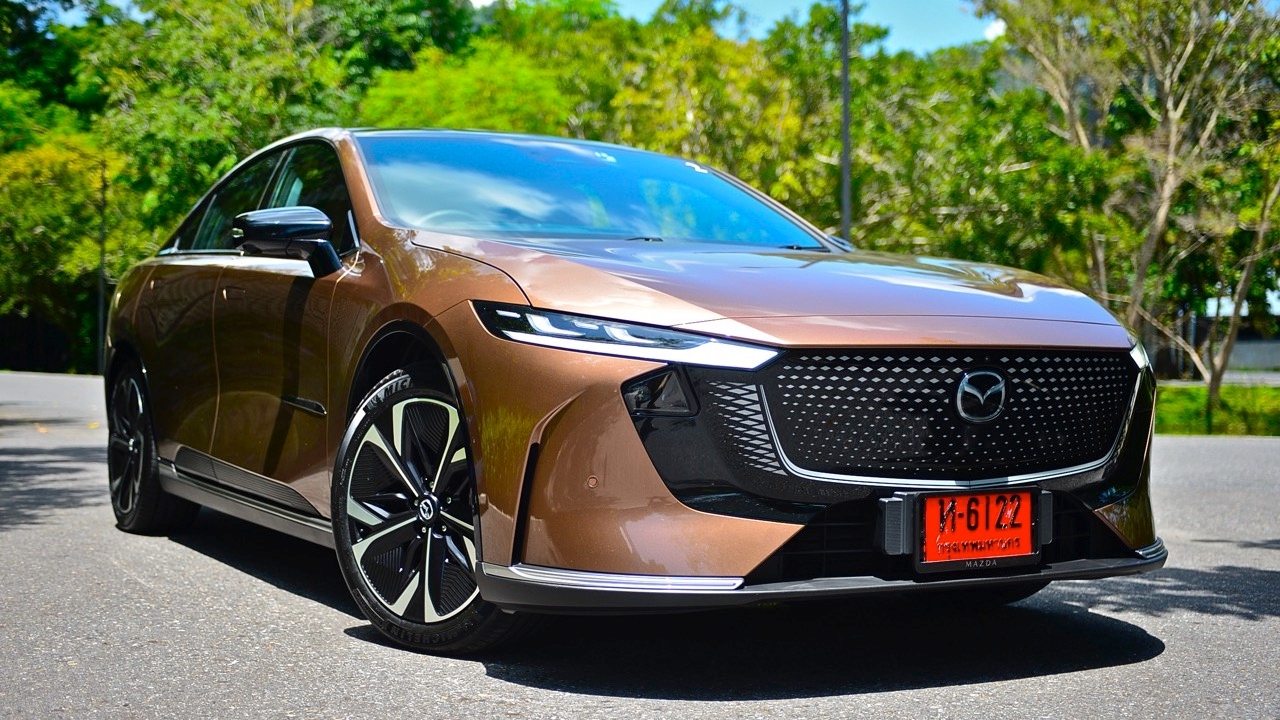
Following the launch of the All-Electric Mazda6e at the Motor Show last March, featuring a 5-door NeoFastback body style, Mazda Sales Thailand has recently imported the first batch of 500 units from the Changan Mazda Automobile (CMA) factory in Nanjing, China, for gradual delivery to customers. A second batch of 600 units is currently being transported, with a goal to fulfill all pre-orders by October.

The Mazda6e is offered in two trim levels:
Premium trim: priced at 1,169,000 baht, featuring a black leather interior.
Exclusive trim: priced at 1,199,000 baht, featuring an interior upholstered in tan Nappa leather and suede.


Theer Phempongpan, CEO of Mazda Sales Thailand, revealed the market and production direction, stating that the Mazda6e is produced at the CMA factory, a joint venture between Mazda Motor Corporation (Japan) and Changan Automobile (China) with over 20 years of collaboration. This factory manufactures various Mazda models such as the Mazda2, Mazda3, CX-30, CX-5, as well as new electric models like the Mazda EZ-6 (Mazda6e) and Mazda EZ-60 (Mazda CX-6e) for sale in China and export worldwide, all under the same quality control standards as Mazda plants in Japan, the US, Mexico, and Thailand.
The executive added that although the vehicle has transitioned to a fully electric powertrain (EV), the development approach retains the unique "Mazda-ness"—including the Jinba-Ittai driving feel (the unity between driver and car), safety systems, manufacturing standards, and refined Japanese-style design—to support the shift to the EV era under the Multi-Solution Strategy.


Although the 6e shares its platform with the Changan Deepal L07, it remains distinctly Mazda, albeit in an unfamiliar form. Mazda, known for offering niche sporty choices in Thailand, has models like the Mazda3 and CX-30 that emphasize sporty character. While it might be an exaggeration to say these family cars drive like the MX-5, especially front-wheel-drive models, the Mazda3 hatchback and Mazda6 sedan often rank among the sharpest designs with the most enjoyable suspension in their segments.
Frankly, over recent years Mazda has struggled to adapt quickly to the wave of electrification that has swept the industry. Mazda seemed more confused by the Chinese EV surge than leading in hybrid or electric vehicle planning. Popular models like the Mazda2 and CX-3 have lingered over 14 years, still selling but showing a clear desire within Mazda for fresh products rather than relying on aging models.
In the coming decades, as the global automotive industry evolves—with China rising to replace once-dominant Japanese brands—major changes loom. Mazda's slow positioning has been viewed as cautious rather than bold, especially after the underperforming Skyactiv X engine that consumed significant development funds. Amid a price war with China as a key player, Mazda urgently needs a shortcut to introduce plug-in vehicles to meet tightening emission targets and appeal to younger consumers facing soaring fuel prices.


The fact is, the Mazda 6e is essentially a Changan Deepal L07 electric sedan with Mazda branding and redesigned styling. The main changes are in driving style, vehicle dynamics, and exterior and interior design. The 6e’s design admirably inherits the handsome traits of the Mazda6. While the Deepal is a good-looking Chinese vehicle and not a poor genetic mix, the transformation into a Mazda badged car with brown suede seats is nearly flawless, especially in driving experience that reflects Mazda's distinct character.
Mazda 6e is not a rushed or half-hearted effort as some might worry, since Changan and Mazda have collaborated since the early 2000s. The 6e is marketed in China as the Mazda EZ-6, available in EV and Plug-in Hybrid/EREV versions. The version attracting Thai interest is the pure EV with right-hand drive, offering a brief preview.


It features a single rear-wheel-drive motor delivering 254 horsepower, accelerating from 0-100 km/h in 7.6 seconds. Performance and interior/exterior finish are comparable to cars priced around 2.5 million baht, making the difference barely noticeable. However, DC fast-charging speed is a decisive factor for many buyers. This first impression is limited to the 77.9 kWh battery model. The driving experience is smooth without the bounce sometimes found in Chinese cars; the steering is sharp with appropriate weight and minimal play, making it competitive in the mid-size sedan segment against rivals like Tesla Model 3, BYD Seal, Hyundai Ioniq 5, Toyota Camry, and Honda Accord, none of which are known for exceptional suspension. The setup prioritizes refined comfort typical of the original Mazda6, satisfying traditional customers and offering a clearer rear-wheel-drive feel than competitors. A challenge for those moving from combustion Mazda models is the shift of all controls onto the touchscreen. Mazda owners accustomed to physical switches may find the large Chinese-style central screen overwhelming, especially as wiper and headlight stalk controls are integrated into the display, signaling a loss of Mazda’s traditional cabin identity.


The interior design of the Mazda 6e marks a significant leap for the brand, moving from traditional analog button-focused design to an Authentic Modern concept emphasizing openness while retaining the refined luxury of Japanese architecture. Mazda distinctly differentiates interior trims to suit varied tastes: the top Exclusive trim uses tan Nappa leather combined with diamond-cut suede, soft and premium to the touch, with black wood grain accents on door panels and console, and titanium trim around air vents. The Premium trim adopts a sporty black leather (Maztex) with silver metallic accents, and black fabric headliner and pillars, creating a snug, integrated cabin feel. Frameless doors add a sleek coupe-like sporty elegance from the moment of opening and closing.


The dashboard and digital cockpit emphasize horizontal architecture to create a spacious cabin feel. Physical buttons are nearly eliminated, consolidated into a 14.6-inch high-resolution floating touchscreen powered by Qualcomm Snapdragon 8155, supporting wireless Apple CarPlay and Android Auto. This center display controls air conditioning, driving modes (Normal, Sport, Individual), and regenerative braking levels. The 10.1-inch digital instrument cluster is embedded in front of the driver, while a large 50-inch AR-HUD projects navigation and speed information onto the windshield within a 7.5-meter viewing distance, minimizing driver distraction.
The center console and seats feature a floating design with a large storage compartment below, including 12V and USB ports (USB-A and USB-C). A 50W air-cooled wireless charger prevents phone overheating during charging. The driver's seat is 10-way power adjustable with lumbar support, memory settings, and a welcoming function that automatically moves the seat back when the door opens. The front passenger seat offers 4-way power adjustment, heated and ventilated with three intensity levels.


Rear passenger comfort and cabin ambiance are enhanced with a rear touchscreen control panel to adjust climate zones, front passenger seat position (boss button), and electric sunshade operation. The 3-zone climate control allows independent temperature settings, equipped with PM 2.5 air filtration and an ion generator. A panoramic glass roof with large heat-rejecting glass includes an electrically operated sunshade. Ambient lighting offers 64 color options, built-in discreetly along the sides of the console and door panels.


The steering wheel features excellent design and leather wrapping for both tactile feel and functionality. It is a D-shaped multifunction wheel with a flat bottom, trimmed in two-tone genuine leather—tan outside and black inside—with precise stitching and a polished metal strip dividing the lower spoke. Left-side controls manage driver assistance systems (ADAS), adaptive cruise control, 360-degree camera, and a star-shaped shortcut button. Right-side controls handle infotainment volume, track selection, phone calls, and voice commands. There are no paddle shifters behind the wheel; regenerative braking adjustments must be made via the touchscreen. The gear selector is a column shifter mounted on the right behind the steering wheel, freeing up space on the center console.


The center console features a floating design clearly separated from the dashboard. Beneath it is an open lower shelf suitable for bags or personal items, with power outlets. The console surface includes a wireless charger on the driver’s left side, a long phone tray with a sliding wood-textured cover, and cup holders on the right trimmed with shiny chrome. The removal of physical buttons, typical of Chinese vehicles, results in a clean console lacking hard keys or dedicated drive mode and electronic parking brake buttons, relying entirely on touchscreen operation. The large, finely stitched tan leather armrest opens butterfly-style, enhancing convenience for driver and passenger.
The Mazda 6e is equipped with a premium SONY Hi-Performance audio system featuring 14 speakers surrounding the cabin, including headrest speakers embedded in the driver’s seat for private navigation prompts or phone conversations without disturbing cabin music.
Cargo capacity includes a 336-liter fastback-style rear trunk with electric opening and closing, expandable to 1,074 liters with the 60:40 split rear seats folded. The front trunk (frunk) under the hood offers 72 liters of storage with a drainage plug, suitable for charging cables or wet items.
Typically, Mazda vehicles have distinctive cabins with favored seating positions and control weights that driving enthusiasts appreciate regardless of model. However, this 6e is essentially a rebadged Changan with well-made materials and a delightful panoramic roof atmosphere. Yet, the repositioning of key controls feels like a betrayal of Mazda’s roots. This compromise is necessary for survival, safety, and launching new products, and Mazda will likely continue to refine this balance until it stabilizes.


The Mazda 6e is a peculiar vehicle that appears premium due to its exterior design. Its battery range is 480 kilometers per full charge, and its interior features rich brown suede, elevating the cabin’s luxury beyond its price. The technology and screen features meet modern EV buyers’ expectations, but it diverges from traditional Mazda offerings. Despite smooth, agile driving and relaxed feel when driver aids are turned off, the charm and identity inside are diminished along with the loss of physical buttons, revealing its Chinese sedan origins. However, if one adapts to its unusual infotainment system and accepts it lacks the sporty DNA of a car like the MX-5, the Mazda 6e stands out as a stylish, better-value EV sedan compared to rivals like the Camry or Accord. It is more affordable, better looking, more powerful, and drives better, except for the Accord’s slightly superior suspension firmness.


A test drive covering 400 kilometers from Bangkok to Khao Yai assessed the performance of the 100% electric Mazda6e, the brand’s first EV sold in Thailand. Globally, Mazda’s MX-30 has been available in Europe and America but was never offered in Thailand. The test route from Bangkok through Khao Yai to Nakhon Ratchasima included city, highway, and steep winding mountain roads to evaluate drivetrain responsiveness and suspension under real conditions.
Test segment 1: Ekkamai to Rangsit-Nakhon Nayok, about 60 kilometers. This involved navigating congested urban traffic, using the Bangkok Expressway from Phra Khanong to Thanyaburi toll plaza, testing acceleration for overtaking, regenerative braking function, and noise insulation at high speeds.
Segment 2: Nakhon Nayok to Prachinburi to Khao Yai, approximately 85 kilometers along Suwannason Road and Narai Circle. During this stretch, all ADAS safety systems were tested, including lane departure warnings and adaptive cruise control (MRCC), especially in heavy traffic conditions.
Segment 3: Khao Yai ascent via Nern Hom side and exit through Pak Chong-Moo See, 90 kilometers, followed by a free-run back to Bangkok covering 145 kilometers. The mountain ascent at speeds up to 60 km/h featured continuous curves and elevation changes to test steering, suspension grip on tight bends, steep gradients, and ride comfort, concluding with an assessment of actual energy consumption.


The first indication that this is not a typical Mazda is the start-up process—there is no start button. Like many EVs, simply entering the car, shifting into Drive, and pressing the accelerator starts the movement. Immediately, drivers must contend with overbearing safety assists, particularly the lane-keep system. To disable it requires navigating menus on the touchscreen, during which the car warns the driver not to take their eyes off the road.


With safety warnings and driving aids turned off, the Mazda 6e delivers remarkably precise cornering on Khao Yai’s paved roads, providing a delightfully smooth drive. The 19-inch alloy wheels produce some clatter over road joints, but overall the suspension absorbs shocks impressively. Noise insulation is refined and pleasing. Its low, streamlined body is quieter than many widely available electric SUVs. Weighing 1,953 kilograms, it is relatively light compared to some EVs exceeding 2,500 kg, easing suspension and tire load handling.


It may seem odd in the EV era for media to praise a mid-size sedan’s weight being under two tons, but this mass is nearly evenly balanced front to rear at 50:50. This balance translates to excellent stability at speed. Enthusiasts who disable stability control can induce and control tail slides similarly to a Miata sports car. The steering offers excellent weight, making navigating Khao Yai’s curves confident and unthreatening. Regenerative braking levels are adjustable, though unfortunately these settings are hidden within the touchscreen. One wonders when Chinese engineers will be told that such designs hinder usability.


The Mazda 6e has a sound structural foundation.Its acceleration is smooth and linear, resembling combustion engine cars. It sacrifices explosive initial thrust typical of many EVs in favor of calm, gentle power delivery, impressively aligning with a mature, successful middle-aged driver’s relaxed driving style—aptly capturing the Mazda 6e’s character.
The Mazda6e uses CALB batteries with a claimed maximum range of 654 kilometers (NEDC/CLTC). After a full-speed test drive covering approximately 400 kilometers, battery capacity dropped by 70%, leaving about 30% on the dashboard gauge. This suggests a realistic single-charge range of about 500–550 kilometers, depending on driving habits.


The chassis and suspension are designed with a low center of gravity and a near 50:50 front-to-rear weight distribution. It rides on 19-inch Michelin 225/45 R19 tires. The front suspension is MacPherson strut with anti-roll bar, while the rear features independent multi-link suspension with anti-roll bar. The integrated brake system works in tandem with regenerative braking to recover energy back to the battery.


Mazda engineers tuned the electric drivetrain of the All-Electric Mazda 6e based on real-world usage to preserve the Jinba-Ittai driving philosophy—the unity between driver and vehicle. This includes smooth linear throttle response, precise steering feel, firm and responsive braking, and stable body control in corners. While it doesn’t quite match the perfect balance of a BMW i5 or the grounded solidity of a Mercedes-Benz EQE, it remains a well-composed EV.


The driver’s seat can be lowered to enhance the sporty image. Regenerative braking works smoothly and intuitively; lifting off the accelerator causes gentle deceleration. Four levels of regen intensity are available but, again, adjustments are only through the infotainment screen. The absence of paddle shifters behind the wheel to easily tweak regen is a notable omission. There’s also no separate drive mode switch; selecting Normal, Sport, or Individual modes requires navigating menus each time. The persistent, frequent alerts from safety and driver assist systems detract from driving pleasure and must often be disabled. These nuisances are common in 2026 Chinese EVs, reflecting excessive warnings and centralized touchscreen controls.


On long trips, even with a practical range of about 450 kilometers, I found myself favoring the Mazda 6e. In daily driving, both urban and suburban, the suspension is tuned softly yet the car handles corners sharply for a 2-ton vehicle. Body roll is controlled impressively, aided by rear-wheel drive and grippy Michelin tires, instilling confidence. Electric power steering performs well, transmitting road surface feedback adequately, though it is lighter and more sensitive than typical Mazda expectations. Settings for steering weight are adjustable via menu. While not a true sports sedan, the car carries the Jinba-Ittai spirit—the deep connection between driver and car—clearly infused throughout.
Details of the two trims.
Premium trim: interior adorned with sporty black tones.
Exclusive trim: upgraded with tan Nappa leather blended with suede.
Exterior design and equipment (NeoFastback):
Front grille features the distinctive Flying Signature with wing-shaped daytime running lights.
Rear design includes elongated LED taillights connected across the back, circular quad lights, and an electrically adjustable active rear spoiler.
Body style: 5-door with a sloping NeoFastback rear.
Interior convenience features:
14.6-inch center touchscreen infotainment display with matte chrome accents.
Panoramic glass roof with electrically operated sunshade.
Seats designed with Human-Centric Architecture to support natural posture.
Premium SONY sound system with 14 speakers (including two embedded in the driver’s headrest), tuned with Clear Phase and Live Acoustics technology.
Mazda6e
Powertrain, acceleration, and driving modes.
Electric motor: maximum output of 258 horsepower (PS).
Maximum torque of 290 Newton-meters.
Acceleration: 0–100 km/h in 7.9 seconds.
Three driving modes:
Comfort: prioritizes smooth, responsive Mazda-style driving.
Sport: enhances acceleration and throttle response for a sharper feel.
Individual: allows customization of steering weight, throttle response, and regenerative braking.
Suspension and steering system.
Front MacPherson strut and rear multi-link suspension with front and rear anti-roll bars.
Near 50:50 front-to-rear weight distribution.
Equipped with an automatically adjusting electric rear spoiler to increase downforce at high speeds.
Michelin e-PRIMACY tires.
19-inch alloy wheels.
Battery and charging.
Lithium Iron Phosphate (LFP) battery from CALB.
Capacity of 77.9 kWh.
Maximum range of 654 kilometers (NEDC standard).
DC fast charging supports at least 200 kW, charging from 30% to 80% in 15 minutes.
In-cabin technology (Smart Cockpit).
AR Head-up Display (AR-HUD) projecting a 50-inch equivalent image onto the windshield at a 7.5-meter focus distance.
10.1-inch digital instrument cluster.
14.6-inch high-resolution center touchscreen display.
Supports voice control and gesture control.
Safety and driver assistance systems (Smart Drive ADAS).
360-degree surround view cameras with See-through View and Side View Monitor.
Front and rear collision warning (FCW/RCW) and automatic emergency braking (SBS/SBS-RC).
Adaptive cruise control with Stop & Go functionality (ACC with Stop & Go).
Lane keeping assist, lane departure prevention, and emergency lane keeping (LAS/LDP/ELK).
Blind spot monitoring and rear cross-traffic alert (BSM/RCTA), plus door open warning (DOW).
Secondary collision mitigation system (SCM).
Automatic high beam control (HBC).
Driver fatigue detection system (DMS).
Available body colors (6 options).
Soul Red Crystal.
Melting Copper.
Machine Gray.
Crystal White Pearl.
Jet Black and Aero Gray.
After-sales policy and service network: nationwide authorized showrooms and service centers; centralized parts warehouse with 24-hour expedited delivery; technicians trained and certified in EV standards; certified body and paint repair centers across the country.
Arkom Ruamsuwan.
E-Mail.chang.arcom@thairath.co.th.
Facebook.https://www.facebook.com/chang.arcom.
https://www.facebook.com/ARCOM-CHANG-Thairath-Online-525369247505358/