

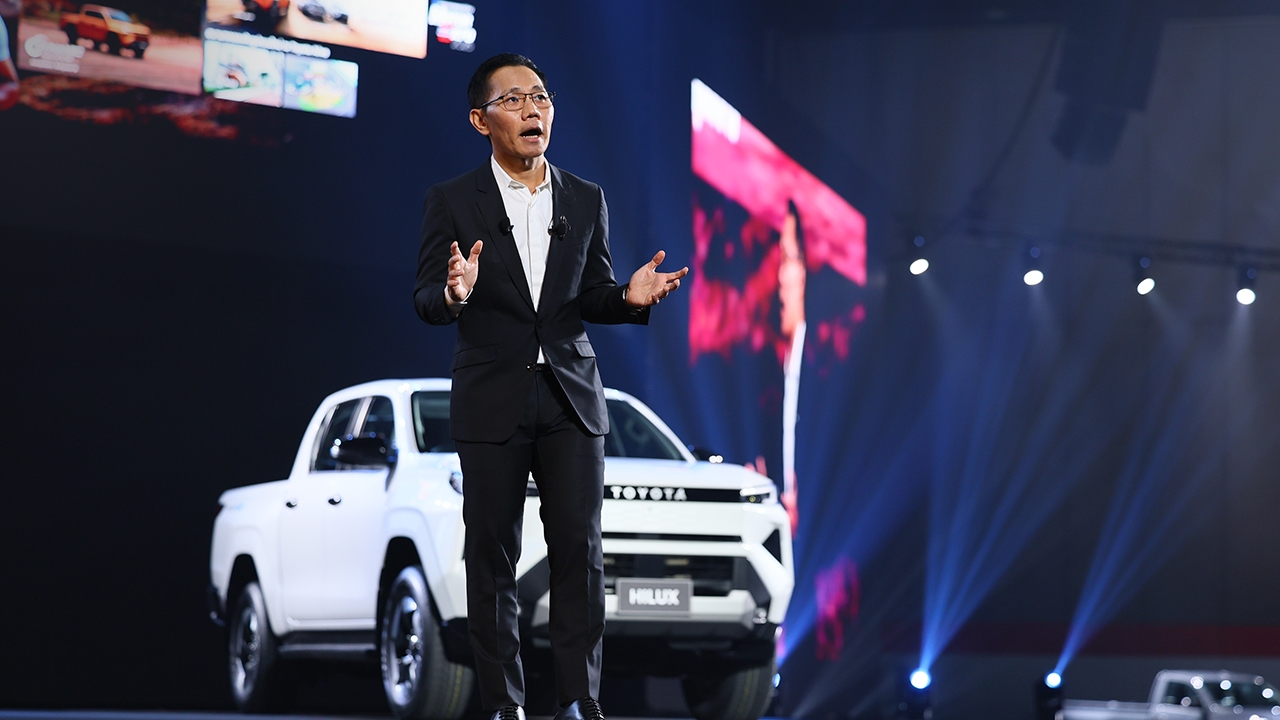
Supakorn Rattanavara, Toyota's top executive, recommends that the government urgently establish clear, transparent automotive industry policies that protect domestic manufacturers. He also calls for criteria to screen investors setting up production bases, creating jobs, and developing Thailand's supply chain versus those exploiting legal and tax loopholes to flood the Thai market with excess foreign goods.
Following Indonesia's announcement challenging Thailand by offering Toyota to relocate its main production base there, along with attracting supplier networks to establish integrated factories, aiming to transform the country from a large automotive market into a global production and export hub as previously reported,Why is Indonesia competing to become ASEAN's automotive hub by inviting Toyota to move its main production base out of Thailand?)
Most recently, on 13 Aug 2026, Supakorn Rattanavara, Senior Executive Vice President of Toyota Motor Thailand Co., Ltd., responded to the Thairath Online news team that Toyota currently continues to invest in Thailand because the country holds a major advantage in its long-developed, strong supply chain with many Thai parts manufacturers. However, neighboring countries like Indonesia are rapidly adjusting policies. Toyota already diversifies investment risks by investing in countries such as China, India, Indonesia, and the Philippines.

The reporter also noted that Supakorn previously posted a personal statement on the automotive industry, saying he holds two roles: first, "employee of a Japanese company," which will end in less than 10 years; second, "Thai citizen," a role that never ends. Thus, he expects to serve as a Thai citizen longer than as an employee, unless he is very unlucky and does not live beyond 10 years. He shared his perspective as a "Thai citizen": Indonesia's news states that if Toyota moves production there, they are ready to provide everything. "Wow! They are aggressive and fearless!"
From this news, Indonesia is signaling, "We are seriously competing with you, Thailand." Thailand should listen carefully because they are trying to attract investment to boost national competitiveness. Thailand has built its automotive industry for over 60 years,
with suppliers, workforce, factories, logistics, engineering, and export markets forming an automotive ecosystem that took years to develop. But will these advantages remain for the next 10–20 years? Especially now, during a major industry transition with the government promoting "EVs."
Let's look globally.
- China’s EV market grew rapidly, but as it expanded, growth slowed and competition intensified, causing over half of manufacturers to exit the market.
- Europe’s EV market continues strong growth driven by environmental policies and regulations.
- The U.S. is different; EVs account for about 10%, and customers are showing renewed interest in hybrids.
What we learn globally is that no single technology fits every country.
Each market seeks its own technology mix, which aligns with the Multi-Pathway concept Toyota has long advocated. Back to Thailand, we must clearly ask ourselves whether we are promoting "EV vehicles" or building an "EV industry"—these are fundamentally different.
Today, more EVs are sold in Thailand because of lower prices and energy costs, benefiting consumers as many say. But if these vehicles are imported or assembled locally only by attaching imported batteries and key parts, what does Thailand gain from this transition?

The automotive industry is more than just cars; it is an entire ecosystem. Is this ecosystem growing alongside EV sales? There are many challenges not yet fully visible: Where do used batteries go after their lifespan? How are they disposed of? Who is responsible?
What will be the residual value of secondhand EVs in 5–10 years as battery technology changes? How will this affect the used car market and customers? Is charging infrastructure sufficient? If EV numbers rise sharply, is the electrical grid ready? Can we truly reduce reliance on imported energy, since natural gas is still imported to generate electricity?
This does not mean EVs are bad, but these issues must be prepared for proactively—not waiting until "the cow is lost to build the fence," because by then, even the buffalo might be gone.
Therefore, Thailand must not try to preserve the past but must answer: "What reasons will make investors choose Thailand in the future?" Certainly, the answer cannot be "just incentives" funded by taxing ICE vehicles heavily to support EVs in a confusing way, which cost us Suzuki and brought in Neta instead.
What must be done is selecting and promoting sincere investors who will build the ecosystem and competitiveness through technology transfer, infrastructure development, personnel training, and a comprehensive supply chain. Most importantly,
"ensuring national policy has a clear, consistent direction," because investors fear uncertainty, not change. I still believe Thai people's capabilities are world-class, and I want to see Thailand become a country that
"produces the vehicles of the future, develops future technologies, creates jobs, and exports globally, serving as a key engine driving the economy."
I am confident that if we achieve this, regardless of whether the future technology is BEV, HEV, PHEV, Bio-Fuel, Fuel-Cell, Hydrogen, or others, Thailand can sustainably remain the region’s automotive hub.

When asked about the current automotive industry situation in Thailand, Supakorn said, "I speak as a Thai citizen," noting that the industry currently faces challenges with excise tax structures, especially for imported vehicles sold domestically.
For example, imported electric vehicles pay a low import duty of only 8% and receive government subsidies of 50,000 baht per vehicle under the EV 3.5 policy. This means imported EVs effectively pay almost no tax, whereas domestically produced vehicles pay full taxes.
"I see this distorted tax structure directly harms domestic manufacturers who pay full taxes at every stage. Simultaneously, it causes significant government tax revenue loss, which was previously used to develop the country’s roads, hospitals, and schools. If this policy continues, the government may need to adjust tax structures in the future to compensate for lost revenue, which will impact everyone."
From a consumer perspective, EVs offer new technology at affordable prices, so naturally consumers want them. Thus, from the consumer side, this is understandable. The problem lies in the tax structure, which could cause future issues for Thailand.
If this situation persists, tax structures may need revision again, possibly including EV taxes or road usage fees, to provide the government with revenue to offset losses.
Regarding automotive industry policies, Thailand should have clear rules to screen between investors genuinely investing and developing the country and those exploiting legal and tax loopholes to offload excess products from other markets.
Additionally, import taxes on all vehicles should be raised, not just on electric vehicles, covering all imported vehicles sold domestically. Toyota would also be affected by such tax increases but believes this is a good solution that will promote fair competition with domestic manufacturers.
Vehicles imported for niche markets or those not competing with mass production can still be imported to meet customer needs while contributing additional tax revenue to the country.
"In my view, it is urgently necessary for Thailand to have clear, transparent automotive industry policies that protect domestic manufacturers to build confidence and sustain long-term industry growth."
Regarding Toyota’s outlook for 2026, the company has slightly lowered its sales target to 240,000–250,000 units, while the overall market is expected to increase to 680,000–700,000 units from the previous 640,000–660,000 units. The pickup truck market remains sluggish; sales declined 4% over the past seven months due to stricter loan approvals by financial institutions. Toyota holds a 52% market share in pickups.
Moreover, Toyota supports the long-term use of biofuels such as B20/E20 because Thailand is an agricultural country. Subsidizing palm oil for B20, despite higher costs than regular fuel, benefits the majority of the country’s farmers.