

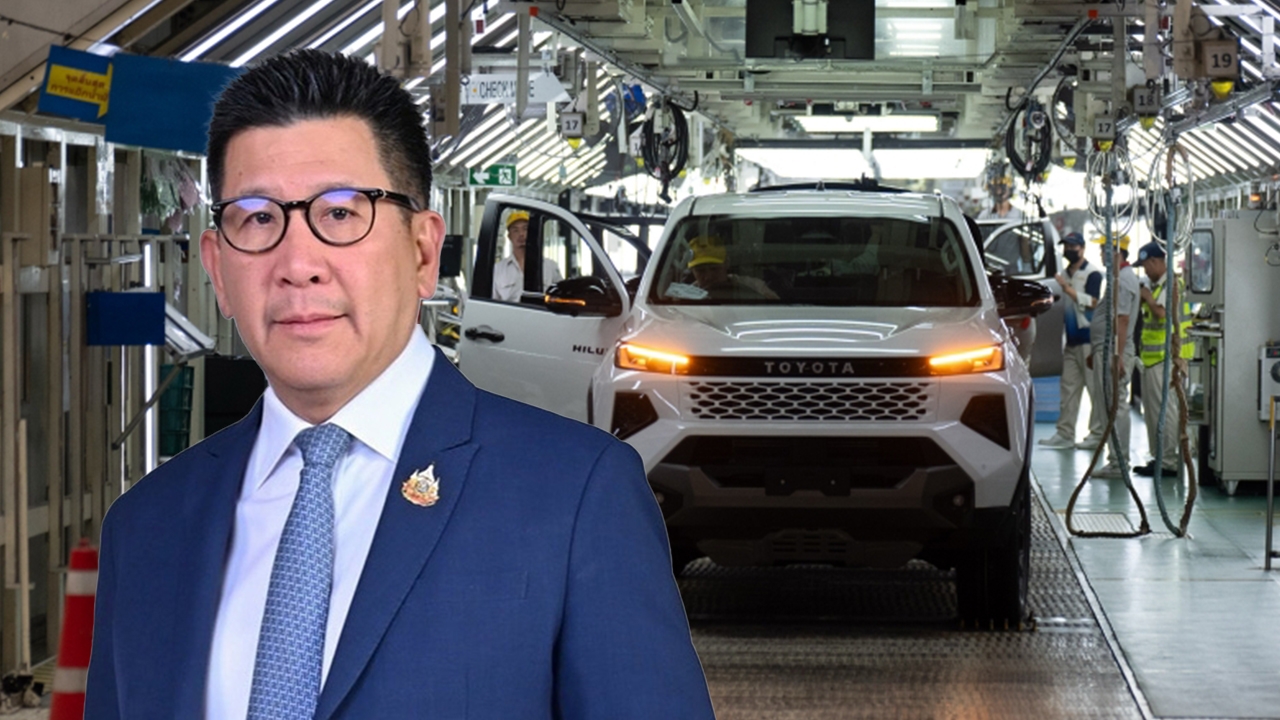
"Aekniti" has ordered an urgent overhaul of the entire vehicle tax system to create fairness for operators investing in factories and employment in Thailand. Plans include raising import taxes on electric vehicles while reducing taxes on EVs produced domestically. The goal is to prevent production base relocation and attract automakers and related industries to invest more in the country. The target is to reach a conclusion by September 2026.
Deputy Prime Minister and Finance Minister Aekniti Nitithanprapas revealed he held discussions with Lavaron Saengsanit, Secretary-General of the Ministry of Finance, and Pornchai Theerawet, Director-General of the Excise Department, about ways to improve the entire vehicle tax structure. The aim is to create fairness for operators and reduce tax disparities between imported vehicles and those produced domestically.
The key objective of these measures is to prevent automakers from relocating production bases from Thailand to other countries. At the same time, tax measures will be used to attract automakers and related industries to move production bases and establish factories in Thailand. The Ministry of Finance will expedite consideration of all details to reach a conclusion by September 2026.
Aekniti stated that the new vehicle tax structure must be completed swiftly. The preliminary approach will raise taxes on electric vehicles imported from abroad, while reducing taxes on EVs produced in Thailand to incentivize operators to invest and establish production bases domestically.
Currently, Thailand produces electric vehicles and exports them abroad. Therefore, the government needs to continuously promote domestic investment to lay the foundation for Thailand to remain a key automotive production base in the long term.
"The Ministry of Finance must quickly complete the new vehicle tax structure. Import taxes on electric vehicles must be increased, while taxes on domestically produced EVs should be lowered to encourage investment. Thailand already produces electric vehicles and exports them. Thus, investment promotion is crucial as investment is the foundation for driving Thailand's economy," Aekniti said.
The aim of this excise tax restructuring on vehicles is to create fairness and equal competition, especially to address disparities caused by vehicles imported from countries with Free Trade Agreements (FTAs) with Thailand.
Vehicles from partner countries sometimes receive customs tax benefits, resulting in lower import costs compared to vehicles from other countries. This may give them an advantage over operators who invest in factories, hire labor, and develop supply chains within Thailand.
Therefore, excise tax is one tool the government can use to balance domestic competition without affecting customs tax obligations under FTAs. It may also help increase government tax revenue.
Aekniti cited the measure of collecting import taxes from the first baht by the Customs Department, which has been effective since 1 January 2026 and is expected to generate about 3 billion baht in revenue for the government.
This measure is not only intended to increase government revenue but also serves as a mechanism to reduce inequality and protect Thai SME operators from competition with imports enjoying tax and cost advantages.
The same concept will be used to consider the new vehicle tax structure to create a level playing field between operators importing complete vehicles and automakers who seriously invest in production bases in Thailand.
Aekniti added that a major reason for adjusting the vehicle tax structure is to reward operators who invest in building factories, create jobs, and develop the automotive supply chain within the country in a tangible way.
The government wants the tax mechanism to reflect the benefits each operator brings to Thailand's economy, including investment, employment, use of domestic parts, technology transfer, and development of related industries.
The Ministry of Finance believes that appropriately adjusting the excise tax structure will help create fair competition, maintain existing production bases, and increase incentives for new manufacturers to choose Thailand as a production and export base in the future.