

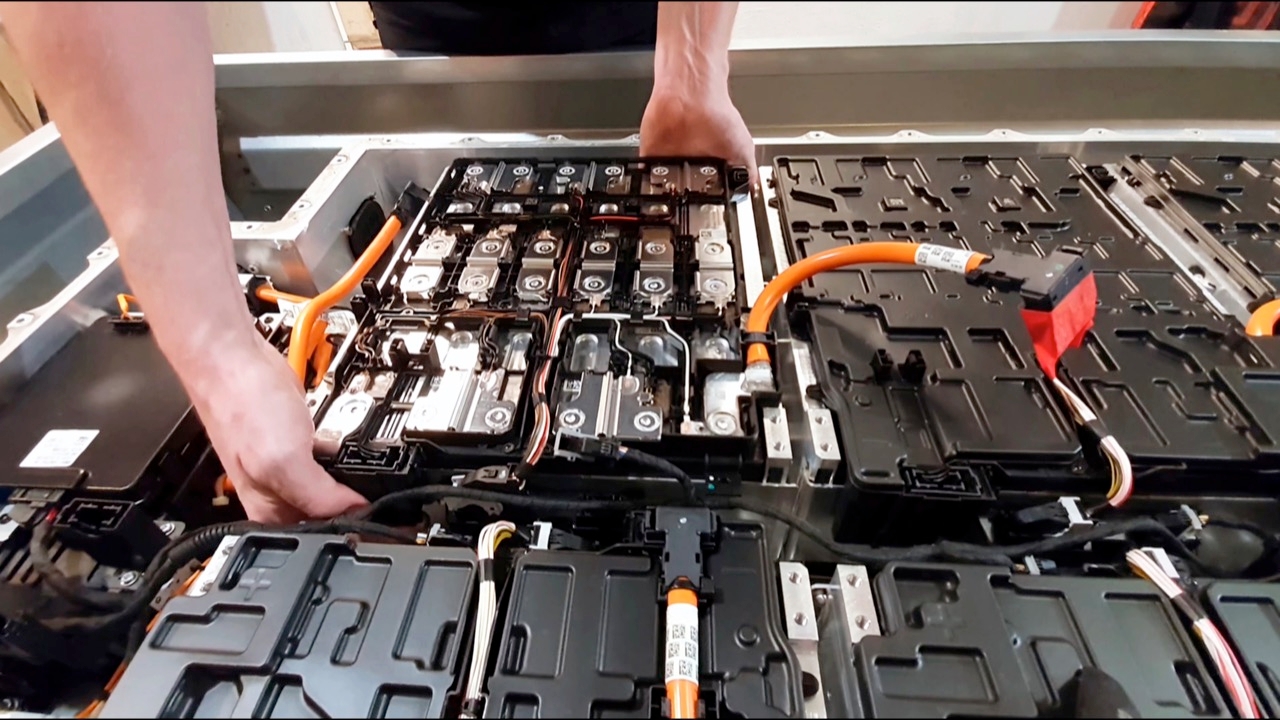
Currently, electric vehicle battery recycling technology is no longer confined to laboratories but has developed to industrial-scale practical use. In the next decade (the 2030s), this process will become a key supply chain for the global automotive industry.


Recycling Lithium Iron Phosphate (LFP) batteries is a major challenge in the electric vehicle industry because modern EVs increasingly use LFP batteries due to their low cost and safety, but LFP's chemical structure creates significant recycling difficulties.
The main reason past LFP battery recycling has been unprofitable compared to Nickel Manganese Cobalt (NMC) batteries is the limited mineral value of LFP components.
NMC batteries contain nickel and cobalt, both high-priced metals on the market, allowing the black mass powder from NMC to sell at high prices and yield profits for recyclers. In contrast, LFP primarily consists of iron (Fe) and phosphate (PO4), which are inexpensive and abundant minerals.

Lithium is the only commercially valuable mineral in LFP batteries, making up about 4-5% of the cell's weight. If global lithium prices fall, the costs of transporting, dismantling, and chemically extracting lithium can exceed the lithium's sale value.
The complexity of extracting lithium from the Olivine crystal structure.
The Olivine crystal structure of LFP is extremely stable, with lithium strongly bound to iron phosphate, making lithium separation difficult and requiring large amounts of chemicals or high energy to extract lithium from the structure.
How can this problem be solved?
To make LFP recycling commercially viable and profitable, industry and researchers have developed solutions in four main areas:

A. Selective Lithium Leaching technology: Modern plants shift from dissolving all minerals—which wastes acid—to selectively extracting lithium first.This uses diluted acid solutions combined with special chemical reagents to extract lithium in the form of high-purity (99.5%) lithium carbonate or lithium hydroxide.This approach reduces chemical usage by 60-70%, leaves iron phosphate residue without costly extraction, and increases net profits even when lithium prices are low.

B. Direct Recycling technology: Instead of breaking down the entire chemical structure with acid or heat, Direct Recycling extracts only the degraded LFP cathode material, then restores lithium into the original crystal structure (Relithiation).
This method avoids atomic-level separation, greatly reducing energy and chemical consumption.
It produces pure recycled LFP cathode powder at lower cost than synthesizing new LFP materials from mining.

C. Upcycling iron and phosphate byproducts: The iron and phosphate sludge leftover from lithium extraction is no longer waste but processed into iron phosphate (FePO4) and fed back into LFP cathode precursor production (Closed-loop).
Phosphate fertilizers are also made by improving phosphate sludge quality for agricultural use.

D. Legal enforcement and the "Battery Passport": When economic incentives alone fall short, governments in major markets like the EU and China regulate the industry.
New EU battery regulations require recyclers to recover at least 50% lithium from old batteries, increasing to 80% by 2031, regardless of chemical methods used.
Extended Producer Responsibility (EPR) laws make EV automakers financially responsible for recycling their batteries, compelling them to subsidize LFP recycling plants to comply with regulations.
In 5-10 years, LFP battery recycling profitability will rely less on mineral sales as with NMC, and more on reduced technology costs, large-scale industrial closed-loop recycling, and recycling fees paid by automakers under EPR laws.

Thailand is building infrastructure to handle EV battery waste expected to retire starting in 2030. Although currently lacking specific laws or large-scale EV battery recycling plants, government and private sectors are advancing multi-dimensional response plans.
1. Government policies and strategies: The Office of Industrial Economics (OIE) has drafted an EV battery waste management strategy aiming to establish a circular economy system covering collection, transport, reuse, and recycling.
Extended Producer Responsibility (EPR) laws require EV automakers and battery manufacturers to be primarily responsible for battery lifecycle management, including take-back and proper disposal.
Battery Passport projects promote digital tracking and origin identification of batteries to monitor history, performance, and location at end-of-life.
End-of-life EV battery management follows two main paths based on battery usage cycles.
Why is recycling Lithium Iron Phosphate (LFP) batteries not cost-effective?
The main reason LFP battery recycling is commercially unprofitable compared to Nickel Manganese Cobalt (NMC) batteries.

Lack of high-value metals.
NMC batteries contain nickel and cobalt, high-value metals that make the black mass powder from extraction valuable and profitable for recyclers. LFP's main components are iron and phosphate, cheap and abundant minerals. Lithium is the only commercially valuable mineral in LFP (about 4-5% of cell weight). If global lithium prices fall, transport, disassembly, and chemical extraction costs exceed lithium's market value.
The highly stable Olivine crystal structure of LFP tightly binds lithium to iron phosphate, requiring large chemical use or high energy to extract lithium, further raising process costs.
Under traditional business models focused on mineral sales, LFP recycling is unprofitable for battery recyclers. Future viability depends on new technologies like Selective Lithium Leaching or Direct Recycling combined with EPR laws requiring automaker subsidies for waste management to sustain LFP recycling.

1. Reuse (Second-Life Applications).
Batteries degraded to about 70-80% capacity, no longer suitable for driving, are not immediately dismantled but repackaged for energy storage systems (ESS) in homes, factories, or EV charging stations, extending their lifespan by 5-10 years.

2. Recycling to extract minerals (Material Recycling).
When batteries are fully spent, they enter metal extraction processes to recover materials for new battery production (Closed-loop Recycling) via three main methods.
Mechanical & Physical: Dismantling, crushing, and separating external components like plastics, aluminum, and copper to produce a concentrated mineral powder called "Black Mass."
Hydrometallurgy (Chemical Process): Using chemical solutions to dissolve metals from Black Mass, this popular method recovers lithium, nickel, and cobalt at rates of 95-97%.
Pyrometallurgy (Heat Process): High-temperature melting separates metals quickly but may lose some lithium and consumes high energy.

In the next 10 years, what will happen to degraded EV batteries? The challenge is that LFP batteries, lacking nickel and cobalt, yield lower mineral value than NMC, necessitating cost reductions in LFP recycling. With legal standards and digital Battery Passports in Europe and China mandating automaker responsibility and traceability of recycled materials, recycling technology will no longer be the issue but rather scaling factories and logistics to handle the simultaneous retirement of many EVs.

Collection and State of Health Testing.
Before processing, retired EV battery packs undergo voltage, safety, and remaining capacity checks to determine which modules can be reused as backup batteries (ESS) and which must be sent for recycling.
Discharging and Disassembly.
For safety, residual charge in battery cells is fully discharged to prevent short circuits, fires, or thermal runaway, then external parts like battery casing, cooling systems, wiring, and control boards (BMS) are removed.
Mechanical Shredding and Separation.
Battery cells are shredded in inert gas or vacuum conditions to prevent reactions with air. Sieves, air flows, and magnets separate plastics, aluminum shells, and copper plates from chemical powders.
Black Mass Extraction.
The result of crushing and separation is a dark concentrated powder called Black Mass, containing cathode and anode coating materials, from which valuable minerals like lithium, nickel, cobalt, manganese, and graphite are recovered.
Hydrometallurgical Extraction of pure metals.
Up to 95-97% of minerals are recovered by dissolving Black Mass in acid solutions, then using precipitation and solvent extraction techniques to separate lithium, nickel, cobalt, and manganese as high-purity sulfate salts or compounds.
Closed-Loop Battery Re-manufacturing.
A perfect mineral recycling loop returns high-purity extracted minerals to cathode precursor factories to produce new battery cells for electric vehicles without relying solely on new mining.