

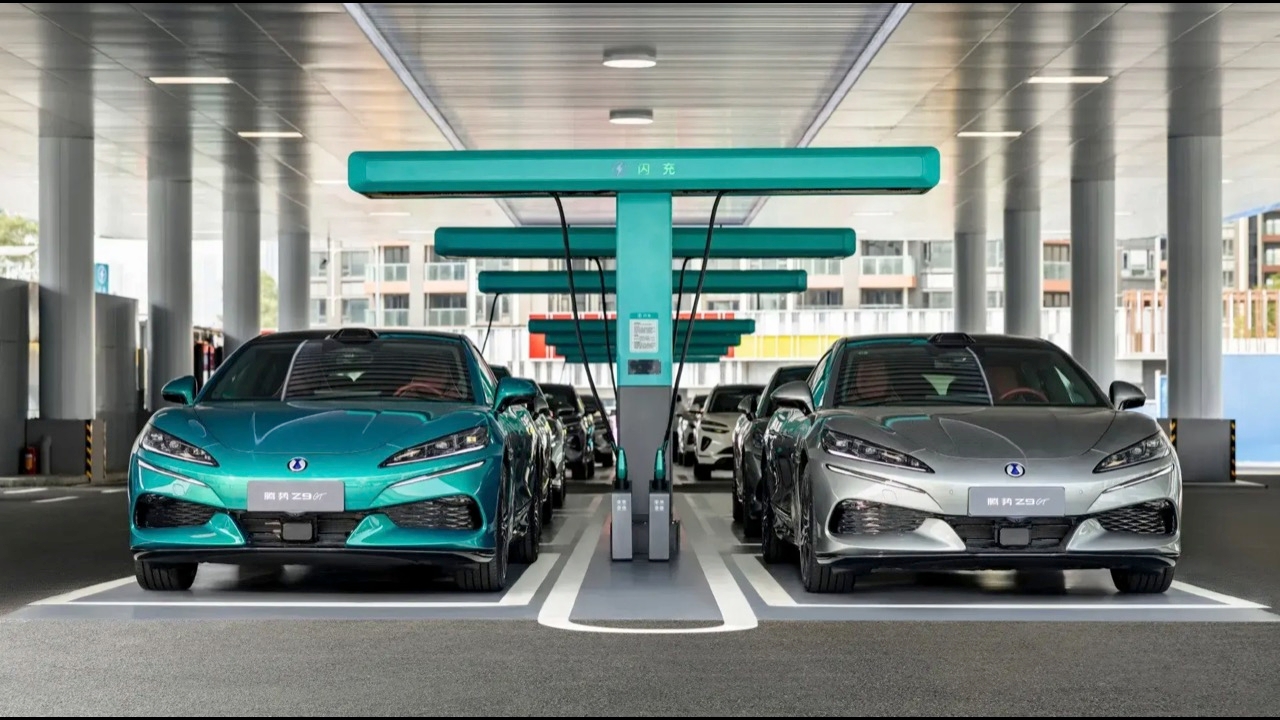
Many startups claim that today they can solve the problem of charging electric vehicles as quickly as stopping to refuel at gas stations. However, it hasn't become widespread or a reality due to two main reasons: first, the battery chemistry itself, and second, achieving a sufficient number of compatible vehicles to justify investing in charging station networks. This has posed a challenge, but now BYD claims to have the answer. Founded originally as a battery manufacturer, the core of the brand remains so, and it continues to accelerate car sales in Thailand. The timeline for deploying high-speed 'Flash Charging' stations remains to be seen.


BYD launched the Flash Charging Ultra-Fast technology boasting a maximum power of 1,500 kW on a high-voltage architecture (1,000V - 1,500V), paired with the Blade 2.0 battery. Rapid charging stations in China use an energy storage system (BESS Storage + Charging) with 200–300 kWh per charging point to prevent impacts on the main electrical grid's peak load. For international expansion including Thailand, BYD plans to start rolling out Flash Charging infrastructure abroad by late 2026. In Thailand, BYD collaborates with existing charging service providers such as PEA VOLTA, EleX by EGAT, OR EV Station PluZ, and dealer service centers rather than heavily investing in its own charging network.

In reality, installing Flash Charging in Thailand requires advanced electrical engineering due to grid constraints, especially for 1,500 kW or Mega-watt chargers. Without integrated energy storage batteries, costs for extending grid areas and installing transformers per station would be very high. BYD's main popular models in Thailand, like Atto 3, Dolphin, and Sealion 5 DM-i, support DC charging between 70 kW and 150 kW. High-voltage Flash Charge systems of 800V-1000V+ will be reserved for top models or premium brands within the group, such as Denza Z9GT or Yangwang.
If there are updates on the official launch of pilot charging stations in Thailand, information will be gathered and provided again.

This charging station can charge the Denza Z9 GT from 10% to 70% in just 5 minutes, adding about 74 kilowatt-hours (kWh) of electrical energy. If more is needed, it can charge from 10% to 97% in only 9 minutes. The Flash Charge system delivers up to 1,500 kilowatts (kW), yes... 1.5 megawatts. To reduce the huge electrical load on the grid, the charging unit includes stationary buffering batteries on-site, supplemented by solar panels at the location. The charger still uses the standard CCS connector.

BYD vehicles continue to use the 'Blade Battery' architecture, which means employing LFP (Lithium Iron Phosphate) chemistry and a cell-to-pack structural layout, but with continuous refinements over six years in materials, internal chemistry, and cooling systems to enhance durability. The main enemy of batteries charged at high speed is heat, as high current charging generates significant heat, damaging battery cells. BYD addresses this issue with a three-pronged approach:
Reducing the electrical resistance inside battery cells to minimize heat buildup.
Enhancing battery cells' ability to withstand higher temperatures more effectively.
Improving and developing more efficient cooling systems.

The reduction in resistance is achieved by using an ultra-thin separator layer, requiring nanoscale engineering and structural optimization. Both the anode (negative electrode) and cathode (positive electrode) have been improved for optimal lithium-ion charge and discharge efficiency. BYD states this results in new battery packs that better endure repeated fast charging than current models. Moreover, energy density has slightly increased. However, media like myself remain skeptical until new brand batteries from this Chinese giant are tested and verified.

BYD states there are no restrictions on other car brands using these Flash Charging stations. However, charging speed limits inherent to each vehicle remain. For example, if your car requires 40 minutes to charge on a 150 kW charger, that time will not shorten. Therefore, BYD is considering measures like limiting charging times in China or increasing fees for vehicles parked too long, although specific details have not yet been disclosed.