

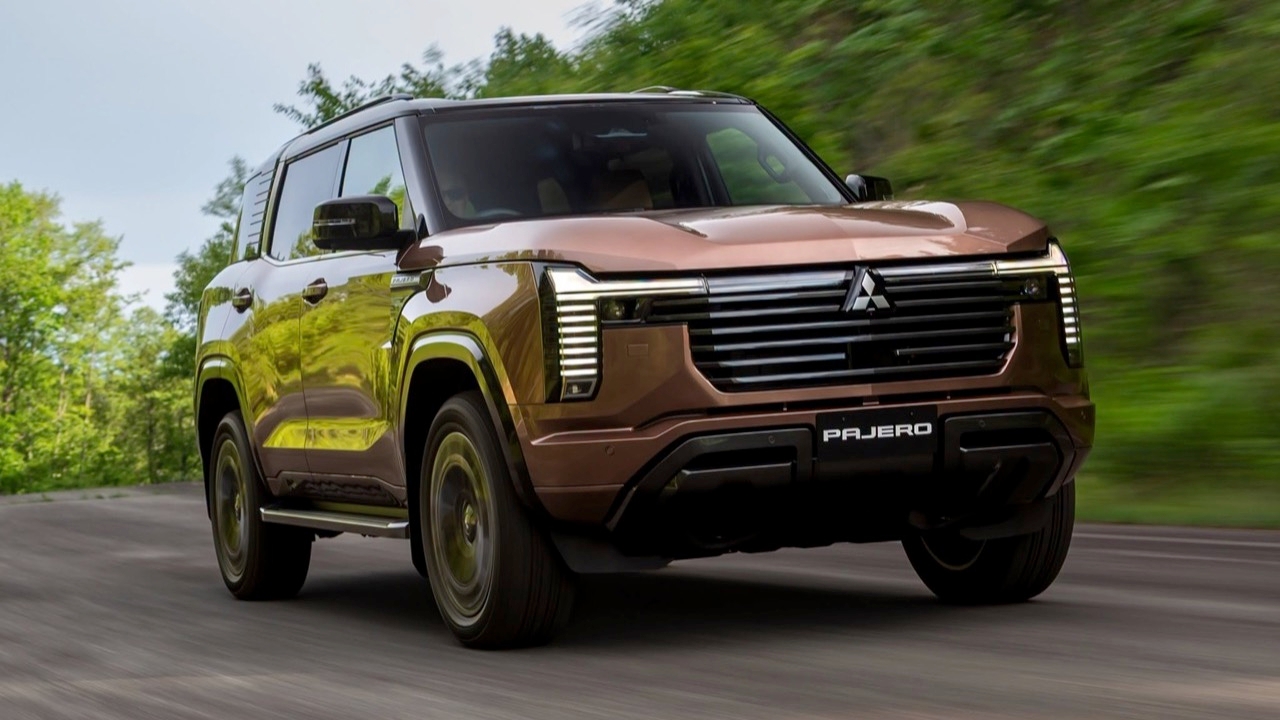
Mitsubishi Motors officially launched the All-New Mitsubishi Pajero Generation 5, marking the model's return without the 'Sport' suffix. The launch on 2 September in Japan was unusual, debuting in its homeland while the vehicle is assembled in Thailand. The Japanese brand has faced challenges over the past two years due to aggressive competition from new energy vehicles from China.


Continuing a new chapter of the legend, after the fourth-generation Pajero (NS-series) ended production in 2021, this new model fills the gap in the Thai and Australian markets, where the Pajero Sport was discontinued in 2025.


This production strategy marks the first time Pajero will be assembled in Thailand, sparking debate in international automotive media focused on the production base. Traditionally, the flagship Pajero sold globally has been manufactured in Japan. However, the fifth generation moves production to Mitsubishi’s Laem Chabang industrial estate in Thailand, sharing the assembly line with the Triton pickup, leading to divided opinions.
This elevates Thailand’s production base to a key global hub for the flagship Pajero. Sharing platforms and production lines with the Triton has led Australian media to speculate it may be positioned more as a Pajero Sport replacement—originally based on the Triton and recently withdrawn from the Australian market in 2025—rather than a true large-body direct lineage Pajero.


The new Pajero features a larger, boxy design reflecting a rugged, tough image true to its off-road DNA. A major technical highlight is the return to a ladder-frame chassis (body-on-frame) after two generations (3rd and 4th) had switched to a monocoque body with integrated chassis for a smoother ride. The powertrain uses a turbo diesel engine optimized for low-end torque to align with clean energy trends and improve fuel efficiency. The hybrid engine remains undisclosed. Dimensions are 4,920 mm long, 1,925 mm wide, 1,910 mm tall, with a 2,870 mm wheelbase, 230 mm ground clearance, 5.8-meter turning radius, approach angle of 30.4°, departure angle of 22.6°, breakover angle of 25.8°, and a 52:48 weight distribution.


The return of the All-New Mitsubishi Pajero 2026 is more than a routine facelift; it is a complete overhaul with Thailand as the main production base to directly challenge rivals in the rugged SUV segment. However, competing against Chinese brands will be tougher than before, as Chinese vehicles have visibly captured much of the market share. The iCAUR V27’s pricing is expected to impact Pajero sales significantly, as the Chery Group is unlikely to allow the majority share of this segment to return to a once-dominant brand.

The New Pajero 2026 platform is adapted from the sixth-generation Triton pickup, heavily modified with a switch to a rear multi-link coil spring suspension replacing leaf springs. This is the first Pajero produced in Thailand, sharing production with the Triton. This has led many to view it as more of a Pajero Sport successor, which was itself derived from the previous Triton generation and assembled in Thailand. Similarly, the Ford Everest shares a platform with the Ranger rather than being viewed as a direct fifth-generation Pajero lineage, which had been produced exclusively in Japan until now.

What engine powers the 2027 Mitsubishi Pajero?
It uses a 2.4-liter 4-cylinder diesel engine, code 4N16, with a Wide-Range Single Variable-Geometry Turbo (VGT), producing up to 204 horsepower and 480 Newton-meters of torque. The transmission is an 8-speed automatic with Sport Mode and Sequential Shift, paired with the S-AWC (Super All Wheel Control) full-time 4WD system. This engine is borrowed from the Triton Athlete model, while the 4WD system is an evolution of the Super Select 4WD-II.
The new Pajero launches with a 2.4-liter 4-cylinder turbo diesel engine, the same version used in the Triton, delivering 150 kW (204 hp) at 3,500 rpm and 480 Nm of torque between 1,500 and 2,750 rpm. The 8-speed automatic transmission is reportedly new internally, tuned for higher torque output in this model. The drivetrain features the updated Super All Wheel Control system, an advancement over the previous Super-Select II 4WD. Overall, it resembles the Pajero Sport's previous diesel biturbo engine but offers more power than the former single-turbo diesel in Pajero Sport (133 kW / 430 Nm) and the 3.2-liter DI-D engine of the fourth-generation Pajero (141 kW / 441 Nm), enabling superior towing capacity rated at 3,500 kg.

The new Pajero revives the legendary off-road model name, but to succeed in Thailand—where the PPV SUV segment faces intense pressure from Chinese brands—it must be priced below the leading 7-seat off-road SUVs like the Fortuner, MU-X, and Everest. It does not aim to directly compete with larger, more affordable models such as the Chery iCAUR V27, which will start at approximately 1.1 million baht. The new Pajero is expected to be priced higher than before.
This is due to upgrades in technology, safety systems, and convenience features compared to both the older Pajero and Pajero Sport models. It includes a digital instrument cluster that replicates the iconic three-analog gauge layout (Multi Meter) that was characteristic of previous Pajero generations.


The All-New Mitsubishi Pajero combines a ladder-frame chassis and the Super-Select II 4WD system with a turbo diesel engine technology derived from the top-tier pickup, extensively refined (though the engine and transmission are described as new, following Japanese standards). Manufactured primarily in Thailand, this underscores the importance of the Thai production line and sends a clear warning to competitors in the SUV market that Mitsubishi is ready to reclaim its throne. However, a significant challenge remains in the form of the soon-to-be-priced iCAUR V27.