

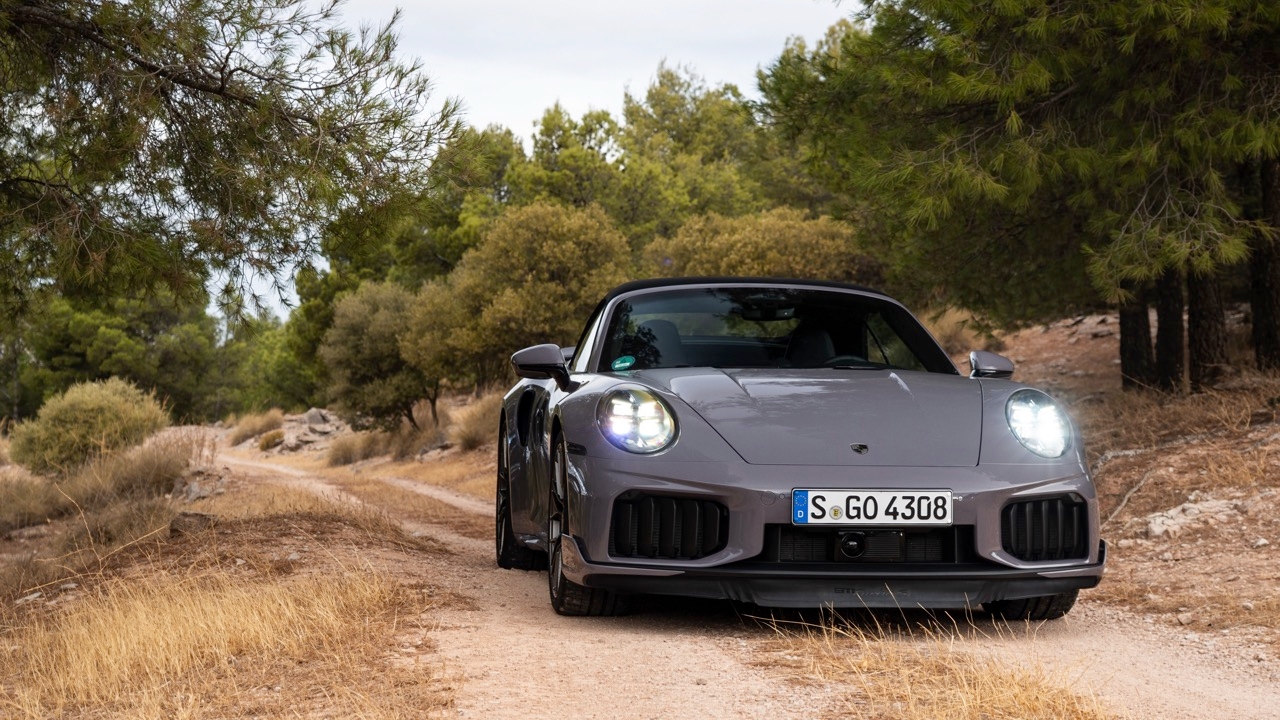
This is the newest, most powerful version, packed with the most technology, infused with the legendary Porsche 911 Turbo madness, identifiable by the distinctive 'S' suffix alone. There is no base model option. This car contains more than just the standard twin turbochargers and massive boost pressure formula. The all-wheel drive remains, as does the signature rear-mounted flat-six engine, practical for daily use. But this time, it hides a dark secret. Don't be fooled by its exterior appearance—this is not a GT family car with an oversized rear wing that often looks ostentatious when going grocery shopping. Instead, it looks refined and polite, unassuming as a regular 911 to passersby. Yet, it is like a serial killer often described as a quiet, unremarkable person with no troubles. Its ordinary looks hide a ruthless capability to shred tires mercilessly on back roads.


Naturally, the 911 Turbo S is extremely powerful, but not in the 1,000-horsepower range common nowadays, since those figures are often just for show and not practical for everyday acceleration. At its core is a 3.6-liter flat-six engine mounted at the rear, compressed and flattened to fit. Porsche engineers have pushed to incorporate new technology. The turbocharger system is electric (e-Turbo), with an electric motor mounted behind the compressor wheel on the turbo shaft. Although smaller than the single turbo in the standard T-Hybrid model, it uses twin turbos to generate maximum boost pressure.


The electric motor precisely and quickly controls the compressor's rotation without waiting for exhaust gas pressure like older turbos, completely eliminating turbo lag. When boost is not needed, this motor acts as a generator, recharging the 1.9 kWh battery. This battery powers the upgraded T-Hybrid system, which includes an 80-horsepower electric motor producing 190 Newton-meters of torque, integrated into the 8-speed PDK automatic transmission to enhance responsiveness.


The pure engine alone produces about 630 horsepower, but when the entire system works together, the official combined output reaches 701 horsepower with full torque of 800 Newton-meters. These numbers are not a simple sum, due to Turbo S's power delivery mechanism. It accelerates from 0-100 km/h in just 2.5 seconds with a top speed of 321 km/h. Remarkably, it can achieve this acceleration comfortably on slippery roads or even in heavy rain. Mid-range torque surprises owners of 1,000-horsepower electric cars, delivering power smoothly from 2,000 to 7,200 rpm, with a flat torque curve like a school dining table. Porsche usually downplays engine numbers, but this is truly a demon-possessed engine.


The suspension uses an electro-hydraulic chassis control system to manage shock absorption, working with Porsche's all-wheel-drive system capable of sending up to 500 Newton-meters of torque to the front wheels. It also features the Porsche Traction Management (PTM) stability system, rear-wheel steering, and numerous Porsche 911 Turbo engineering codes. There are four main driving modes, offering a car that can smoothly cruise in the city with a premium sound system for relaxed listening, yet instantly transform to race spirit performance—a true dual-personality vehicle.

The front brakes have 10-piston calipers with 420 mm ceramic discs, and the rear brakes have 4-piston calipers with 410 mm discs, stopping the car faster than expected. Yet braking isn't the only highlight. The remarkable stability, agility, and confidence provided by the system and mechanical components are overwhelming. Simply put, this Turbo S feels like a superhero, forgiving driver mistakes with ease. The Nürburgring Nordschleife lap time shows this 911 Turbo S is 14 seconds faster than the previous model, clocking about 7 minutes and 3 seconds. This is a significant improvement on a challenging track resembling real roads more than a race circuit.


Inside, it is a luxuriously appointed 911 with electrically adjustable sport seats embossed with the 'Turbo S' logo. A small plaque is on the console, carbon fiber weave is special, and Turbonite-colored accents adorn window frames and exterior badges. Overall, it resembles a fully optioned 911 GTS but with more storage space in the front trunk than expected. The Coupe model comes standard without rear seats to increase cargo space, but rear seats can be added at no extra cost. The Cabriolet launched simultaneously includes rear seats as standard, with sales split about 70/30 favoring the Coupe. The interior features all necessary technology, premium materials, and top-level craftsmanship.


A key feature of the 911 Turbo is its less visually aggressive stance compared to the 911 GT2 family, and this new model maintains that concept. Owners get exclusive wheel designs, a front packed with active aerodynamic components that open and close, a redesigned rear bumper, Turbo Active rear spoiler, and widened wheel arches—45 mm wider in front and 25 mm at the rear. The front features vertical fins on the lower parts that open for cooling or close for aerodynamic effect, a retractable front splitter, and underbody flaps that reduce front lift or channel cooling air to the brakes.

When it rains, the diffuser flaps close to prevent brake discs from getting wet and losing efficiency. The rear spoiler raises and retracts as needed, with winglets at the ends resembling aircraft wingtip devices. The exhaust pipes and tips are made of titanium with a new design; the standard tips are hexagonal with chamfered edges, but an optional pair of oval dual tips is available. The logo and window frame trims use the exclusive Turbonite shade, with overall details neatly refined without appearing overly aggressive.

The word 'fast' feels too mild to describe this car. The Turbo S is not as razor-sharp or surgically precise as the GT3 RS on the track but excels at 'magical deception,' warping from one place to another instantly without anyone noticing. The engine’s power is terrifyingly intense, while the suspension remains steadier than the speed in use suggests. You'll approach every corner 32 km/h faster than expected and stop quicker than imagined, thanks to ultimate braking power. It is a stable car that inspires confidence and makes the driver feel instantly more skilled. Yet, this is the danger Porsche builds into itself—it encourages arrogance, making one believe they can do anything with it, which is not always true. The real task is to stay calm and use the throttle wisely, as the Turbo S needs throttle input to allow the suspension and electronics to perform perfectly. Then just grip the steering wheel firmly! The perfectly linear power delivery of the flat-six engine may reduce some raw appeal but is unmatched for speed and control.


This is an honest, no-exaggeration description. The most impressive aspect is the 'dual personality' in one car. You can crawl in traffic, cruise motorways, or main roads, fully aware of the hidden power beneath the 911 Turbo S’s calm exterior—and ultimately, it may intimidate you. All 911 models except the GT3/GT3 RS are daily drivers, with a manageable size. The best part: the 911 Turbo S has always been a true road car, shining brightest in this role. It is a twin-turbo coupe that can run on race tracks faster than most cars worldwide. In fact, an average driver might even post a quicker lap than a GT3 RS. On unfamiliar roads, its blend of confidence and performance is unrivaled. This is the fastest sports car for unseen roads, unmatched by any competitor, placing the Turbo S at the pinnacle. Furthermore, its 27,900,000 Baht price point suddenly seems like a good value.
Technical specifications
Porsche 911 Turbo S 2026 Coupe starting at 27,900,000 Baht
Engine: 3.6-liter flat-six twin electric turbo (+ T-Hybrid electric motor)
Power: 701 horsepower / Torque 800 Newton-meters (590 lb-ft)
Transmission: 8-speed PDK automatic, all-wheel drive (AWD)
Performance: 0-100 km/h in 2.5 seconds
Top speed: 321 km/h (200 mph)
Curb weight: 1,725 kilograms