

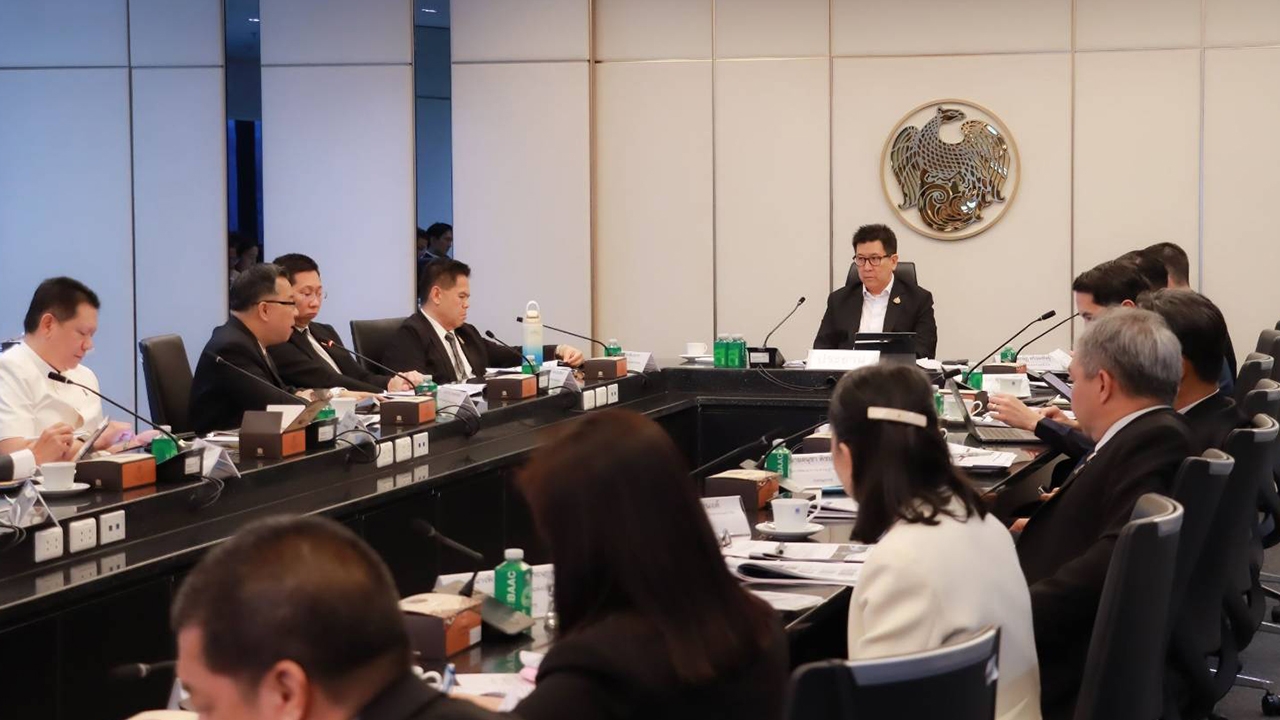
The EV board approved the principle of restructuring excise taxes on electric vehicles, adopting the concept "more benefits to the country, pay less tax." Imported EVs without factories in Thailand will face higher taxes, while domestically produced vehicles will receive graduated tax rates based on investment, employment, and the use of Thai parts. This aims to create fair competition and maintain Thailand's status as a global automotive production base.
On 10 Sep 2026, Mr. Narit Therdsteerasak, Secretary-General of the Board of Investment (BOI) and secretary to the National Electric Vehicle Policy Committee (EV Board), revealed that the EV board meeting, chaired by Deputy Prime Minister and Finance Minister Mr. Aeknithi Nitithanprapas, approved the principle of restructuring excise taxes on electric vehicles.
The main goal is to use tax measures as a mechanism to balance imported vehicles with those produced in Thailand while encouraging automakers to increase investment, production, use of domestic parts, and employ Thai workers to maintain Thailand's position as a global automotive manufacturing hub.

The new approach sets tax rates differentiated by the economic benefits each manufacturer generates for Thailand, including investment value, production volume, proportion of local parts, employment, and workforce skill development.
Electric vehicles imported from abroad by importers without manufacturing plants in Thailand will be subject to higher tax rates to ensure fair competition with operators who invest in production bases and supply chains within the country.
Manufacturers with existing factories in Thailand who need to import certain models for market testing will have import volumes regulated, linked to the economic value that manufacturer creates domestically.
This approach reflects the principle of Investment-Driven Import, which does not block vehicle imports but seeks to tie imports to actual investment and production plans in the country.
For electric vehicles manufactured in Thailand, tax rates will be progressively reduced based on production levels and domestic value addition, especially the use of key electronic components and raw materials produced locally.
Vehicles produced domestically with a high proportion of Thai parts will have different tax rates compared to those using moderate domestic parts or not yet able to use key electronic components made in Thailand.
However, some vehicle groups with low production volumes but potential for increased use of domestic parts in the future, such as premium vehicles, will be considered appropriately to avoid tax structures becoming obstacles to investment and new product development.
This tax adjustment principle includes five key approaches: linking imports to actual investment, promoting Thailand as an EV production and export base, increasing domestic component value, ensuring fair competition, and strengthening Thai parts manufacturers.

The meeting also approved the appointment of two subcommittees to support the comprehensive transition to the electric vehicle industry.
The first is the Subcommittee on Promoting Modern Vehicle and Parts Manufacturing Industry, chaired by the Minister of Industry, responsible for developing the production chain, managing used EV batteries, and systematically disposing of vehicle scrap.
The second is the Subcommittee on Developing Infrastructure Systems to Support EV Charging, chaired by the Minister of Energy, tasked with promoting sufficient charging stations and systems to meet demand and improving related regulations.
Additionally, the EV board assigned the Permanent Secretary of the Ministry of Finance to study measures to promote production and commercial use of electric vehicles, including electric motorcycles.
Data from the first seven months of 2026 show that battery electric vehicles (BEVs) had 126,950 registrations, an 88% increase from the same period last year.
Meanwhile, the xEV group, including BEV, HEV, and PHEV, accounted for 55% of all vehicle registrations, indicating that the Thai automotive market is clearly transitioning from internal combustion engines to electric energy technologies.
Regarding investment, as of 31 August 2026, the BOI reported promoting 189 projects in the EV industry and related businesses, with total investment value of 151.372 billion baht. Among these, battery manufacturing had the highest investment at 87.073 billion baht, followed by BEV production at 38.563 billion baht, and key parts manufacturing at 12.558 billion baht.
Investment-promoted EV charging station projects plan to install a total of 23,135 charging points, including 10,249 Quick Charge points, representing about 85% of the target of 12,000 fast charging points by 2030.
At the same time, automakers with production bases in Thailand—including Mitsubishi, Honda, Mazda, and Isuzu—plan to invest an additional 50 billion baht to develop new models, upgrade production lines with automation and robotics, and support HEV, MHEV, and various electric vehicle forms.
Mr. Narit stated that the global automotive industry is transitioning toward electric energy technologies, and Thailand must adapt to maintain the strength of its production base in the long term.
This excise tax restructuring is a crucial moment to balance imports with domestic investment, remaining open to technology but emphasizing benefits to Thailand through production, technology development, use of parts, and creation of quality jobs.