

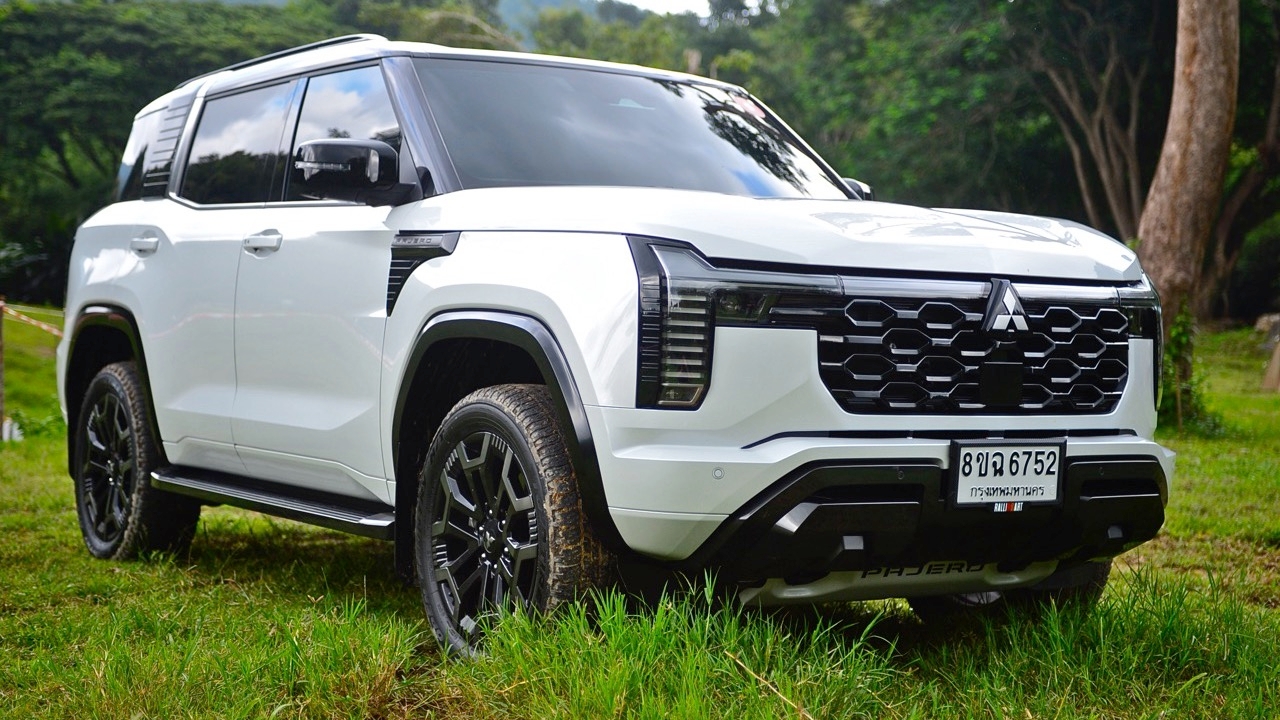
The Mitsubishi Pajero 2026 was launched on 2 Sep 2026 in Japan, with its Thai debut and price announcement scheduled for 19 Oct 2026. Recently, Mitsubishi invited media to test the New Pajero 2026’s performance and driving capability in Chiang Mai province. The New Pajero is an SUV for which Mitsubishi uses Thailand as a primary production base, serving both domestic sales and exports to markets including Japan, Australia, and New Zealand. Returning under the Pajero name, it now adopts a body-on-frame chassis structure and is sold alongside the Pajero Sport, which still has some stock available. The top 4WD model of the New Pajero 2026 is expected to be priced around 1,890,000 THB. Competition from Chinese brands using price wars means the sales landscape for new Japanese SUVs will be different going forward.


The Mitsubishi New Pajero 2026 emphasizes premium craftsmanship inside and out, delivering superior quality. This elevates the flagship SUV that has a legacy of ruggedness and global victories in events like the Paris-Dakar Rally. The exterior design draws inspiration from the toughness of past Pajero models, reinterpreted with a modern aesthetic. The interior is fully equipped with stylish, contemporary fixtures, including T-shaped front daytime running lights, a C-pillar design inspired by the original Pajero's roll bar, a central hood crease, and Dynamic Flow Light system on the top 4WD trim that illuminates when entering or exiting the vehicle. All exterior lights use LED technology with automatic headlight functions.


Standard equipment includes LED headlights and taillights, automatic headlight and high beam control, LED third brake light, front and rear LED fog lamps, LED daytime running lights, automatic cornering side lights, and LED parking lights. Front windshield wipers operate automatically, rear wipers have intermittent delay, side mirrors include LED turn signals and are electrically adjustable and foldable. The roof features rails and a shark-fin antenna, while rear door side steps open and close electrically with a hands-free system.


The dimensions of the All NEW Mitsubishi PAJERO (2026) flagship full-size SUV are: length 4,920 mm, width 1,925 mm, height between 1,900 and 1,910 mm, wheelbase 2,870 mm, ground clearance 230 mm, minimum turning radius 5.8 meters, approach angle 30.4 degrees, breakover angle 22.6 degrees, and departure angle 25.8 degrees.
Specifications for wheels, tires, fuel tank, and fuel efficiency of the Mitsubishi Pajero Sport 4WD model include 20-inch alloy wheels, Toyo Tire Open Country H/T 255/55 R20 107V tires, a fuel tank capacity of 68 liters, and an average fuel consumption ranging from 13.5 to 15.2 km/l on extended highway driving. Real-world mixed urban and suburban driving yields 11.5 to 13.8 km/l.


Inside the cabin, the dashboard design emphasizes horizontal lines to create a spacious feel, reflecting Japanese craftsmanship and meticulous detail to provide a luxurious passenger experience. The cabin is roomy, flexible, and upscale, offering a commanding driving position with clear visibility, modern and intuitive interface systems, and easy-to-read display screens.
The 2026 PAJERO’s interior is distinctly elevated in luxury, transforming its look into a modern Premium Rugged SUV. It features a two-tone color scheme of camel and black, with camel brown synthetic leather contrasted by black, enhancing openness and spaciousness with a premium European SUV ambiance. The cabin trim demonstrates precise craftsmanship, with soft-touch materials and stitched accents on the dashboard and door panels, providing a premium tactile experience throughout. The panoramic glass roof/sunroof includes an electrically operated sunshade, adding to the cabin’s airy feel.


Included amenities include sound-insulating glass, a dark-tone interior, automatic climate control with independent rear controls and rear passenger air vents, an interior rearview mirror, panoramic glass roof, power windows with auto up/down for the driver’s side, LED front map lights, lighting for second and third row passengers, an electric power steering wheel adjustable in four directions (up/down and in/out), steering wheel controls for audio and phone, a display control switch on the steering wheel, a KOS smart key with engine start button.


The sport-style seats feature thick, high side bolsters that firmly support the body during cornering or off-road driving. Seats adjust electrically in 8 directions with power lumbar support to reduce fatigue on long drives. Memory seat settings for two drivers are available on the driver’s door panel. The seat surfaces have perforations for ventilation, supporting the ventilated seat system suitable for Thailand’s climate. Seat upholstery uses soft synthetic leather. Both front seats have large backrests, electric adjustment in 8 directions, and lumbar support. The second-row seats recline and slide forward/backward, while the third-row seats recline and fold 50:50. The second row can slide 150 mm to increase legroom or ease access to the third row. The third row offers ample headroom and shoulder space. Cargo capacity with all seats in use is 519 liters, plus a 10-liter underfloor storage compartment.
Cup holders are integrated into the central console near the air vents and rear armrest, which also includes cup holders. Dual front sun visors feature vanity mirrors with adjustable LED lighting. There’s a sunglasses holder, rear seat storage compartments, four grab handles near the doors and six ceiling grab handles. The touchscreen system supports wireless Apple CarPlay and Android Auto. USB-C ports and a 12V DC power outlet are located on the front console. The top trim level offers a generous array of usable features.


The front console and digital technology include a Monolithic Dual Display—a large digital instrument cluster seamlessly connected with the central infotainment screen, offering a modern, sharp, and easy-to-read interface. The new leather-wrapped four-spoke multifunction steering wheel provides a firm grip and includes controls for ADAS driver assistance and infotainment. A pop-out cup holder beneath the air vents is a thoughtful design allowing airflow to help keep drinks cool. The side leather trim features an elegantly embossed PAJERO logo.


Additional features include a 220V AC power outlet on the rear center console, wireless phone charging, and the Dynamic Sound Yamaha Ultimate audio system, which creates an immersive driving atmosphere. The cabin also features ambient lighting and Mitsubishi Connect technology offering automatic collision alerts, SOS emergency calls via a call center (eCALL), roadside assistance requests, theft and towing alerts, door and window lock status notifications, remote climate control, vehicle status reports, remote light and horn activation, vehicle location tracking, iCALL information support, trip logging, and adaptive cruise control.

The central console and controls for the Super Select 4WD-II drivetrain—the key selling point of the 4WD model—feature a robust and user-friendly design. The rotary dial controls the 4WD system with four main selectable modes.
2H: Two-wheel drive mode for normal roads, prioritizing fuel efficiency.
4H: Full-time four-wheel drive mode suitable for wet or slippery roads, enhancing traction.
4HLc: Four-wheel drive mode with center differential lock, ideal for dusty or muddy terrain.
4LLc: Four-wheel drive with low-range gearing and center differential lock for off-road use on steep or rocky surfaces.
The Drive Mode Selector button in the center of the 4WD dial allows selection of seven off-road driving modes (Gravel, Mud/Snow, Sand, Rock). The vehicle also includes an electric parking brake (EPB) with Auto Brake Hold, a leather-wrapped gear lever for comfortable grip, and front USB Type-C charging ports.
Comfort and comprehensive features include Memory Seats, Power Lumbar Support, a Panorama roof, and ventilated seats—offering the most complete package in its class. The placement of controls such as the 4WD dial and electronic parking brake is ergonomic for easy operation while driving. The New Pajero 2026 uses soft-touch materials and premium stitching, shedding the traditional ruggedness associated with previous PPVs.
Safety features include blind spot monitoring, lane change warning, forward collision warning with speed reduction assistance, forward collision prediction, lane departure warning and prevention, front vehicle departure alert, cross-traffic alerts when reversing, rear parking sensors, emergency accelerator override in case of mistaken pedal use, a 360-degree camera system with front underbody view, moving object detection, automatic braking for cross-traffic while reversing, lane keeping assistance, and traffic sign recognition.

The new Pajero is powered by a 2.4-liter four-cylinder diesel engine, code 4N16, a new generation evolved from the Triton’s twin-turbo engine. It delivers the same maximum output of 150 kW (204 hp) but with an increased torque of 480 Nm, up 10 Nm. The engine switches from a bi-turbo to a single turbocharger with a water-cooled intercooler mounted atop the cylinder head. This redesign simplifies the system, reducing complexity and parasitic drag by adopting the latest variable geometry turbocharger technology.

Regarding the engine development, the forced induction system was changed from bi-turbo to a wide-range single variable geometry turbo (VGT). The limitation of the bi-turbo system in the Triton—using a small turbo for low rpm and a large turbo for high rpm—was its added weight, complex exhaust plumbing with bypass valves, and higher engine bay heat. The new single wide-range VGT in the 4N16 Gen II uses a single turbo with a broad operating range, controlled by an electric actuator adjusting the turbine vanes. It generates 480 Nm of torque at low rpm (1,750 rpm) by narrowing the exhaust vanes to increase exhaust gas velocity, simulating a small turbo for quick boost. At higher rpm (3,500 rpm), the vanes fully open to reduce backpressure, supplying ample air for peak power of 150 kW (204 hp) without needing a second turbo, thus simplifying the forced induction system.

The common-rail fuel injection pressure has been increased to compensate for the single turbo’s air compression, with solenoid/piezo injectors upgraded to handle over 2,500 bar. Multi-stage injection (pre-, main-, post-injection) is employed. The piston crown design has been revised to optimize air swirl and improve fuel-air mixing, enhancing thermal efficiency and reducing soot and carbon deposits. Mechanical friction and heat management improvements include reducing mechanical stresses and friction, with the single turbo reducing exhaust backpressure in the cylinder head, lowering power losses from pumping exhaust gases.

Friction-reducing coatings are standard, including a reinforced aluminum alloy cylinder block with diamond-like carbon (DLC) coatings on moving parts such as piston pins, valve lifters, and low-friction piston rings. A variable displacement oil pump adjusts oil flow based on engine speed and load, reducing mechanical drag at steady cruising speeds.


The engine is paired with an 8-speed automatic transmission called AT Synergy. This 8-speed gearbox provides closer gear ratios for smooth engine operation and maintains peak torque of 480 Nm between 1,750 and 2,500 rpm through all gear changes. This eliminates the need for a complex bi-turbo system. Upgrading the 4N16 to single VGT leverages the latest electric actuator technology and 8AT to reduce weight and complexity. The result is 10 Nm more torque (480 Nm total), unchanged 204 hp, lower engine heat, fewer components, and enhanced durability for heavy use or off-road/towing.

These performance figures surpass the single-turbo diesel in the Pajero Sport (133 kW / 430 Nm) and the 3.2-liter 4-cylinder DI-D diesel in the previous Pajero generation 4 (141 kW / 441 Nm). Compared to competitors in the large SUV segment, the Ford Everest offers a 2.0-liter 4-cylinder diesel turbo (125 kW / 405 Nm) and a 3.0-liter V6 diesel turbo (184 kW / 600 Nm). Toyota provides a 2.8-liter 4-cylinder diesel turbo (150 kW / 500 Nm). The Isuzu MU-X offers 2.2-liter (120 kW / 400 Nm) and 3.0-liter (140 kW / 450 Nm) diesel engines.
The new engine is noted for smooth operation, improved control, faster response, and higher efficiency. It meets Euro 6d emissions standards for the first time among Mitsubishi engines, thanks to features such as a water-cooled intercooler, dual-loop exhaust gas recirculation (EGR), AdBlue selective catalytic reduction, and a switch to an electric cooling fan.
The automatic engine stop-start system (Automatic Idle-Stop) enhances fuel efficiency in stop-and-go traffic. The latest variable geometry turbocharger boosts mid-range torque and throttle response in commonly used speed ranges. The 8-speed automatic transmission has been lightened compared to the Pajero Sport’s previous version, with a wider gear ratio spread to improve responsiveness and reduce fuel consumption. The fuel tank capacity is 80 liters. The 4WD model features a low-range transfer case, rear differential lock, and Super Select II four-wheel-drive system.


The New Pajero returns to a ladder-frame chassis construction to increase torsional rigidity, making it more suitable and a replacement for the Pajero Sport. The ladder-frame chassis is upgraded to deliver rugged off-road durability combined with modern refinement for quietness and cabin comfort. The new chassis is significantly more rigid against twisting than the previous Pajero Sport, working with long-travel suspension, increased track width, responsive shock absorbers and stabilizer bars, plus electric power steering (EPS).


The front suspension uses double wishbones with coil springs, while the rear suspension employs a five-link setup with torque arms and coil springs. Both front and rear chassis structures are Pajero-specific, with the front double wishbone improving lateral stiffness and the rear multi-link balancing off-road capability with ride comfort. Rear drum brakes are replaced by discs, the turning radius is slightly reduced, and the driver’s eye-point is raised to enhance all-around visibility. The front door structure and A-pillar angle have been redesigned to be more upright.


Towing capacity is rated at 3,500 kg, exceeding the Pajero Sport by 400 kg and the previous Pajero by 500 kg. Trailer Load Assist (TLA) detects trailer sway and independently modulates power delivery and braking to each wheel to stabilize towing. The roof load capacity is 300 kg static and 100 kg dynamic, supporting secure installation of roof racks and accessories.


On the road toward Mae Rim district in Chiang Mai, the New Pajero 2026 top 4WD impresses immediately inside and out. Inside, the driving position remains excellent, with the driver as the central focus of controls. The larger seats slightly restrict reaching the seatbelt latch, but this is manageable with use. Starting the engine, selecting D gear, and gently accelerating initiates movement. The test route through city traffic demonstrates the flagship SUV’s balanced overhangs and sub-3-meter wheelbase provide nimble handling in congested Chiang Mai traffic. At low speeds, noise insulation is commendable; diesel engine noise is notably reduced. Acoustic laminated double-pane glass and soundproofing materials make the cabin very quiet. Overall, urban agility, low-speed noise control, and initial torque from traffic light starts all exceed expectations.


The 2.3-ton weight of the New Pajero 4WD imposes some acceleration constraints. Overtaking requires planning due to the increased mass compared to previous models. The 480 Nm torque suits steady cruising; however, full-throttle acceleration response is somewhat sluggish. Nonetheless, steering comfort and control ease improve the driving experience. If not driven aggressively, the New Pajero 2026 4WD offers a smooth, comfortable ride. On undulating concrete roads, rear passengers feel the spring and shock absorber movement, likely set for a balanced ride—not too soft or stiff. Briefly pushing speed to 140 km/h tests stability; the vehicle remains confidence-inspiring, cornering smoothly without strain. Electric power steering gains some weight at speed to avoid feeling too light. The front double wishbone suspension combined with Toyo tires performs well, while the rear multi-link suspension manages uneven out-of-town roads less smoothly.
Ideally, 550 Nm torque would improve overtaking performance, but 480 Nm suffices for daily use. The New Pajero offers comfortable control and front-seat comfort. The 8-speed transmission shifts smoothly, with wide gear ratios allowing near-peak torque delivery at just 1,750 rpm. This results in smooth takeoffs, less suited for impatient drivers but enjoyable for steady cruising. Some quick drivers may find the torque slightly insufficient for rapid acceleration. On winding roads at Samoeng, vehicle dynamics and weight transfer balance excellently. Wheel size is moderate, and factory tires perform well. The standout feature is exceptional cabin quietness.

Now, let's explore what Yamaha, a leading audio brand, contributed to the Mitsubishi Pajero 2026—a system I truly appreciate.
The Dynamic Sound Yamaha Ultimate audio system in the Mitsubishi Pajero 2026 was developed through close collaboration between Mitsubishi Motors and Yamaha, combining Yamaha's world-class expertise in acoustics, stereo sound, and musical instruments with automotive engineering.

Starting with the design of a 12-speaker layout and dual amplifiers, the system uses an 11-channel dual amplifier along with Yamaha's Digital Signal Processor (DSP). Originally developed in the 1990s for Audio Video Receivers (AVRs) in home theater systems, the DSP processes and amplifies signals from various sources, delivering power to 12 speakers arranged as a 3-way system on the front console to create a realistic soundstage.


Midrange speakers (Squawkers) number three, each 90 mm, installed on the front console. The IP Top Speaker uses a diaphragm developed with technology derived from Yamaha's flagship NS-5000 speakers, incorporating ZYLON® fibers. This delivers accurate, detailed, and emotionally rich vocal and instrument reproduction in the mid-frequency range. However, the system is selective about music source quality and is less suited for electronically dense music like EDM with rapid electronic drum hits, favoring acoustic instruments and powerful vocal performances from the 1970s and 1980s.


Tweeter speakers number four, 25 mm cones mounted on the front A-pillars and rear door panels. They use aluminum voice coils instead of copper, a Yamaha specialty. Aluminum voice coils are lighter and paired with high-power magnetic circuits, enhancing clarity and transparency of high frequencies while reducing distortion from poor original recordings.


There are four 160 mm woofers located in the front and rear door panels. These are precisely controlled to produce tight, dimensional bass without interfering with midrange frequencies.
A single 200 mm subwoofer is installed at the rear of the cabin. It uses Dual Voice Coil (DVC) technology, powered by a dedicated amplifier channel, producing deep ultra-low bass with powerful resonance.

During development, Yamaha’s sound engineers collaborated with Mitsubishi from the outset to design the vehicle’s body structure to function as a high-quality speaker enclosure. Door structures were modified with sealed inner panels, resin covers sealing service holes, and soundproofing materials to prevent sound leakage that could cancel out speaker output. Outer door panels were reinforced with special spot welds to reduce vibration. Steel beams were added along with vibration-damping sheets and weights to lower resonance when playing bass-heavy music.

Yamaha DSP tuning uses a proprietary digital algorithm that preserves analog sound quality. It compensates for distances and reflection angles of sound waves from glass and interior surfaces, raising the soundstage to eye level in front of the driver and passengers for balanced, immersive audio.
The system offers intelligent sound modes and environmental compensation.
There are four distinct sound character modes.
Signature mode delivers sharp, realistic sound with detailed instrument and vocal reproduction full of emotion.
Lively mode enhances brightness and rhythm, suited to pop and upbeat music.
Powerful mode maximizes bass and dynamic range, adding excitement during driving.
Relaxing mode softens tones for a soothing atmosphere, ideal for long journey background music.


The system features automatic volume and EQ compensation called Triple Compensated Volume.
Speed Compensated Volume (SCV) adjusts volume and equalizer settings automatically based on vehicle speed to mask wind and tire noise.
Rain Compensated Volume (RCV) tunes audio levels in response to windshield wiper operation to reduce rain noise interference.
Air-Conditioner Compensated Volume (ACV) adjusts volume and frequency response based on interior fan speed.

Yamaha’s Digital Signal Processor (DSP), adapted from home AV receivers, overcomes the physical and acoustic challenges inside a car cabin, such as reflective glass, sound-absorbing leather seats, and uneven distances between listeners and speakers.
Yamaha DSP’s processing chip and algorithms excel in several areas.
1. Timing and soundstage creation: The DSP precisely calculates distances from all 12 speakers to the listener’s ear positions for each seat, delaying sound emission by microseconds so all audio arrives simultaneously. The soundstage is elevated to eye level, replicating concert hall acoustics, positioning vocals and instruments as if on a stage before the console rather than sounding localized near door panels.


Enjoying music, the drive arrives at an off-road testing site with prepared hills and streams to evaluate the Super Select 4WD-II system.
Mitsubishi’s exclusive Super Select 4WD-II (SS4-II) system combines full-time and part-time four-wheel-drive advantages, working with the transfer case and rear differential lock to ensure effective off-road capability.

Super Select 4WD-II offers four main driving modes.
2H (2WD High Range): Rear-wheel drive mode for dry, smooth roads, reducing drivetrain load and saving fuel.
4H (Full-Time 4WD High Range): Power split 40:60 front to rear via center differential, suitable for wet or slippery roads and high-speed cornering without steering resistance (no Tight Corner Braking Effect). The center differential allows front and rear axles to rotate at different speeds.
4HLc (4WD High Range with Center Differential Lock): Locks the center differential to a fixed 50:50 power split, ideal for dusty, gravelly, slippery, or dirt roads requiring balanced traction.
4LLc (4WD Low Range with Center Differential Lock): Engages low-range transfer gearing and locks the center differential, delivering full torque at low engine speeds for steep climbs or water crossings.


Transfer case and torque multiplication operation.
In 4LLc mode, the transfer case uses the full low-ratio gearing.
Torque multiplication: The low gear ratio in the transfer case multiplies engine torque by over 2.5 times, providing immense low-speed torque to all four wheels without needing high engine revs.
Creep control assists smooth vehicle movement over large rocks, shallow streams, or deep mud, reducing wheel spin and preventing tire damage or vehicle instability on rough terrain.


Rear differential lock and off-road capability.
In extreme situations where a wheel loses contact with the ground or sinks into deep rocky or muddy spots (such as stream crossings with large boulders).
100% locking mechanism: When activated, the Rear Diff Lock electrically locks the left and right rear axles to rotate at the same speed regardless of traction loss on one side.
Addressing power loss: Normally, if a wheel is airborne, power transfers to the free-spinning wheel. Rear Diff Lock forces 100% torque to the wheel with traction, helping the vehicle pull itself over slippery rocks or out of water easily.


Integration with off-road modes (7 drive modes) and brake-based limited-slip differential (Brake Active LSD).
Beyond the SS4-II mechanical system, the vehicle employs electronic technologies to enhance performance.
Off-Road Modes (Rock, Mud, Sand, Gravel): Adjust throttle response, gear shifts, and wheel slip control to match terrain conditions.
Active Yaw Control (AYC) and Brake Active LSD: When Rear Diff Lock is off, the system applies brakes to spinning wheels to transfer torque to wheels with grip, improving traction and steering precision on streams or muddy surfaces.
4WD modes via SS4-II allow the driver to select from four drivetrain configurations.
2H (Rear-Wheel Drive): Rear-wheel drive for regular dry roads, optimizing fuel economy.
4H (Full-Time 4WD): Permanent four-wheel drive for enhanced traction and safety on wet or high-speed roads.
4HLc (Locked Center Differential): Four-wheel drive with locked center differential for semi-challenging off-road or muddy terrain requiring symmetrical power.
4LLc (Locked Center Differential with Low-Range Gear): Four-wheel drive with locked center differential and low-range gearing for heavy off-roading, steep climbs, or difficult obstacles.


Summary verdict.
The Mitsubishi Pajero 2026 stands out as one of the most valuable and practical SUVs for families and long-distance travel, with serious off-road capability. It offers quietness, smoothness, ventilated seats, Memory Seat, and Yamaha audio to make journeys enjoyable. The Super Select 4WD-II drivetrain combined with 230 mm ground clearance can tackle any terrain without modification. It uniquely balances urban luxury with rugged off-road strength, supported by widespread service centers and aftersales. Expected pricing starts under 1,590,000 THB for 2WD models, with the top 4WD likely around 1,790,000 THB—competitive pricing. Prices approaching 2 million THB could hinder sales.
Arkom Ruamsuwan
/ E-Mailchang.arcom@thairath.co.th
Facebookhttps://www.facebook.com/chang.arcom
https://www.facebook.com/ARCOM-CHANG-Thairath-Online-525369247505358/