

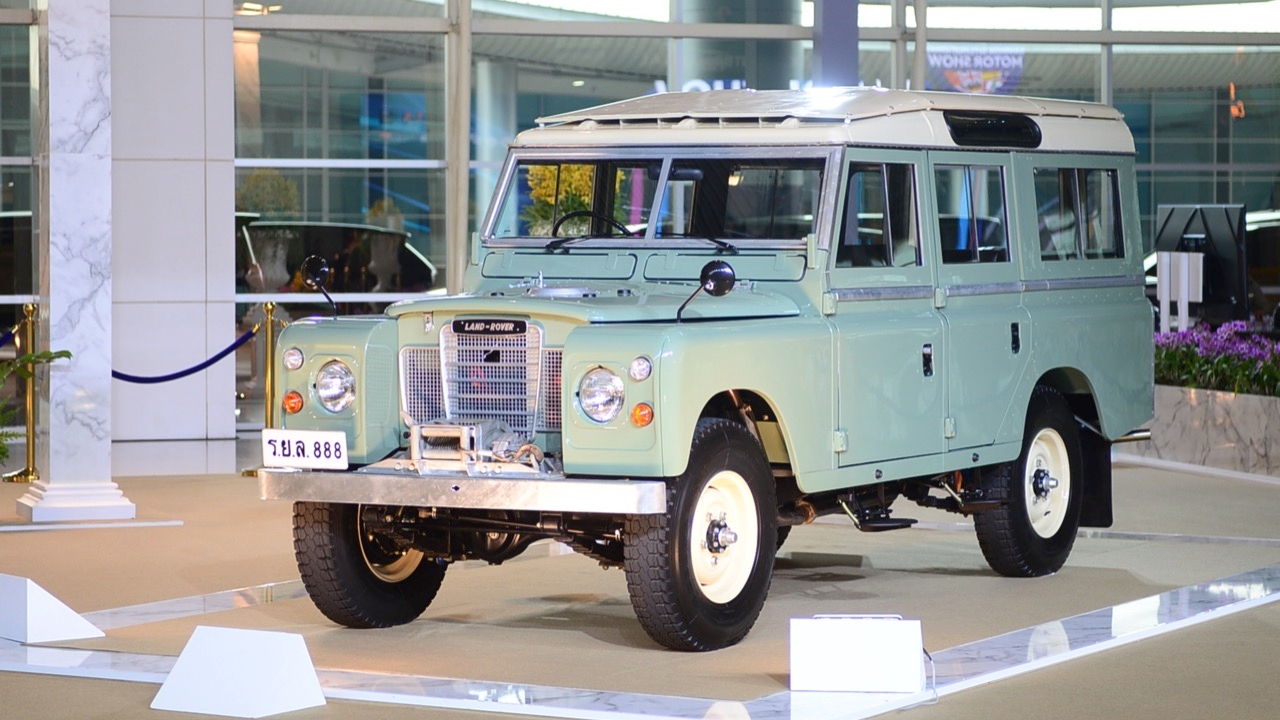
The royal vehicle รยล Land Rover Series 3 was a common presence in news photos of the royal activities of His Majesty King Bhumibol Adulyadej the Great, Rama IX. Around 1976, the Royal Household ordered this model for use in the Royal Office to serve as the King’s vehicle for visits to remote, hard-to-reach communities.


The royal vehicle รยล Land Rover Series 3 is the 109-inch Long Wheelbase (LWB) 5-door Station Wagon version, with a Birmabright aluminum body. It was exhibited at the 46th Bangkok International Motor Show (2025). This early multipurpose vehicle was highly resistant to rust and corrosion, making it well-suited for harsh conditions and difficult off-road routes. Its distinctive grille and headlights recall the inset headlights of early Land Rover Series II / Series IIA models (produced 1958–1969) before headlights were moved to the fenders in late Series IIA and Series III models to comply with international safety regulations. The safari roof features a dual-layer design with curved upper Alpine windows and ventilation slots below the roof, designed to reduce cabin heat accumulation when stationary or driving in intense sunlight.
The front bumper includes a winch assembly, serving as a recovery tool for off-road rescue or extraction on rugged trails.
The round side mirrors are mounted on the front fenders, consistent with the era’s design.
Foldable side steps are installed beneath all four door sills to facilitate entry and exit from the vehicle, which has a high ground clearance.
At the rear, the spare tire is mounted on the safari-style tailgate, alongside a towing hitch and mud flaps featuring the authentic Land Rover logo, custom-fitted for the model.
The standard wading depth for the royal Land Rover Series III is 500 millimeters (about 50 centimeters or 20 inches), allowing it to ford water roughly up to the midpoint of the wheel hub, approximately half the wheel’s height. This depth is considered safe without requiring special preparations before crossing streams or flooded areas.

The royal vehicle รยล Land Rover Series 3 109 LWB 5-door Station Wagon served as transportation for royal attendants accompanying His Majesty during work in remote areas throughout the 1960s and 1970s. At that time, roads to remote villages in northern, central, northeastern, and southern Thailand were mostly dirt, muddy, or mountain trails. The Land Rover Series III was a high-performance vehicle of the Royal Household, granted to officials to accompany royal visits, inspect Royal Projects, and plan water management. The registration prefix “ร.ย.ล.” stands for “Royal Vehicle,” a special series for royal and palace vehicles. Land Rover Series 3 vehicles with registration numbers ร.ย.ล. 888 and ร.ย.ล. 135 have been meticulously preserved and restored to pristine condition for display as memorials honoring the benevolence of King Rama IX, showcased in exhibitions and learning centers to commemorate the King's gifts to the people’s welfare.


Looking back to 7 September 1981, His Majesty King Bhumibol Adulyadej the Great traveled to visit villagers by royal Jeep Grand Wagoneer at Ban Cho Bakong, Moo 3, Puyo Subdistrict, Su-ngai Kolok District, Narathiwat Province. As the royal vehicle crossed a wooden bridge in the village, villagers—both Thai Buddhists and Thai Muslims—working in the rice fields came out to greet the King. His Majesty dismounted from the Jeep Grand Wagoneer and stood on the wooden bridge beside the royal Land Rover Series 3 109 LWB, observing the area and engaging in conversation with the villagers who had gathered to welcome him.


The royal vehicle รยล Land Rover Series 3 is a 109-inch series 3 5-door station wagon with four-wheel drive. Its aluminum alloy body was considered a high-performance off-road vehicle for its time, suitable for use in harsh terrain such as tropical rainforests and even deserts. The Series 3 was designed to resemble its predecessors, the Series 1 and 2 Land Rovers from World War II, with improved performance. It became widely popular among government agencies and private sectors, including the Department of Highways, Forestry Department, Royal Irrigation Department, and Ministry of Agriculture, due to its drivetrain’s superior capability to navigate difficult terrain compared to other vehicles of the era.
Land Rover is a British Leyland automotive brand from the United Kingdom, now under Tata Motors. The Series 3 model features a long wheelbase 5-door body sharing the same platform as the Series 2A Land Rover. Production began in 1971, with a total of 440,000 units built. This British off-road vehicle is notable for its aluminum alloy body to reduce weight, a cast steel chassis for strength, and design suited to challenging terrain. The Series 3’s headlights were relocated to the front fenders, accompanied by round turn signals, and the grille bears the Land Rover emblem made from aluminum alloy.

The Land Rover Series 3 is powered by a 2.6-liter inline six-cylinder gasoline engine (2.6-Litre 6-Cylinder IOE Petrol) used in the 109 Station Wagon. It employs an IOE (Inlet-Over-Exhaust or F-Head) valve configuration, with intake valves located in the cylinder head and exhaust valves in the block. The engine displacement is 2,625 cc (2.6 liters) with a bore and stroke of 77.8 mm x 92.07 mm and a compression ratio of 7.8:1 (with a low compression 7.0:1 variant for low-octane fuel). Fuel is delivered via a single Zenith 175 CD2 carburetor. Maximum output is 86 horsepower (BHP) at 4,500 rpm, with peak torque of 178 Nm at 1,500 rpm. The transmission is a 4-speed manual gearbox with synchromesh on all gears, coupled with a 2-speed part-time 4WD transfer case (Hi-Low). The vehicle’s suspension is robustly designed, and the steering is manual without power assist, resulting in a wider turning radius and heavier steering and clutch effort.
The Series 3 braking system includes front cast iron disc brakes measuring 280 mm by 76 mm (11" x 3") and rear drum brakes sized 280 mm by 63 mm (11" x 2.25"). It rides on 16-inch steel wheels with five lug nuts, fitted with 9.0 x 16 Dunlop tires. The fuel system includes two tanks, each holding 18 gallons. The chassis design was adapted from Willys, using four welded steel plates. The aluminum body was chosen due to steel scarcity at the time and a slowdown in automotive industry growth. Producing a simple, affordable multipurpose vehicle helped Land Rover maintain competitive advantage.
We, your humble servants, respectfully commemorate the boundless royal benevolence.
Arkom Rumsuwan
E-Mailchang.arcom@thairath.co.th
Facebookhttps://www.facebook.com/chang.arcom
https://www.facebook.com/ARCOM-CHANG-Thairath-Online-525369247505358/