

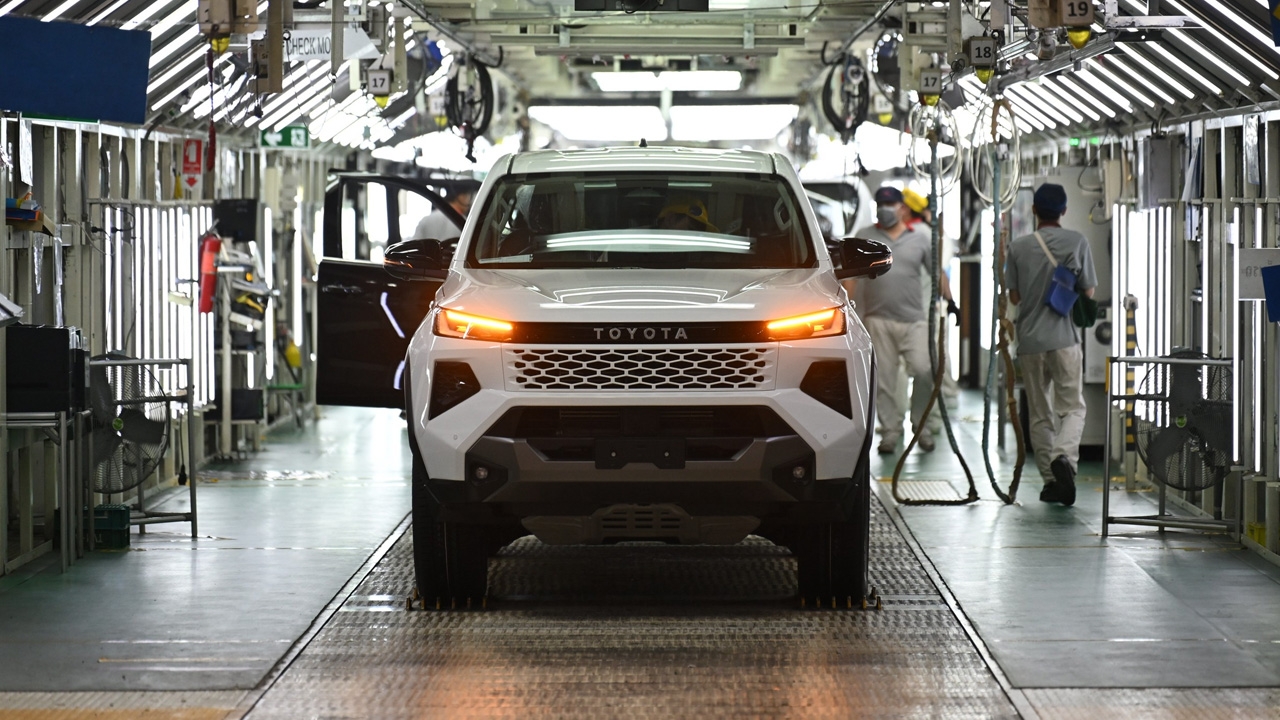
Toyota is expanding its investment by 1.49 billion baht to produce the New Hilux hydrogen-powered pickup at its Ban Pho plant, targeting an annual capacity of 3,000 units. Production is expected to start in December 2027, with exports planned to Europe, Australia, and New Zealand. The company is also developing Thai personnel and parts manufacturers to support future automotive technologies.
On 19 Oct 2026 GMT+7, Mr. Narit Therdsteerasak, Secretary-General of the Board of Investment (BOI), announced that the project's subcommittee, authorized by the BOI board, approved an investment promotion application from Toyota Motor Thailand Co., Ltd. worth 1.49 billion baht to produce hydrogen fuel cell electric vehicles (FCEV) pickups for the first time in Thailand.
The project will produce the New Hilux pickup at Toyota’s Ban Pho plant in Chachoengsao Province, with an annual capacity of 3,000 units. Production is expected to begin in December 2027. Initially, all output will be exported to overseas markets, especially Europe, Australia, and New Zealand, alongside developing personnel skills in FCEV technology.
This investment reflects Toyota's confidence and continued commitment to Thailand, reinforcing the country's potential as a future automotive production base and supporting the transition to clean energy technologies.

Mr. Narit stated that Toyota's choice to introduce hydrogen fuel cell electric vehicle (FCEV) technology—a new generation of electric vehicles—onto the existing Hilux production line in Thailand shows that the country is playing a key role in producing future vehicles for the global market.
Thailand has a strong foundation as the main production and export base for the Hilux pickup within Toyota’s global manufacturing network. It also has a ready supply chain and experienced workforce, which are strengths for supporting the global automotive industry's shift to clean energy.
Toyota’s investment aligns with the national automotive industry development strategy aiming to make Thailand a global production hub across all technologies, including:
Internal Combustion Engine (ICE) vehicles.
Mild Hybrid Electric Vehicles (MHEV).
Hybrid Electric Vehicles (HEV).
Plug-in Hybrid Electric Vehicles (PHEV).
Battery Electric Vehicles (BEV).
Fuel Cell Electric Vehicles (FCEV).
This is being pursued alongside goals of carbon neutrality and net-zero greenhouse gas emissions by 2050, while creating an investment environment conducive to all automakers from all countries.
"BOI thanks Toyota for its confidence in Thailand’s potential, demonstrated by over 60 years of continuous investment. This time, choosing to produce the latest hydrogen fuel cell electric pickup trucks (FCEV) in Thailand for global export sends a strong signal that, amid technological and market shifts, Toyota continues to see Thailand as a strategic partner, elevating the country to a new technology base. This investment not only enhances hydrogen technology capabilities but also creates opportunities to develop personnel, transfer technology, and advance Thai parts manufacturers into the future automotive supply chain," said the BOI secretary-general.
Toyota is a major Japanese automaker with 64 years of business in Thailand, continuously expanding investment to upgrade its production base to support new technologies and products, with total investment exceeding 200 billion baht.
Currently, Toyota operates three vehicle manufacturing plants in Thailand: Samrong, Gateway, and Ban Pho, with a combined capacity of over 770,000 units per year and directly employing more than 13,000 workers.
Thailand is Toyota’s fourth largest production hub worldwide, after Japan, the United States, and China. Toyota uses Thailand as an export base to over 100 countries globally.
This FCEV vehicle production investment is part of Toyota’s Multi-pathway strategy, which aims to reduce carbon emissions through diverse energy technologies, addressing varying usage needs and infrastructure readiness across different markets.
Toyota will use its Ban Pho plant in Chachoengsao Province as the production base for FCEV pickups, building on the existing Hilux pickup production line. The process will be upgraded with additional investment in assembly stations for key FCEV drivetrain components, including:
Hydrogen storage tanks (Fuel Tank).
Fuel cells.
Battery packs.
Electric motors.
Power control units.
Additionally, the company plans to install a hydrogen refueling station on-site to support FCEV vehicle production and testing.
Using 640 million baht worth of domestic parts annually to support Thai suppliers in entering the global supply chain. This includes air conditioning and cooling systems, seats, wheels and tires, wiring harnesses, and interior parts.
Toyota will also enhance the capabilities of domestic parts manufacturers, especially Thai companies, through technology transfer and knowledge sharing in production, quality control, safety, environmental management, and human resource management.
This approach will raise the standards and capabilities of Thai manufacturers to support FCEV automotive technologies and increase opportunities to enter the global automotive supply chain.
Regarding Thailand’s overall electric vehicle (EV) industry, as of September 2026, the BOI has approved investment promotion for 203 projects valued at over 141 billion baht.
These investments cover production of MHEV, HEV, PHEV, BEV, and recently FCEV vehicles, as well as battery production, key components, and related infrastructure. This reflects Thailand's development of a diverse automotive ecosystem supporting multiple technologies rather than focusing on a single drivetrain system.
Toyota’s FCEV project is another important initiative to build capabilities in hydrogen fuel cell technology and strengthen Thailand’s role as a comprehensive automotive production base amid the global automotive industry’s transition.