

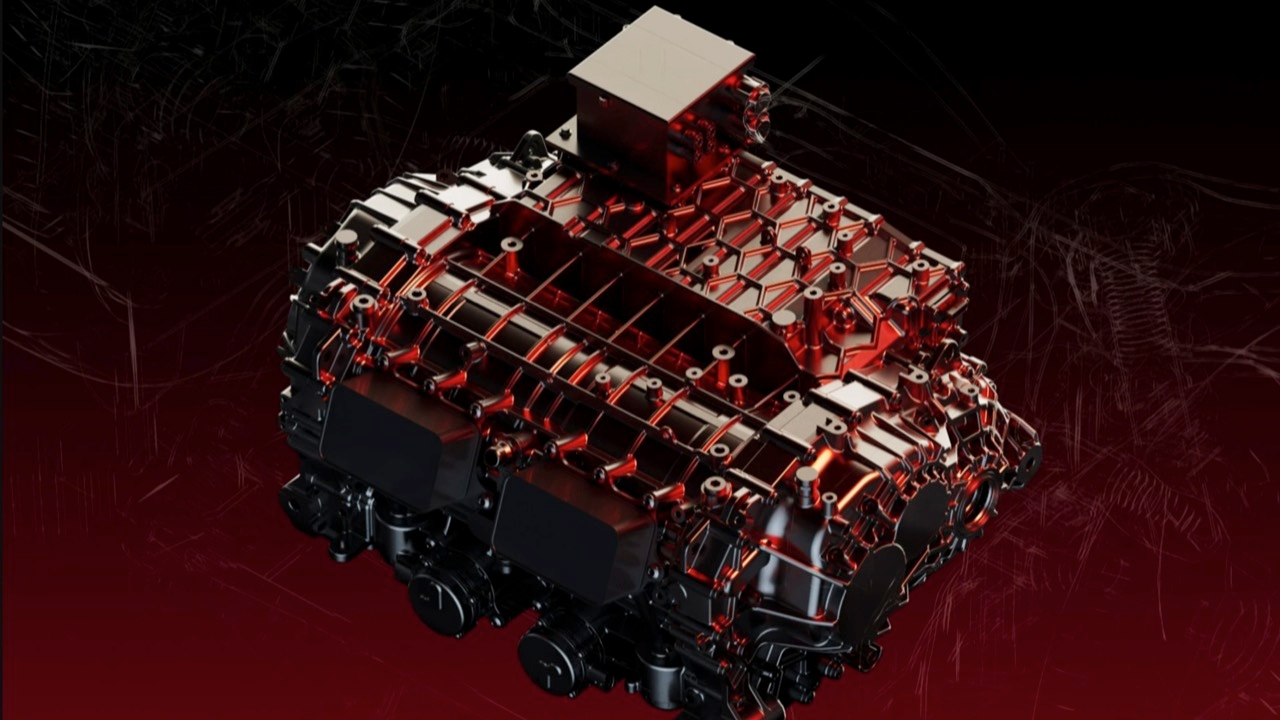
The most powerful electric vehicle motors currently (2024-2025) are found in hypercars and high-performance sedans, with standout models detailed as follows:


1. BYD Yangwang U9 is a high-performance electric supercar (EV Hypercar) equipped with four electric motors (e4 Platform) delivering a combined maximum output exceeding 1,300 horsepower in the standard version and 2,978 horsepower in the U9 Xtreme variant. It accelerates from 0 to 100 km/h in 2.36 seconds and 2.1 seconds respectively, and the U9 Xtreme sets a production EV top speed record at 496.22 km/h.


2. Rimac Nevera R
Currently regarded as the world's most powerful electric car, it features four independent motors driving each wheel separately. Each motor independently delivers torque to its wheel, with a total output of 2,107 horsepower (1,571 kW) and peak torque of 2,340 Newton-meters. The motors use permanent magnets with carbon sleeves to endure extremely high rotational speeds. Performance: 0-100 km/h in 1.72 seconds and a top speed of 430 km/h.


3. Lotus Evija
This British hypercar emphasizes immense power from four electric motors producing a combined 2,011 horsepower (1,500 kW) and 1,703 Newton-meters of torque. Each motor generates around 500 horsepower, ranking it among vehicles with the highest power per motor unit.


4. Lucid Air Sapphire
The most powerful electric sedan, this sports sedan breaks records with a tri-motor system producing a combined 1,234 horsepower and 1,940 Newton-meters (1,430 lb-ft) of torque. The configuration includes a single motor on the front axle and dual motors on the rear axle, enabling torque vectoring for improved cornering. Performance: 0-100 km/h in 2.1 seconds and a top speed of 330 km/h (205 mph).


5. Tesla Model S Plaid
A popular performance EV sedan utilizing carbon-sleeved rotor motor technology, it delivers a combined output of 1,020 horsepower and 1,420 Newton-meters of torque. It features a tri-motor all-wheel-drive system, with carbon sleeves allowing sustained power at high speeds.


Special Motor Technology (Koenigsegg Dark Matter)
Koenigsegg developed the "Dark Matter," the most powerful single electric motor designed for production cars, producing 800 horsepower from one motor and 1,250 Newton-meters of torque. It boasts an exceptionally high power density while weighing only 39 kilograms, delivering immense torque in a lightweight package.
Considering total power output, the four motors of the BYD Yangwang U9 Xtreme lead with 2,978 horsepower. However, evaluating single motor efficiency, Koenigsegg Dark Matter represents the most advanced innovation currently available.


To ensure motors and batteries operate at peak performance without thermal throttling, high-performance electric vehicles employ advanced technologies as follows:
Cooling Systems
Motors producing 1,000 to 2,000 horsepower generate massive heat rapidly, requiring more than standard water circulation cooling:
Oil-Cooling (Internal): Motors like those in the Lucid Air Sapphire and Tesla Plaid spray lubricating oil directly onto the copper stator coils and rotor shaft to extract heat from the hottest points, a method more effective than conventional water jackets alone.

Carbon-Sleeved Rotors: Tesla and Lucid use carbon fiber sleeves around rotors to prevent thermal and centrifugal expansion, allowing rotation speeds exceeding 20,000 rpm without damage.
Active Thermal Management: Computer-controlled cooling fluid flow anticipates heat generation, using heat pumps and smart valves to transfer heat between battery and motor or dissipate it via oversized radiators.

Battery Technology: The key is not just capacity (kWh) but the ability to deliver very high current (C-Rate) to power motors up to 2,000 horsepower. Lucid and Tesla use many small cylindrical cells with better heat dissipation surfaces compared to pouch cells, enabling sustained high power. Rimac Nevera employs immersion cooling by submerging battery cells in electrically insulating dielectric fluid, maintaining uniform temperature even under rapid acceleration or fast charging. High-voltage systems (e.g., Lucid’s 900V+) allow massive power delivery at lower current, reducing heat in wiring and coils. Silicon Carbide (SiC) inverters reduce energy loss as heat by over 50% compared to traditional silicon chips, improving precise and stable power delivery.
The secret to power is not just the motor itself but mastering "thermal management" and delivering battery energy as quickly and smoothly as possible.


Using carbon fiber materials in high-performance electric vehicles is not merely for aesthetics but is essential to offset the hundreds of kilograms of battery weight. Structural details include:
Carbon Fiber Monocoque (Passenger Cell): Cars like the Rimac Nevera and Lotus Evija use a single-piece "tub" structure entirely formed from carbon fiber. This lightweight yet rigid structure offers the highest torsional rigidity among production cars (70,000 Nm/degree) while weighing far less than steel or aluminum. This safety cell acts as a protective cage shielding occupants during impacts.


Carbon-Sleeved Rotors (Carbon-Wrapped Motors): This is crucial for high-horsepower motors, found in Tesla Model S Plaid and Lucid Air. These electric motors spin so fast that centrifugal force and heat could cause the copper rotor to expand and contact the stator. Engineers tightly wrap the rotor in carbon fiber under high tension, maintaining shape even at over 20,000 rpm. This allows for smaller motors with massive power output.


Active Aero: Rear wings, underbody panels, and diffusers made from carbon fiber ensure minimal thickness and weight, enabling rapid motor-adjusted wing angles in response to speed. Forged Carbon: For complex shapes, short carbon fiber composites (Forged Composite) are used, which are as strong but faster to produce and more flexible than traditional woven carbon fiber. Using carbon fiber reduces body weight by roughly 20-30% compared to aluminum. The saved weight is allocated to larger batteries, extending range and improving acceleration.
A comparison of kerb weight among high-performance electric vehicles reveals interesting differences between hypercars (which prioritize carbon fiber to reduce weight) and super sedans (larger, more practical vehicles) as follows:
Weight and Carbon Fiber Composition Comparison Table
Lotus Evija weighs between 1,680 and 1,887 kg. As a hypercar, it is the lightest in its category and uses nearly full carbon fiber construction.
Rimac Nevera R weighs between 2,265 and 2,300 kg. Also a hypercar, it is heavier than the Evija due to a larger battery and four motors.
Tesla Model S Plaid weighs between 2,162 and 2,265 kg. As a luxury sedan, it achieves a respectable weight considering it seats five passengers.
Lucid Air Sapphire weighs between 2,404 and 2,420 kg. This super sedan is the heaviest in the group due to luxury features and a large battery. Its nearly 2.5-ton weight affects tight cornering and braking distances.