

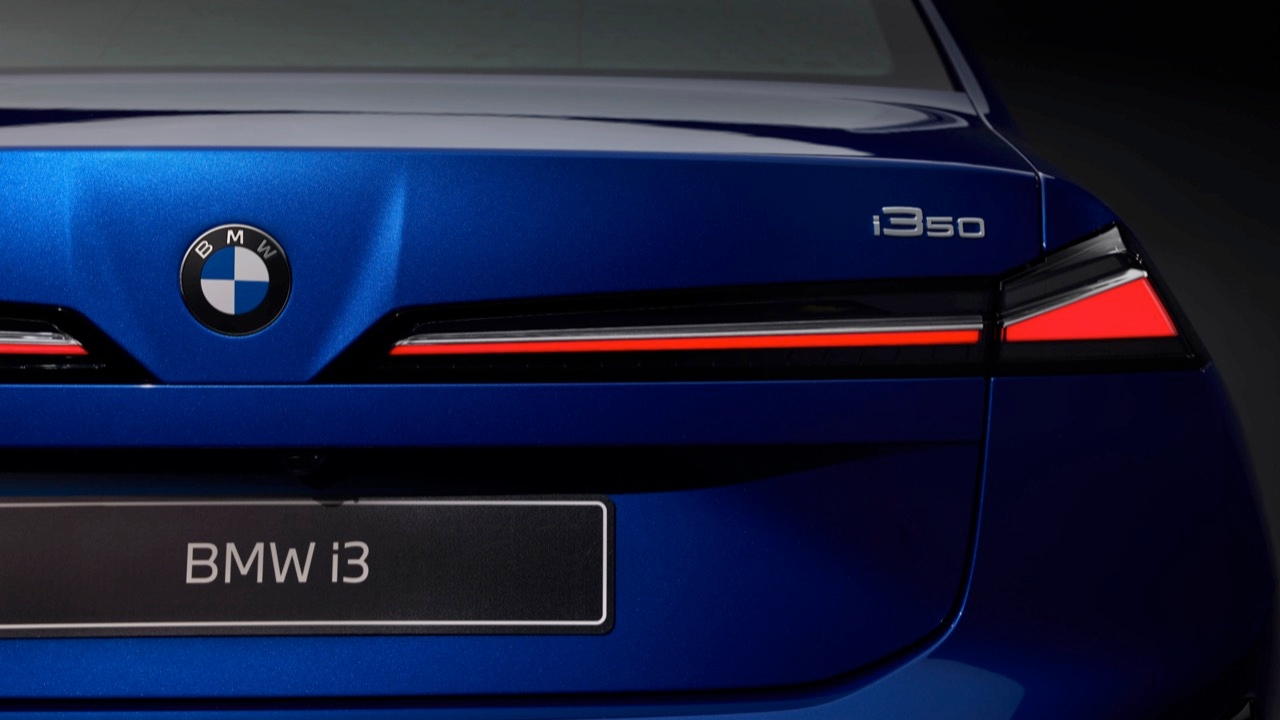
The i3, BMW's most important electric vehicle, represents the "essence of the brand" on the brand-new Neue Klasse electric platform, developed to elevate the latest transformation. The new i3 holds greater significance than the first Neue Klasse platform vehicle, the iX3, launched at the end of 2025, which earned high praise for its driving dynamics. The latest 3 Series, now an electric model, features a new look including a kidney grille distinct from the iX3, new headlights with automatic lighting technology, a high-power motor drive, and a large battery comparable in size to the Mercedes-Benz EQS. BMW launched the i3 with its longest-range model, the i3 50 xDrive, equipped with more efficient electric motors than previous BMW i models. Dual motors are installed on the front and rear axles, integrated with an 800-volt architecture producing a combined output of 345 kW (463 horsepower). Torque is moderate, similar to the new M4, at 645 Nm. The 108.7 kWh battery delivers a driving range of up to 900 kilometers.

This range represents BMW's determined effort to surpass Mercedes-Benz Electric. The technology improvements stem not only from enhanced motor, battery, and energy management systems but also from a new cell design that forgoes traditional modules, instead bonding cells directly together. This reduces weight and increases structural strength. Additionally, new software has been developed to optimize battery energy management.


Moreover, the new i3 can charge enough battery in about 10 minutes to travel 400 kilometers when connected to a high-power 400 kW charger—though such chargers remain scarce in Thailand. Another highlight is the vehicle's four intelligent control units, or "Superbrains," which centrally manage all aspects of driving to maximize comfort.
BMW i3's four Superbrains are high-performance computing units that strictly separate control of key vehicle systems, enabling operation speeds and precision up to 20 times greater than previous systems.

Heart of Joy (Driving Control Unit)
This core unit integrates the powertrain and chassis dynamics control systems into a single computer, enhancing vehicle responsiveness. It operates up to ten times faster than the electric control units (ECUs) in the internal combustion engine Series-3 models being phased out.

The automated driving control unit processes data from sensors and cameras around the vehicle to manage driver assistance and parking systems. Its intelligence reduces unnecessary interventions—for example, it will stop steering corrections if it detects the driver is intentionally looking to turn. It also controls battery energy management, steering, braking, regenerative braking, and suspension. The car supports Level 2 driver assistance, bidirectional charging, over-the-air software updates, and many other advanced technologies too numerous to detail here.
The infotainment control unit manages display output via the Panoramic Vision screen and runs BMW Operating System X (based on Android). It supports over-the-air updates and voice commands through Alexa AI.
The comfort functions control unit manages in-cabin convenience features, ensuring smooth, personalized user interactions. Separating these four computing units reduces wiring complexity and vastly improves overall data processing efficiency.
Key Technology and Charging Features
Supports DC fast charging up to 400 kW, enabling a 10-minute charge to add 400 kilometers of range.
The new battery technology uses next-generation cylindrical cells with 20% higher energy density and reduces charging time by 30% compared to previous models.
Bidirectional charging supports V2L (vehicle-to-load), V2H (vehicle-to-home), and V2G (vehicle-to-grid) functions.
Design and Driving Dynamics: The BMW i3 features a long wheelbase and very short front and rear overhangs to enhance agility. The rear suspension uses a Five-link setup for a smooth yet sporty ride.

The BMW i3 (Neue Klasse) interior represents a complete design overhaul from traditional BMW styling. Some customers are surprised on first view—either liking it immediately or feeling indifferent—while others note a total departure from the current G20 interior. The design follows a "Digital-First" concept, emphasizing openness and reducing physical buttons in favor of smart display technology.

New Display System (BMW Panoramic Vision)
The panoramic display strip replaces the traditional instrument cluster by projecting data onto a black band along the lower edge of the windshield. This allows both driver and front passenger to view driving, navigation, and entertainment information simultaneously without diverting eyes from the road.
The BMW 3D Head-Up Display projects three-dimensional real-time driving data onto the windshield within the driver's line of sight.
Steering Wheel and Central Control Screen
The steering wheel features a futuristic design with a new transparent, sporty spoke and touch-sensitive buttons that provide haptic feedback.
The central display is a geometric-shaped, floating touchscreen angled toward the driver for modern looks and ease of use.
Sustainability in Materials and Design
The interior avoids chrome finishes to reduce environmental impact.
Verdana Textile uses high-quality recycled fabrics and knitted materials instead of genuine leather or low-grade plastics, providing a soft, premium, minimalist feel.
Interior colors emphasize light and pastel tones to highlight spaciousness.
Lighting and Atmosphere (Ambient Lighting & Interaction)
Backlit Textile: The front console uses backlighting through fabric materials, creating a soft light effect that changes color with driving modes (My Modes).
Integrated Controls minimize physical buttons by consolidating climate and audio controls into touchscreens and voice commands via the Intelligent Personal Assistant.
Spaciousness: The all-electric platform enables a flat floor throughout the vehicle, increasing legroom and giving the center console an open, furniture-like appearance.
The panoramic glass roof enhances cabin brightness and spaciousness.
BMW Panoramic Vision in the i3 (Neue Klasse) is more than a larger screen; it fundamentally changes how drivers interact with their vehicle.
Full-Width Projection: Information is displayed not on a standard LCD but projected with high brightness onto a dark-coated strip along the windshield’s lower edge, creating a floating effect visible in all lighting conditions.
Positioned at eye level, this design prevents drivers from having to look down at a traditional instrument cluster, promoting "eyes on the road, hands on the wheel" safety.
Drag & Drop Interaction
Users can customize the display by selecting widgets (maps, music, battery status) from the central screen and swiping them onto the Panoramic Vision strip as desired.
Front passengers can also assist with adjustments or send information to the display, creating a shared in-car experience. The HUD is an optional accessory. The central display measures 17.9 inches and includes a multifunction steering wheel and advanced AI integration.
Integration with "My Modes" (Contextual Lighting)
Colors and graphics on the screens change with driving modes, while ambient lighting from the console reflects onto the windshield to match the Panoramic Vision display, creating an immersive cabin atmosphere.
Working alongside the 3D Head-Up Display, which projects critical driving info like speed and AR navigation arrows farther ahead on the windshield, the system avoids cluttering the driver’s view.
Safety and Distraction Reduction with Minimalist UI
Graphics are designed with high contrast and simple symbols for immediate comprehension, reducing cognitive load at high speeds. The windshield becomes a smart screen visible to all occupants while allowing the driver to maintain full focus on the road.
For the BMW i3 (Neue Klasse) with the latest BMW Operating System X, smartphone integration advances beyond separate displays to seamless smart projection integration.
Wireless Integration
Standard support for both Wireless Apple CarPlay and Wireless Android Auto.
Once connected, the system remembers user profiles via BMW ID to automatically load personalized settings upon vehicle entry.
Display on Panoramic Vision Screen
Smartphone widgets from Apple CarPlay or Android Auto—such as currently playing music or recent calls—can be placed on the Panoramic Vision strip at the windshield edge.
Feature Limitations
Complex features like Google Maps or Waze navigation are primarily displayed on the central console screen.
Apple Maps Privileges: Reports indicate Apple Maps will initially offer enhanced support for turn-by-turn navigation arrows on the Panoramic Vision and 3D Head-Up Display compared to other apps.

Dimensions of the new BMW i3 50 xDrive (Neue Klasse, chassis code NA0) are larger in every aspect than the current BMW 3 Series (G20) to accommodate the new battery pack and increase interior space.
Dimensions: Length 4,760 mm, Width 1,865 mm (excluding mirrors), Height 1,480 mm, Wheelbase 2,897 mm, Front/Rear Track 1,605 / 1,613 mm.
Comparison with the previous BMW Series 3 (G20) model shows the new i3 is:
47 mm longer
38 mm wider
40 mm taller
41 mm longer wheelbase, significantly increasing cabin legroom.

Distinctive Design Features: The i3 employs a 2.5-box design, blending a sedan profile with a fastback sloping rear. Aerodynamics are improved with shorter front and rear overhangs and wheel placement at the vehicle corners, enhancing sportiness and handling. The launch model features 21-inch two-tone aerodynamic alloy wheels (model 1067 M).
The BMW 3 Series has been the brand's cornerstone for five decades, symbolizing sporty driving pleasure, unmistakable design appeal, and ongoing innovation.