

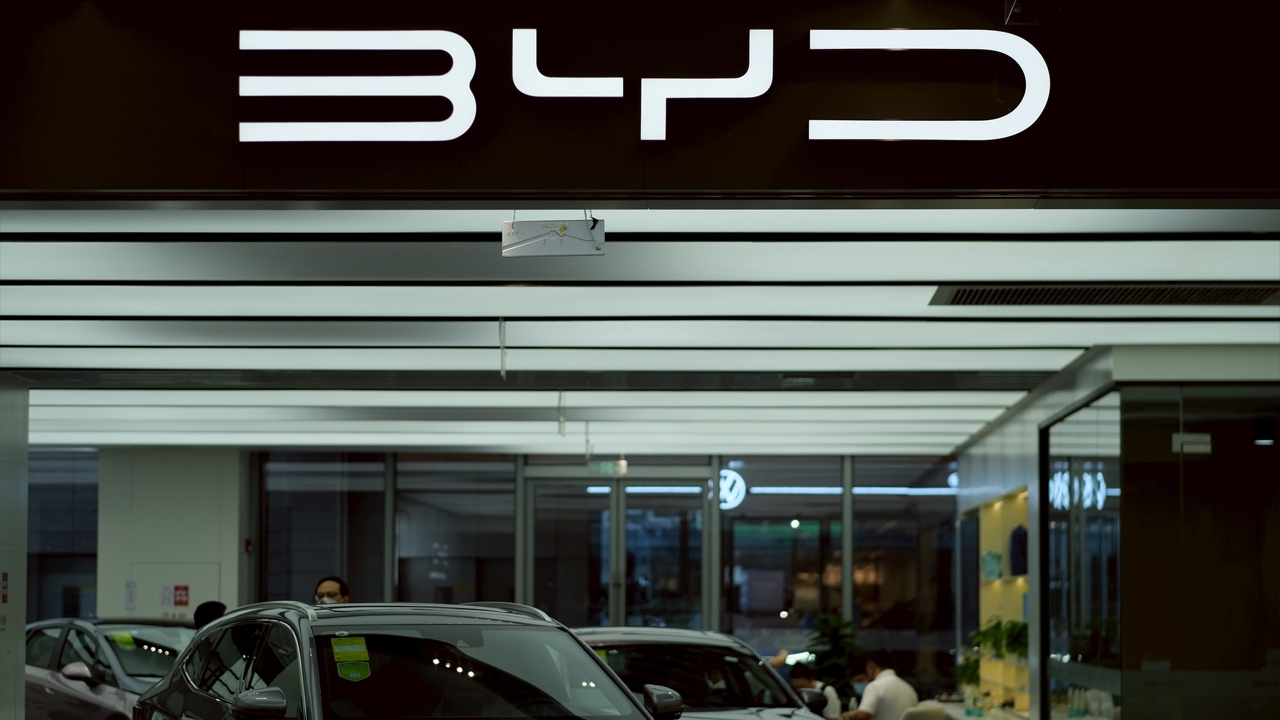
BYD's sales have surged past Tesla's, but profits have fallen 19% over five years due to a fierce price war.
On 27 Mar 2026 GMT+7, a news agency reportedCNBCthat BYD, the Chinese automaker, disclosed its financial results showing record annual sales reaching $116 billion, surpassing Tesla. However, profits declined for the first time since 2021 amid intense competitive pressure.
BYD is the largest electric vehicle (EV) manufacturer and has been steadily expanding globally, including into Latin America and Europe, where analysts note profit margins are generally higher than in China.
Additionally, the company is counting on advanced technology upgrades to boost appeal, having announced a powerful new fast-charging battery just days before releasing its earnings.
Amid shockingly fierce domestic competition in China, analysts predict a challenging year ahead. However, rising oil and gasoline prices due to the Iran war are rekindling interest in renewable energy, which benefits EV makers.
BYD, headquartered in Shenzhen, recently saw domestic sales decline but overtook Tesla to become the world's largest EV manufacturer in 2025, selling 2.26 million electric vehicles last year—a 28% increase from the previous year—while Tesla reported deliveries of 1.64 million vehicles, down 9%.
The Chinese company's revenue rose 3.5% to reach 804 billion yuan ($116 billion) in 2025, setting another record and eclipsing Tesla’s full-year revenue of $94.8 billion.
However, BYD reported annual profits of 32.6 billion yuan ($4.7 billion) last year, a 19% decline from 2024, marking the first profit drop since 2021.

BYD's sales momentum is weakening.
The Chinese automaker group reported six consecutive months of declining sales, with total sales in January-February down 36% year-on-year to 400,241 units, as rising overseas sales failed to offset continued weak domestic demand.
"They can no longer rely on electric vehicles for the mass market to maintain previous sales levels," said Chris Liu, a senior analyst in Shanghai at consulting firm Omdia.
The brutal price war in China, the world's largest auto market, has hurt BYD's profitability, while competitors like Geely Auto have begun to catch up in early 2026.
"We fully recognize that competition in the new energy vehicle (NEV) industry has reached a boiling point and is entering a brutal knockout phase," wrote Wang Quanfu, BYD's chairman, in the Friday earnings report.
Although broad government subsidies aimed at encouraging Chinese drivers to switch to EVs have been extended, their scale was reduced this year, putting additional pressure on automakers.
Nonetheless, the Iran war and global energy crisis are expected to accelerate EV adoption, benefiting companies like BYD both domestically and internationally.
Despite launching 11 new models with faster-charging batteries and expanding fast-charging networks, analysts say focusing on higher-priced products may not be enough to boost sales, as consumers seek more affordable options—a strategy seen as mistimed and misplaced.
BYD's Hong Kong-listed shares fell over 20% last year but began to recover in March.
Increasing exports and strategic shifts.
Analysts note that significant technology upgrades could be key to reclaiming market share. In early March, BYD unveiled a new generation Blade Battery capable of nearly full charge in just nine minutes.
The company also introduced new models like the Datang SUV featuring the latest technology, which automotive analysts at HSBC say could "help BYD regain domestic market share through technological leadership."
Internationally, BYD plans to continue growing its global market share to boost profitability. It has already entered the UK, Brazil, and Argentina markets and aims to sell around 1.3 million vehicles overseas in 2026, up from about 1.05 million last year.
The strategy of building and expanding factories abroad will also drive the company's growth in global markets, said Claire Yuan from S&P Global Ratings.