

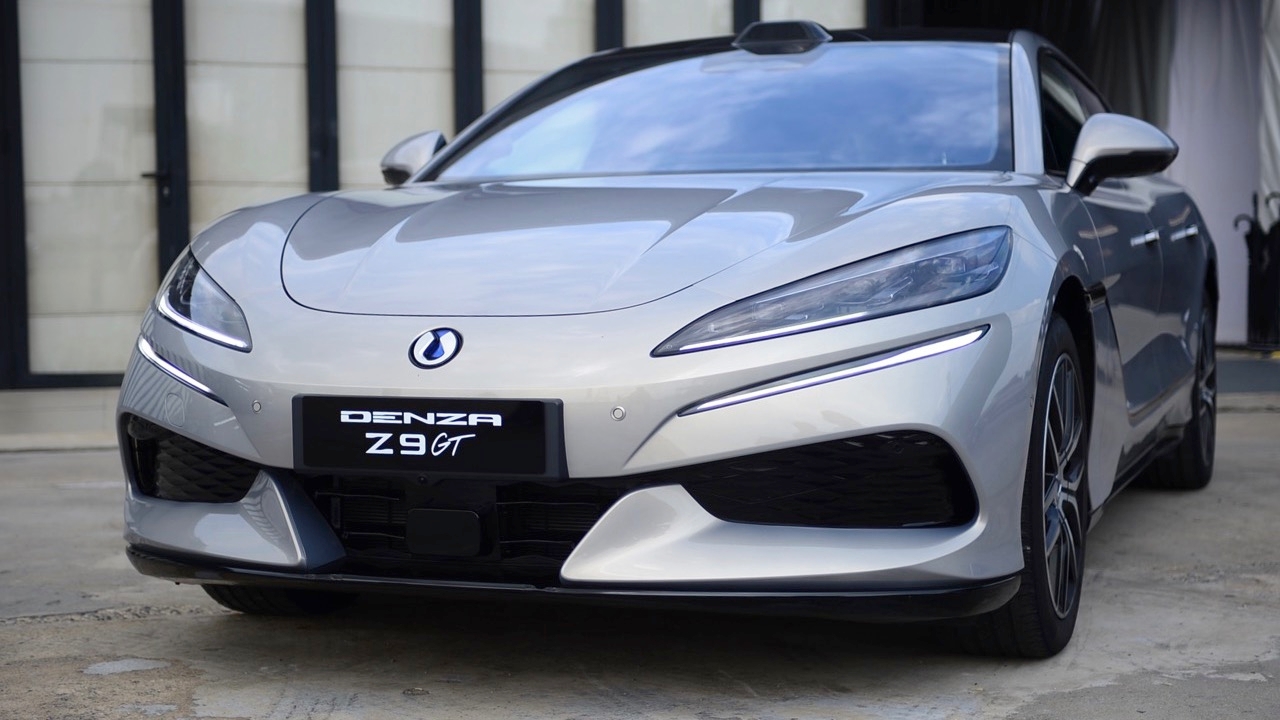
Denza, a luxury brand under BYD, is preparing for its official launch in Thailand with the Z9 GT, a shooting brake-style sport wagon expected to reach customers by October, following the success of its popular van model. For those unfamiliar or curious about Denza, BYD Thailand's marketing team describes it as a premium automotive technology brand. The Z9 GT, available in China as either a 1,140-horsepower EV or a 765-horsepower plug-in hybrid, could almost be marketed as a Porsche Taycan Sport Turismo for those who struggle with parking. This electric vehicle is packed with automatic parking systems that allow the car to mimic a crab's sideways walk. But why would it do that?


In reality, automatic parking systems are beneficial, but how many people would dare to use them when trying to squeeze into a tight spot already occupied by expensive new BMWs and Mercedes cars? Using such a system to park in a narrow space beside luxury vehicles can be nerve-wracking. While these features are practical for everyday use, the question remains: how willing are owners to rely on them? Or are these options merely showy gadgets to impress friends, used once and then forgotten forever?
After testing the multi-dimensional automatic parking system at the Pathum Thani track to experience its intelligent parking maneuvers, here are our impressions of each feature on the Denza Z9 GT.

Self-parking system
Similar to many modern cars, the Z9 GT can detect parking spaces and steer itself into parallel or perpendicular spots smoothly and quietly. Activation is quick and straightforward, done via a physical button on the front console followed by two taps on the massive 17.3-inch central touchscreen.

This Denza Z9 is equipped with 34 sensors around the vehicle, allowing precise automatic parking. It can detect parking spaces and perform swift, confident turning maneuvers—even when parking lines are faded or the spot is oddly angled. If the system initially fails to find a space, the driver can manually select a spot using the bird's-eye view camera and drag the car icon to the desired position and orientation on the touchscreen—an impressive feature. Moreover, if the parking spot is too tight to enter or exit, remote parking allows the owner to step out and let the car park itself via an app, even when surrounded by BMWs and Lexus vehicles.

The Denza Z9 GT features between 33 and 34 sensors and detection devices around the vehicle, depending on the smart driving package DiPilot version. The breakdown by device type is as follows:
Ultrasonic Sensors: 12 locations (6 front and 6 rear for parking assistance)
Cameras: 11 to 14 locations (including 360-degree view, ADAS lane and long-range object detection, and interior cabin monitoring cameras)
Millimeter-wave Radars: 5 locations (for blind spot detection, front/rear collision warning, and adaptive cruise control)
LiDAR Scanners: 1 to 2 locations (depending on the advanced autonomous driving option DiPilot 300)
Toe-out rear wheel rotation system

Denza might consider giving this feature a catchier, more concise name, as it is a highlight of the Z9’s capabilities. When parallel parking space is too short to reverse the nearly 5.2-meter-long car straight in, the vehicle first drives the front end in. Then, it independently turns the rear wheels outward in opposite directions, causing them to rotate counter to each other. This action slides the rear sideways toward the curb, resembling Michael Jackson's moonwalk or a crab walking sideways instead of straight ahead.

The reverse parking maneuver is somewhat eerie to watch as the Z9 GT slides in accompanied by the sound of tires scraping the Pathum Thani Speedway's drift track, which is known for aggressive tire wear. However, this crab-like sideways parking works effectively, enabling the owner to park in narrow urban spaces that would be impossible with a standard 5-meter vehicle. Owners just need to accept the increased tire wear and not question why Denza’s engineers designed it this way.

Crab Walk mode
In this mode, the Z9 GT’s rear wheels turn in the same direction as the front wheels, with a maximum angle of 8.5 degrees, allowing the car to move diagonally forward and backward, mimicking a crab’s walk. From inside the plush Nappa leather cabin, this diagonal motion feels unusual. Yet, in everyday life, one wonders when such a maneuver would actually be needed.

The Z9 GT’s standout feature is the 360-degree Compass Turn, similar to the toe-out rear wheel rotation used in parallel parking. This function commands the rear wheels to turn in opposite directions while one front wheel reverses, rotating the car a full 360 degrees on its own axis. When tired of multiple-point turns in dead-end alleys, the driver can simply stop, activate this function on the screen, and specify the desired rotation angle.
A 180-degree turn is ideal for escaping tight spots, but for some reason, the system allows a full 360-degree rotation, which brings the car back to its original spot exactly. The downside is the smell of burning rubber and significant tire wear. Most people grow up being told not to turn the steering wheel while stationary to protect tires, so sitting inside the Denza as it scrapes its tires on the rough gravel alongside the Pathum Thani Speedway track is a strange but functional experience.


The Denza Z9 GT is a shooting brake sport wagon that combines power and advanced technology, especially its diverse automatic parking aids (Self-parking, Remote Parking, Toe-out Rotation, Crab Walk, and Compass Turn). These features effectively solve parking and turning challenges in tight spaces for a nearly 5.2-meter-long vehicle.
However, while these sophisticated technologies have practical everyday uses, some are primarily flashy options designed to impress.
Practical and convenient features include traditional self-parking, remote parking outside the vehicle, and the toe-out rear wheel rotation that enables sliding the rear into tight spots, making large vehicle handling in urban settings easier.
More advanced but less essential features like Crab Walk and Compass Turn showcase motor and rear-wheel steering capabilities but may rarely be used in real life and cause considerable tire wear when executed on road surfaces.
Overall, the Denza Z9 GT is not just an electric car focused on power or design but a moving tech showcase setting new standards in automatic parking systems among premium vehicles. It caters to drivers seeking high performance, luxury, and ultimate convenience from futuristic technology.
Summary of specifications and technical details for the Denza Z9 GT (Performance AWD)
1. Dimensions
Length: 5,180 millimeters
Width: 1,990 millimeters
Height: 1,490 millimeters
Wheelbase: 3,125 millimeters
Ground Clearance: 120 millimeters
Minimum Turning Radius: 4.62 meters (with split-type rear-wheel steering system)
Cargo capacity: Rear 495 liters / Front trunk (Frunk) 53 liters
2. Powertrain and performance
Power source: Three electric motors (Tri-Motor AWD) on the e³ Platform architecture
Front motor (Asynchronous): 230 kW (~313 horsepower) / Torque 410 Nm
Rear motors (Permanent Magnet Synchronous): each 310 kW (~421 horsepower) / Torque 400 Nm each
Total system power: 1,156 horsepower (850 kW)
Maximum torque: 1,210 Newton-meters
Acceleration 0–100 km/h: 2.7 seconds
Top speed: 240–270 km/h
Battery: BYD Blade Battery Generation 2 with 122.5 kWh capacity, supporting up to approximately 630–701 km range (CLTC standard)
3. Suspension, drive system, and brakes
Front suspension: Double wishbone independent
Rear suspension: Multi-link independent
Suspension control: DiSus-A dual-chamber air suspension with automatic height and damping adjustment
Brakes: Ventilated disc brakes on all four wheels (optional carbon-ceramic discs in high-performance version) with electronic parking brake (EPB)
4. Wheels and tires
Wheels: 20-inch alloy wheels (21-inch in some trim packages)
Tires: 255/45 R20 (or front 255/40 R21 and rear 275/40 R21 in top trims)
Price estimate and launch schedule in Thailand
In China, the Denza Z9 GT is priced around 269,800 to 369,800 yuan, approximately 1.34 to 1.83 million baht, excluding import taxes and fees. When introduced in Thailand as an EV Grand Tourer flagship, the expected price range is 2.5 to 3.5 million baht.
An official launch and price announcement in Thailand are expected around August.