

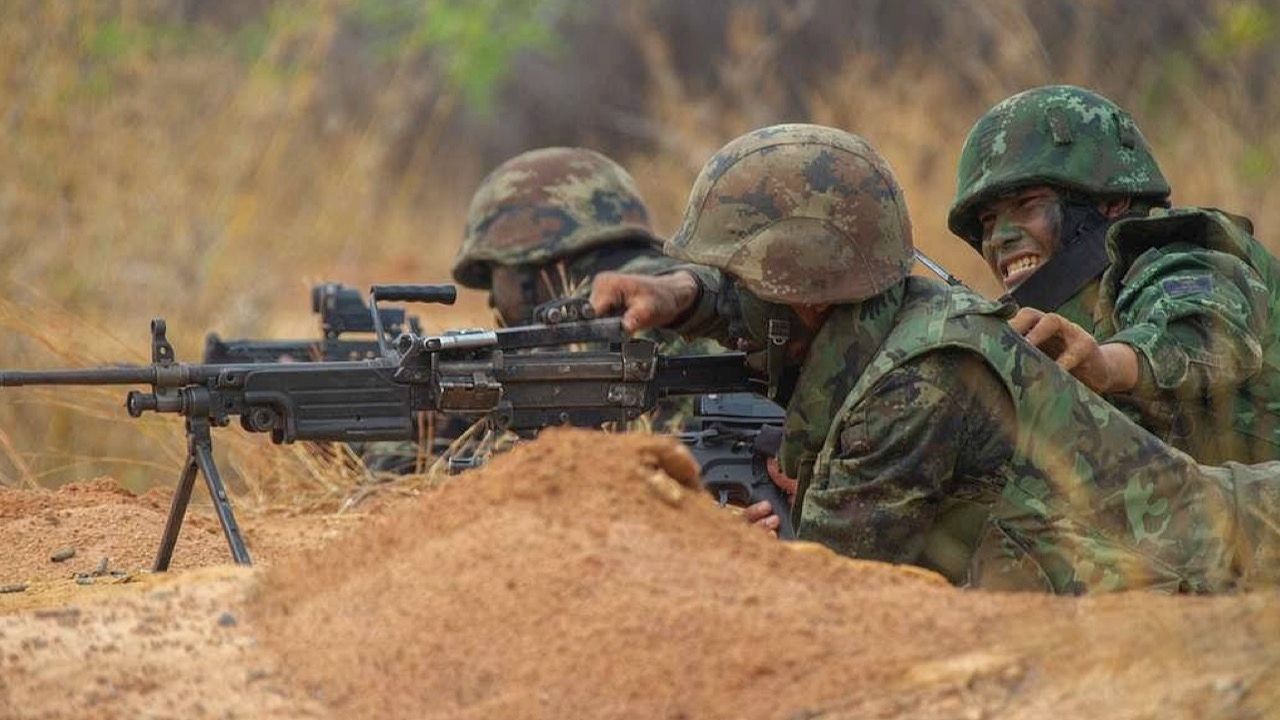
The purpose of installing coaxial machine guns in the Thai military is based on the concept of downsizing artillery to achieve versatility. Certainly, 20 mm guns are effective against infantry and light vehicles, similar to heavy machine guns. Additionally, they can destroy lightly armored personnel carriers. However, cavalry tanks already have anti-armor weapons, namely the main gun. Tank crews use 120 mm rounds to destroy enemy armored personnel carriers, which is more effective than firing numerous 20 mm rounds that cause limited damage to armored vehicles. Infantry face limitations carrying large-caliber guns. While 20 mm rounds have high destructive power, firing 7.62 mm light machine guns is also effective, capable of suppressing the enemy continuously throughout the day. Maintaining a steady rate of fire provides an advantage during assaults.

M240
The M240, officially named Machine Gun, 7.62 mm, M240, is a 7.62 mm general-purpose machine gun used by the U.S. military, based on the Belgian FN MAG (Mitrailleuse d'Appui General). It operates by gas and feeds 7.62x51 mm NATO ammunition from belts. The M240 entered U.S. service in the late 1970s, used widely by infantry and mounted on various land, sea, and air vehicles. Despite its weight, it offers high system reliability and is a NATO standard weapon. The M240 can feed linked 7.62 mm ammo belts with either disintegrating or non-disintegrating links, with variants differing in weight and accessories. The M240B and M240G models can be fired from bipods, tripods, or vehicle mounts. Firing rates range from 650-950 rounds per minute depending on the setting. The M240 serves as the coaxial machine gun on armored vehicles like the M1 Abrams tank and M2/M3 Bradley infantry fighting vehicles in the U.S. Army, and on the LAV-25 wheeled armored vehicle in the Marine Corps.

Fabrique Nationale M249 (5.56 x 45 mm)
The Fabrique Nationale M249 (5.56 mm), also known as the M249 SAW (Squad Automatic Weapon), is the U.S. military's standard light machine gun. Developed from Belgium's FN Minimi, it fires 5.56x45 mm NATO rounds using a gas-operated automatic system. It is lightweight, powerful, and supports infantry firepower. There are many variants, including the M249 Para, SPW, and Mk 46, which is modified for special operations forces.

Kharkiv Morozov DB KT-7.62 (PKT)
The PKT machine gun is a vehicle-mounted weapon originating from the Soviet Union, developed in the 1960s to replace the SGMT as a coaxial weapon on vehicles. Derived from a general-purpose machine gun, the PKT serves as a tank-mounted coaxial weapon. For flexibility, the PKB variant was also developed. The PKT uses a solenoid firing system with a heavy barrel and operates by gas with an open bolt. It was designed to be compatible with existing sights and maintain barrel alignment close to the SGMT. The PKT fires 7.62x54 mm Russian rounds, typically from 250-round belts, though capacity varies with the mounting. Its heavy barrel allows rapid firing of 500 rounds continuously. The rate of fire is 750 rounds per minute, higher than infantry light machine guns. Effective practical range is up to 1 km, with target engagement possible up to 1.5 km. The PKT is widely used, mounted on Soviet and Russian armored vehicles and tanks.

U.S. Ordnance M60
The M60 machine gun fires from an open bolt and operates by a gas-operated, short-stroke piston system with the piston assembly located under the barrel. The operating rod is long, resembling a long-stroke system. It uses a rotating bolt locking system released clockwise by a camming slot powered by the operating rod, which has a buffer at its rear. Ammunition feeds from the left via belt feed, using a bolt cam roller and feed cam mechanism to advance the belt. The M60 fires at 500–650 rounds per minute with an effective range of 1,100 meters (standard model). It comes with a built-in bipod and can be used with a tripod mount (M122 tripod). Units typically carry two barrels to swap out when one overheats, using a release lever on the right above the barrel base.

Rhinemetall MG3
The MG 3 is a German general-purpose light machine gun chambered for 7.62×51 mm NATO rounds. It is mounted on the V-150 Commando armored vehicle. The MG 3 is known for its high rate of fire and reliability, with minimal jamming. It is a design derived from the World War II German infantry machine gun that fired 7.92×57 mm Mauser rounds. The MG 3 serves as both squad support and vehicle-mounted weapon, featuring a bolt handle to reduce recoil sensitivity and improved feed mechanisms. It can use both the German Patronengurt DM1 and the U.S. M13 disintegrating belts. Compared to the MG 1A3, the MG 3 has enhanced feeding and a belt holder to secure belts when the top cover is open. It can be equipped with anti-aircraft sights and new ammunition boxes. Produced further by Heckler & Koch in Germany, the MG 3 shares parts compatibility with the original MG 2 model.

US Army M37
The M37 machine gun is a medium light machine gun chambered for .30 caliber (7.62 mm), adapted from the M1919 A4. It provides effective fire support to infantry during assaults. Historically, the M37 served as the coaxial machine gun on M48 and M60 Patton tanks. It resembles the M1919, is belt-fed, air-cooled, and designed for vehicle mounting on armored fighting vehicles and tanks. Its main difference is ambidextrous ammunition feed capability. The M37 fires .30-06 Springfield rounds from approximately 250-round belts, with a rate of fire between 400 and 550 rounds per minute and an effective range of about 1 km. Some M37s were modified to use 7.62x51 mm NATO ammunition, known as the M37E1. The U.S. Army adopted the M37 in 1955, primarily for main battle tanks. The limited M37C variant was mounted on the XM1/E1 base for OH-13 and OH-23 attack helicopters. The M37 was temporarily adapted to 7.62x51 mm NATO until replaced by the M73 machine gun.

M2 Browning machine gun
The M2 Browning machine gun is a heavy machine gun with a 0.50 inch (12.7 mm) caliber, firing 12.7×99 mm NATO or .50 BMG rounds. Designed in 1921 by John C. Browning, the production license was granted exclusively to FN in Belgium. It can be mounted on vehicles, aircraft, and tripods, engaging various targets including ground forces, light armored vehicles, and low-flying aircraft. The M2 Browning entered service in the Thai military in 1950, with assistance from the United States Operations Mission (USOM) after World War II. Officially designated as Machine Gun Type 93 or MG 93, it serves at the company level. It fires at a rate of 450-550 rounds per minute, with a muzzle velocity of 930 meters per second (2,789 feet per second), and weighs 37 kilograms.