

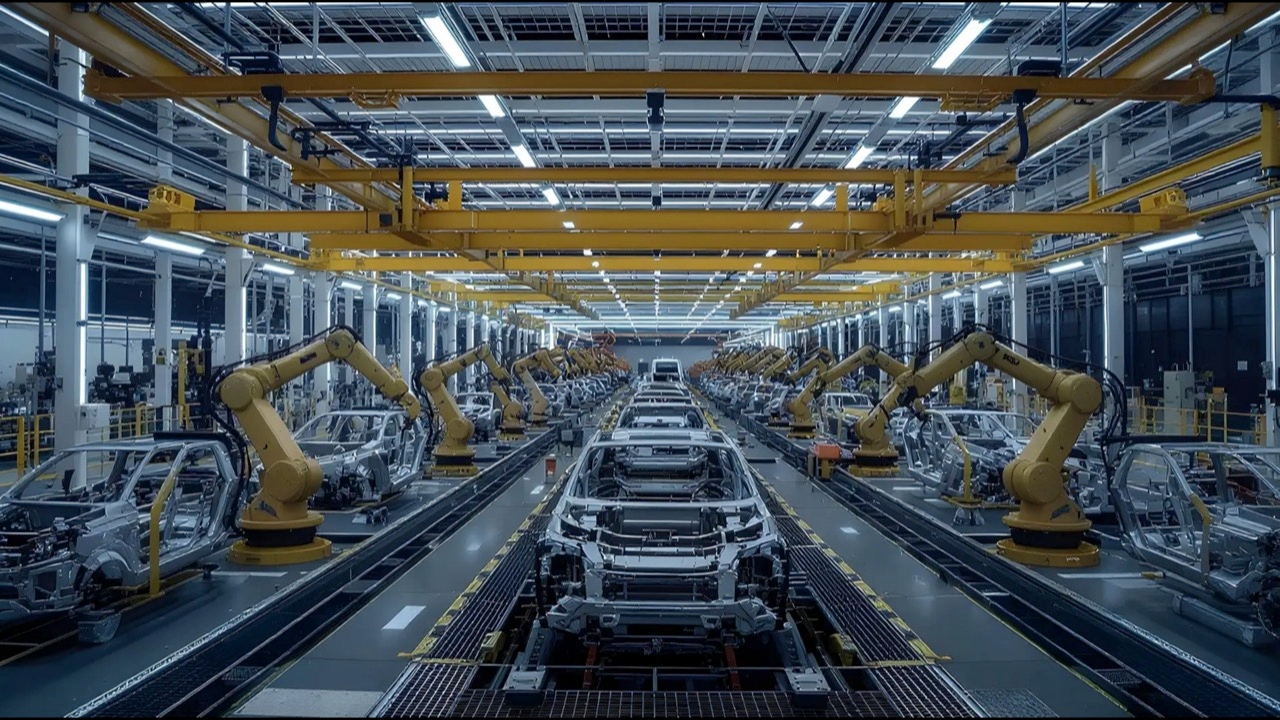
For automotive journalists, visiting a car assembly plant, regardless of the brand, is usually not the highlight of overseas trips arranged by automakers. However, the BYD Zhengzhou Factory that my colleagues and I visited upon BYD's invitation covers an immense area of 10.67 square kilometers and employs thousands of workers across its various departments. Approximately 98% of the work is carried out by robots, enabling production of one car per minute. This is truly impressive. Welcome to the BYD Super Factory in Zhengzhou, China, a city that experiences cold weather in January.

The BYD Super Factory is located in the Zhengzhou Airport Economic Zone. It stands as a remarkable industrial achievement in new energy vehicles and advanced technology within China's rapidly expanding electric vehicle market. Even more impressively, the factory was completed within just one year.
The BYD Zhengzhou Factory, situated in the Zhengzhou Airport Economy Zone, is a massive car assembly plant spanning 10.67 square kilometers. Beyond planning for new energy passenger vehicle production—including stamping, welding, painting, and assembly in the four main stages—BYD has also organized production of components related to the drivetrain, such as electric motors, electronic control systems, power distribution, engines and powertrains, air conditioning, steering systems, decorative parts, lighting assemblies, vehicle body structures, passenger seats, and other key components like the Blade Battery and drive batteries. Additionally, it includes advanced material manufacturing industries. Currently, BYD is pursuing a long-term strategy to develop a comprehensive automotive industry chain within Zhengzhou.

The BYD factory in Zhengzhou, China, is a colossal electric vehicle manufacturing facility that continues to expand. Its vast scale has led to comparisons with an entire city, featuring comprehensive amenities for over 60,000 employees. The factory emphasizes ultra-fast production—achieving one EV per minute and one battery every three seconds—and serves as a key hub propelling BYD toward global leadership in the electric vehicle market.

Key features of the BYD Zhengzhou Factory include:
The factory covers a vast area larger than the city of San Francisco.
It functions like a large city, with residential buildings, sports facilities, parks, hospitals, and shops to support its massive workforce.
High production capacity aims for manufacturing one electric vehicle every minute and one battery every three seconds.
Continuous expansion is underway, with multiple construction phases and rapid hiring.
A state-of-the-art testing center includes specialized facilities like a large dune climbing track and drift testing grounds.
Overall, the factory exemplifies BYD’s ambition to dominate the global electric vehicle market, serving as the primary production base for China's top brand.

The vast BYD Zhengzhou Factory encompasses employee housing, recreational facilities, and ongoing construction expansions. Its workforce numbers approximately 60,000, with an additional 20,000 employees expected in the first quarter of 2025, making it a self-contained city with its own infrastructure.

In comparison, the BYD Zhengzhou Factory is ten times larger than Tesla’s Gigafactory. It focuses on comprehensive production and design, with expansive grounds, high-rise dormitory buildings, and essential infrastructure to support the large workforce, highlighting the project's immense scale.
Behind the creation of the BYD Zhengzhou Factory lies a bold commitment to support the new wave of hybrid electric vehicles combined with intelligent technology to develop new energy vehicles for both domestic and global markets. The factory employs 98% automation in vehicle manufacturing, particularly in robotic industrial welding, which is a competitive strength.

The BYD Zhengzhou Factory’s production lines accommodate various new energy vehicle models by integrating 11 advanced automated manufacturing processes, including automated structural welding and online inspection. The factory can produce up to 50 vehicles per hour with precise error control within 0.01 millimeters, utilizing real-time production monitoring, operational inspection systems, fully automated grouping, and automatic assembly lines. Blade Battery and plug-in hybrid drive battery production are efficiently managed from raw materials to final assembly.

Strategically chosen in 2022 and reaching full production in 2023, this large factory demonstrates BYD Group's efficiency and ambition. It currently produces models such as the Song Pro DM-i, Song L DM-i, Seal DM-i, Fangchengbao 5, Fangchengbao 8, and Shark 6. It integrates four main production stages: stamping, welding, painting, and assembly, for new energy vehicles.
Additionally, BYD has established production lines for key components such as electric motors, electronic control systems, batteries, powertrains, air conditioning, steering systems, decorative parts, lighting, and seats. The site also includes the Blade Battery Power industrial park, new materials industrial zone, and a new testing ground. Together, these facilities rapidly advance a comprehensive industrial supply chain, sometimes progressing at an exceptionally fast pace.

The Thai automotive media tour began at the body stamping plant, where fully automated machinery powered by advanced robots operates. The stamping process can handle up to 30 steel sheets per minute, reaching a maximum of 50, all without direct human control.
Large steel sheets are formed into vehicle structural parts, with the area filled with the sounds of robotic arms and conveyor belts operating with high precision. Safety is paramount at BYD Zhengzhou Factory, featuring dedicated walkways for visitors. The stamping process proceeds unhurriedly, with finished steel parts organized and stored for subsequent assembly stages.

In the final stage, advanced laser welding technology is applied to the vehicle’s upper body. This welding system provides decentralized heat and traceability to reduce errors or defects later in production, enabling direct trace-back to the origin through a comprehensive inspection system.
Once the body structure is complete, vehicles proceed to the painting stage, which serves as crucial protection for both aesthetics and durability. Afterwards, the assembly phase installs windows, sunroofs, and interior equipment. BYD Zhengzhou Factory’s flexible production lines allow the rapid simultaneous manufacture of multiple vehicle models.

Although the media did not have access to the Blade Battery factory, the Blade Battery Power Battery Park employs cutting-edge technologies such as real-time production monitoring, automated mixing, and fully automated assembly lines, ensuring comprehensive production efficiency from raw material preparation to final battery pack assembly.
One of the strengths of the BYD factory within the Zhengzhou industrial park is its scale and integration. The park covers the entire supply chain for new energy vehicle production, from component and battery manufacturing to final assembly. Specialized testing grounds assess vehicle performance. Over 1,000 robots drive various production processes. The total area spans approximately 80,937 to 81,000 rai, employing around 16,000 people. Current production capacity is 550,000 vehicles per year, with plans to increase to one million.
Founded in 1994, BYD has rapidly grown into a global automotive giant. It ranks among China's leading companies in electronics and new energy vehicles. The Zhengzhou industrial park is one of nine BYD-operated industrial parks in China and is part of a network spanning 30 leading industrial parks worldwide.
Visiting the BYD factory is more than just observing a vehicle production line; it offers a glimpse into the future of manufacturing, where automation, sustainability, and innovation converge to drive next-generation transportation.