

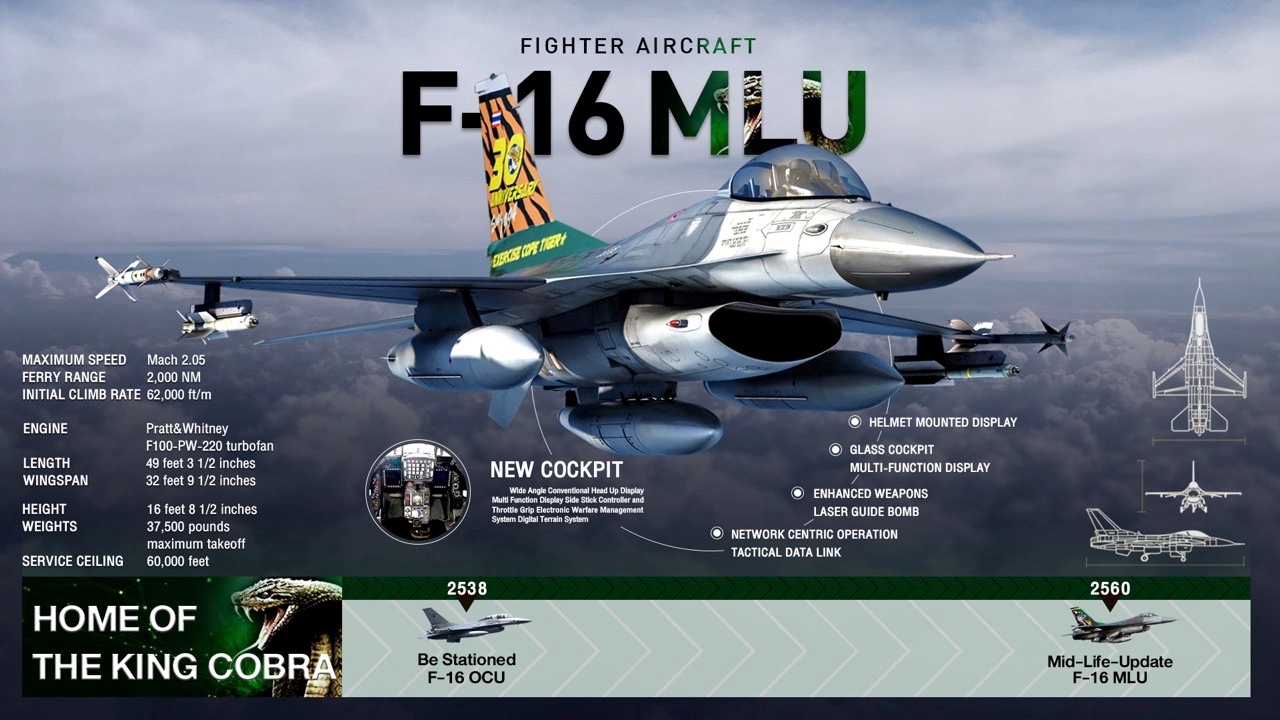
Sorasak Subongkotch, an expert in fighter jets and military weaponry, wrote a brief article on his Facebook page stating that the fighter jets we use "do not have a Kill Switch" and do not need "permission" to operate.
/https://www.facebook.com/sosakus/

I am tired of having to answer questions or argue with people who "believe" that the aircraft we bought from America have a "kill switch." This article is my declaration that I am... "so tired" and will no longer write about such nonsense, absurdity, superstition, and foolishness.
For the reasons stated below. At the end of the article are references, in case anyone thinks I am speaking nonsense.
1) The conditions in the purchase contract do not control tactical use. The US controls arms exports through legal frameworks and contracts (such as specifying end users and prohibiting transfer), but does not control mission-level tactical decisions of the user country.

Once the aircraft is delivered, decisions such as takeoff, target selection, and use of force are sovereign powers of the owning state.
1) There is no "procedure to call Washington for permission" before pressing the weapon release button.
2) End-user conditions are often overinterpreted. These conditions do exist but are limited to prohibiting transfer or resale to third parties and forbidding use contrary to major policy conditions (such as severe human rights violations in some cases). They do not require permission for every instance of combat or defense.
3) Examples in foreign news cause people to mistakenly generalize cases where the US "did not approve delivery of certain weapons" or "delayed spare parts/ammunition" to some countries as equivalent to "controlling the firing button." The truth is these are political pressures at the state-to-state level, not real-time battlefield flight controls.
4) Misunderstandings about the "Kill Switch" and digital systems: The idea that there is a secret switch that the US can use to immediately disable aircraft has no evidence, especially for F-16s operated by user countries.


Fighter jets must operate autonomously in wartime conditions. Having a remote kill switch would be a severe strategic weakness. What does exist is dependency on spare parts, software updates, and new guided weapons, which represent "long-term leverage," not an instant off switch.


5) Context in Thailand: The Royal Thai Air Force has used F-16s for decades for training, patrols, and operations without ever needing to "ask the US for permission on a per-mission basis." The decision to use force is made by the Thai government and military. In summary: True: The US controls export, end-user conditions, and long-term support. False: Permission is needed before every combat mission or there is a kill switch to instantly disable aircraft. The essence: Seller control lies in "supply and support," not "tactical battlefield orders."