

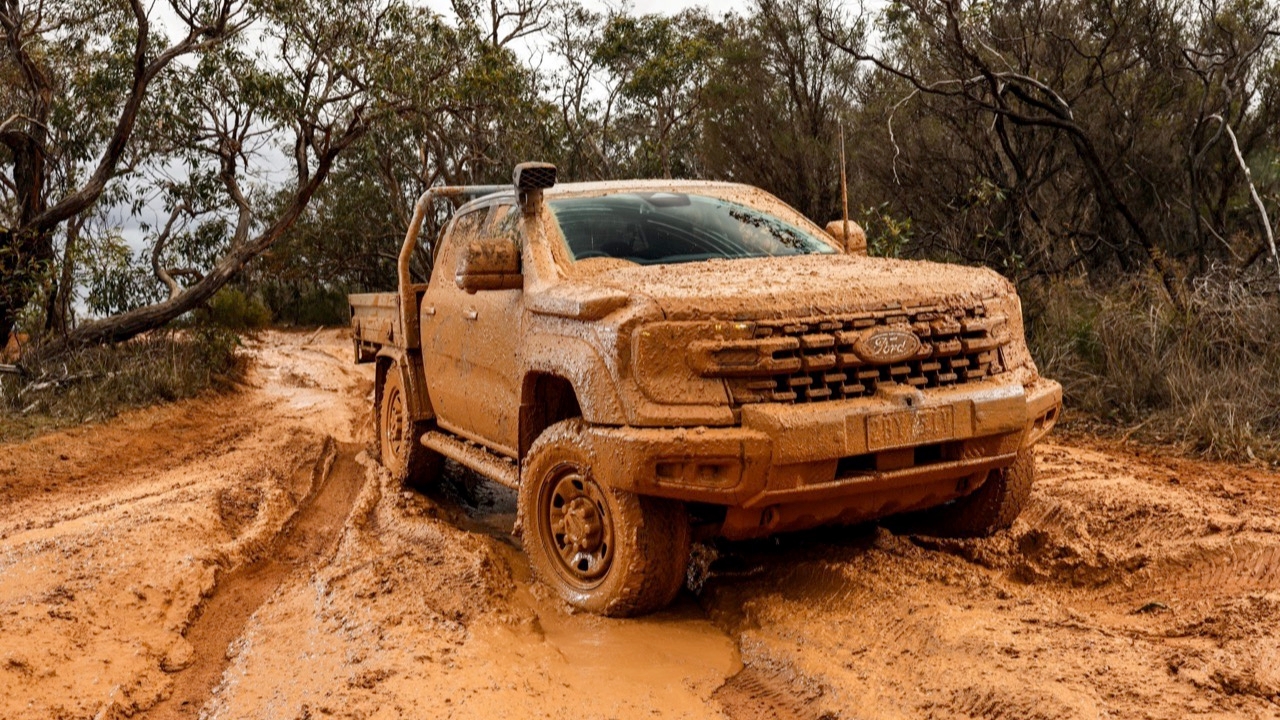
If a vehicle must “carry heavy loads like a packhorse” yet also “climb mountains nimbly like a mountain goat,” how would you design it? This was the real challenge Ford's team used as the starting point to develop the Ford Ranger Super Duty. This challenge did not originate in a meeting room but from real conversations on site—both on rugged forest trails and remote mining sites. Jeremy Welsh, Special Projects Manager for Heavy-Duty Automotive Engineering at Ford Australia, who has been involved with this project from the beginning, recalled feedback from users who often felt they had to “trade off something.” Vehicles that could carry heavy loads were often too large and cumbersome to navigate narrow routes, while those that could go far lacked sufficient payload capacity for real work.

The clear objective was to develop a vehicle capable of heavy-duty hauling with driving performance ready to tackle every tough terrain efficiently. “We set the engineering design goal for this pickup truck to support a payload of up to 1,982 kilograms,” said Drew O'Channassy, project engineer for the Ford Ranger Super Duty. “But strong performance is pointless if it can't get you to your destination. We needed to create a pickup tough enough to carry heavy loads and access any area, ensuring every heavy mission could be accomplished wherever needed.”

Compared to the standard Ford Ranger, the Ranger Super Duty uses a thicker and stronger chassis frame, reinforced drive axles, and the most durable rear differential ever fitted in a Ranger. It also features a more robust drivetrain for improved low-speed torque delivery. Additionally, it adopts an 8-lug wheel hub design borrowed from the F Series Super Duty lineup, enhancing load distribution and carrying capacity.

The Ford Ranger Super Duty’s wheelbase has been widened by 90 millimeters, matching that of the Ford Ranger Raptor. It comes with 33-inch All-Terrain tires, raising the minimum ground clearance to 299 millimeters. The suspension system features extended travel in both front and rear to boost off-road capability. For confidence in all situations, engineers installed locking differentials on both front and rear axles and reinforced the underbody with 4-millimeter thick steel skid plates.


The true test isn’t just in the components but in the grueling testing program. The Ford Ranger Super Duty underwent longer and tougher off-road trials than ever before—from repeatedly speeding through mud with over 600 kilograms of mud sticking to the vehicle, to deliberately intense use testing the off-road steering assist at its limits. It also endured prolonged travel over speed bumps while heavily loaded, among many other tests—all designed to prove maximum toughness and durability for real-life use where off-road driving is frequent throughout the vehicle’s lifetime.

Beyond Ford’s U Yhang Proving Ground, engineers sought out adventure-grade routes across Australia to find the harshest tests. One such is the so-called 'Rocky Track,' a punishing trail so narrow it barely fits the vehicle and is strewn with steep, jagged rocks. “Rocky Track isn’t a route typical four-wheel drives can handle,” said Rob Hugo, automotive engineering supervisor. “But the Ford Ranger Super Duty isn’t an ordinary vehicle. We didn’t just drive it on Rocky Track; we conquered the trail carrying over 1,000 kilograms of payload in the bed.”


“We fully understand that owners will take this vehicle on tough, rugged routes, so it was crucial for us to test drive it ourselves,” Hugo added. Moreover, engineers demonstrated the Ranger Super Duty’s capability in Australia’s harsh deserts, stationed it on remote Queensland cattle farms, and collaborated with rural fence-building teams—handling tasks from towing to heavy hauling and enduring severe, repeated impacts from speed bumps. This involved thousands of kilometers and tens of thousands of speed bump crossings.

This was not merely about ticking test checklist boxes; it was a further proof of toughness and a confirmation that the team developed a pickup for heavy missions and rugged terrain, providing customers with a reliable vehicle ready for real-world use and able to complete their intended tasks.