

Bertha Benz (née Ringer) was the third of nine children. Her father, Karl Friedrich Ringer, was a skilled contractor and carpenter. Her mother was Auguste Friedrich Ringer. Both were wealthy individuals who invested heavily to support their children's education, aiming to equip them with knowledge suited to the changing times. Bertha Ringer attended a boarding school in Pforzheim for 10 years. Ambition and a passion for technological innovation were part of her character from an early age.

In 1869, Bertha Ringer met Karl Benz at an Eintracht club party. At that time, Benz was a young, enthusiastic inventor focused on developing a vehicle engine that no longer relied on horses. Bertha seemed to have foresight and confidence in her boyfriend Benz's potential as a pioneering inventor. Appreciating Karl's work, she invested a substantial amount of her personal savings as the daughter of a wealthy family into his project. Although Benz’s vision was promising, he had yet to successfully turn his inventions into commercially viable products, instead building and testing prototypes without clear signs of profit-oriented production.

Two years before their marriage, Bertha invested a significant sum to buy back shares from an unreliable business partner, a friend of Karl Benz. At that time, as she was unmarried, she retained legal rights as a business investor. However, in July 1872, when their love matured, Bertha Ringer and Karl Benz married in Pforzheim. After marriage, under German law of the era, a wife was no longer recognized as a business investor in her husband's ventures, even though her dowry supported Karl's automobile production project.
Besides financial support, Bertha Benz frequently provided practical assistance in her husband's projects. The couple exemplified mutual support in developing automotive technology. On one occasion, they jointly wound copper coils to successfully build an ignition system.
Bertha Benz’s relationship with her father, Karl Friedrich Ringer, combined love, ideological conflict, and later became a driving force behind her becoming a strong woman.

The “disappointment” later turned into motivation. Records note that when Bertha was born, her father wrote in the family Bible with regret that it was “unfortunate to have another girl.” At that time, Germans and most people globally shared the Chinese family mindset that sons would inherit the family business and intellect, while daughters were expected to marry and leave the family. Bertha accidentally saw this message, which became a personal challenge to prove to her father that “women can achieve greatness and understand machinery as well as men.”
When Bertha met Karl, then a poor engineer with seemingly no future due to repeated failures, her father strongly opposed the relationship. He saw Karl as a broke dreamer unlikely to provide Bertha a comfortable life like her family home. However, Bertha insisted on her choice, having far greater confidence in Karl than her father did.

On New Year's Eve 1879, the Benz family successfully ran their two-stroke engine for the first time. By December 1885, Karl Benz completed his first horseless carriage. On 29 January 1886, he applied for a patent for his gasoline-powered car. However, the invention faced significant public opposition, with doubts about replacing horse-drawn carriages practically. Benz’s engine had not yet been tested over long distances. Karl struggled to market his patented car, but Bertha, who foresaw the invention's value to transform human travel, supported him. During the patent process, she could not co-apply due to laws, despite her financial and engineering contributions.

Early on 5 August 1888, Bertha Benz set off with her sons Eugen (15) and Richard (13) in Karl’s first conceptual three-wheeled Benz Patent Motorwagen while Karl was still asleep. She left a note on the breakfast table stating she and her sons were visiting her mother in Pforzheim, about 100 kilometers away. At that time, she had no driver’s license (Karl Benz had only received the world’s first driver’s license a few days earlier).

Bertha Benz’s journey with her sons was a historic long-distance trip, both an adventure and the first real-world test of a car. They traveled from Mannheim to Pforzheim over roughly 13 hours, driving about 100 kilometers on dirt roads and hills to visit her parents. After arriving with difficulty, Karl was informed by telegram of the Motorwagen prototype’s success. During the trip, Bertha made multiple repairs with simple items—using stocking garters to repair the ignition system and a hat pin to clear blocked fuel lines. The family also stopped at a pharmacy in Wiesloch to buy several liters of Ligroin, a petroleum-based cleaning solvent used as fuel for the single-cylinder engine. This pharmacy is still regarded as the world’s first gas station.

On the return trip, the Motorwagen’s wooden brake lining wore down. Bertha stopped at a cobbler’s shop and had them replace it with thick leather strips, inventing the world’s first brake lining. This journey proved to skeptics that the Motorwagen had the potential to become a new vehicle replacing horse-drawn carriages. The problems encountered served as the first real test and helped improve the drivetrain and other incomplete systems. Along the way, Bertha and her sons pushed the Motorwagen uphill, leading her to suggest adding a third gear and brake lining in future Benz models. These recommendations were incorporated into later production cars.

Before Bertha Benz’s historic trip, most automotive driving was experimental and supervised by experts. The roads they traveled remain today, known as the Bertha Benz Memorial Route. This strong woman was inducted into the Automotive Hall of Fame in 2016. Bertha and Karl (inducted in 1984) are the only married couple worldwide honored in the Automotive Hall of Fame.


Historical Significance
First Investor: Bertha Benz invested her dowry in Karl’s factory before they married, supporting her husband’s dream of creating the "horseless carriage."
Historic Journey (1888): In an era of public skepticism about cars, Bertha secretly took her two sons on a 106-kilometer trip from Mannheim to Pforzheim in the Benz Patent-Motorwagen Model III to prove its practical usability.

Mechanic and Brake Innovator: During the journey, she tackled numerous issues, such as using a hat pin to clear clogged fuel lines, stocking garters to insulate damaged wiring, and commissioning a cobbler to attach leather strips to wooden brakes—creating the world’s first brake lining.
First Gas Station: Bertha stopped to buy Ligroin (then a cleaning solvent) at a pharmacy in Wiesloch, marking that pharmacy as the world’s first gas station.
Her journey changed the world’s view of cars from "expensive toys" to "indispensable vehicles," paving the way for Mercedes-Benz’s later success.


Over 140 years, Mercedes-Benz has continuously innovated, transforming the global automotive industry with key milestones:
Pioneering Era and Birth of the Automobile (1886 - 1930s): 1886: Benz Patent-Motorwagen, the world’s first patented car with an internal combustion engine by Karl Benz.
1888: First long-distance journey by Bertha Benz, proving practical car use over 104 km.
1923: Introduction of supercharged engines to improve performance.
1936: First diesel car, the 260 D, the world’s first diesel-powered sedan.
Safety Innovations (1950s - 1990s): 1951: Crumple Zone invented to absorb collision impact.
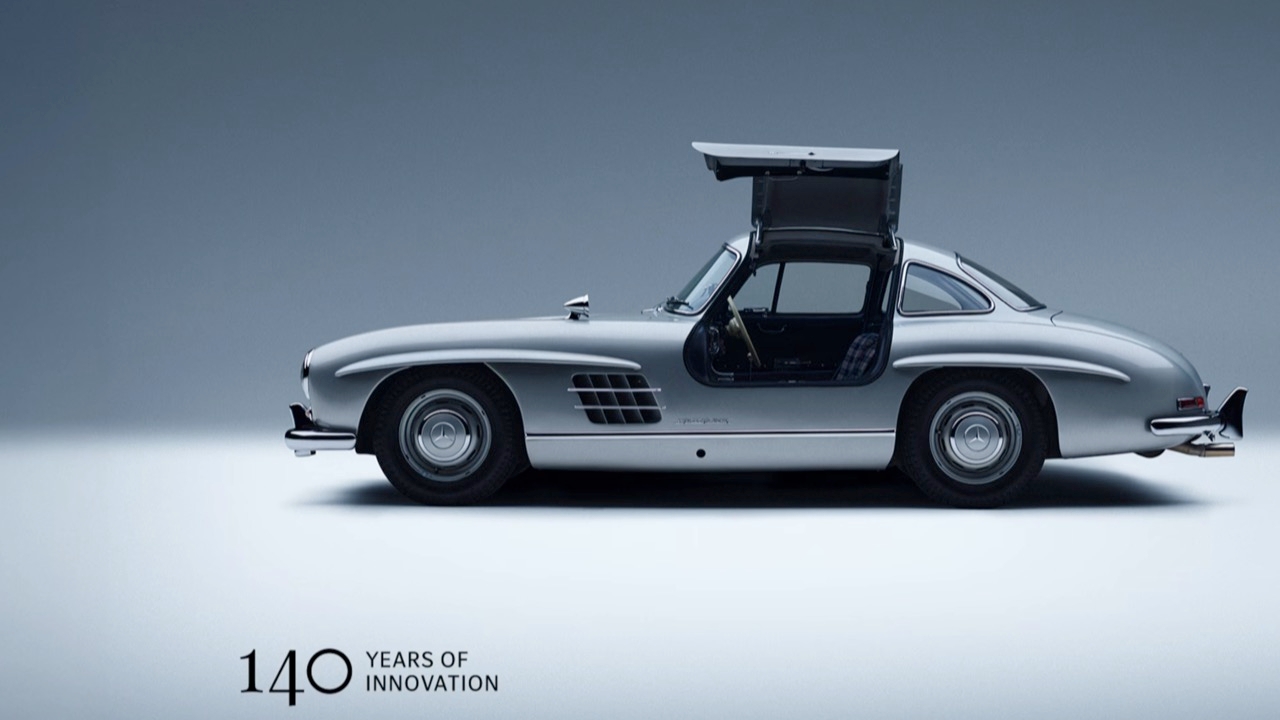
1954: Direct Fuel Injection introduced in the 300 SL, first in four-stroke cars.
1978: ABS (Anti-lock Braking System) launched in the S-Class (W116).
1981: Airbag and seatbelt tensioner installed for the first time.
1995: ESP® (Electronic Stability Program) developed, now a global safety standard.
Digital and Electric Mobility Era (2000s - Present): 2002: PRE-SAFE® system prepares occupants before accidents by tightening belts and closing windows automatically.
2016: Car-to-X communication enables vehicles to warn each other and infrastructure in advance.
2026 (Goal): Marking 140 years with the launch of the all-new electric CLA and over 40 new models focusing on fully electric, plug-in hybrids, and smart software-driven vehicles.