

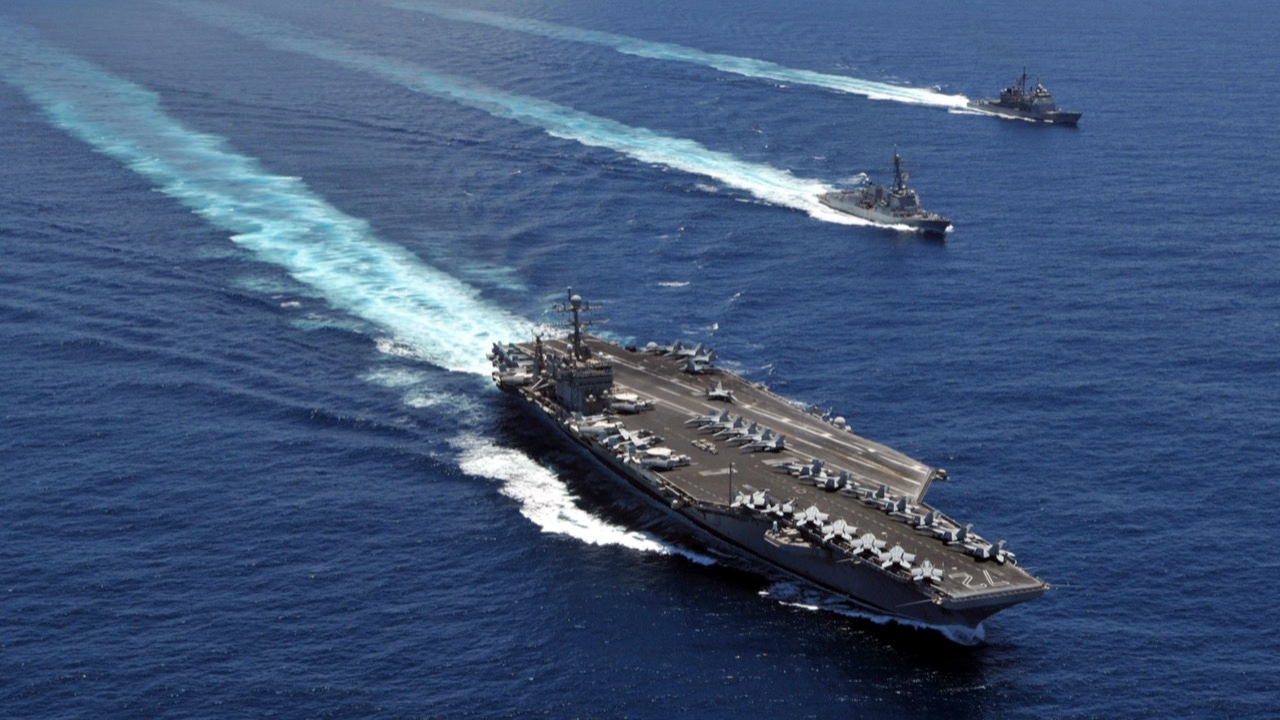
After repeatedly threatening to attack Iran, Trump still seems hesitant. On one side, he might think that if struck, Iran would be unable to respond. On the other, he cannot help but consider that the USS Abraham Lincoln (CVN-72) aircraft carrier and its support fleet—large, floating targets—face serious risks of being hit by a barrage of long-range missiles from all directions. Certainly, the fleet's defensive weapons might not intercept all incoming missiles. If Iran launched hundreds or thousands of missiles at the American fleet, mixing conventional missiles with dozens of hypersonic missiles, the US ship-based missile defenses would likely be overwhelmed. A direct hit to an aircraft carrier's flight deck—especially if weapons are being loaded or aircraft are being refueled—could cause damage far worse than the kamikaze attacks by the Japanese during the Pacific War.

The idea that aircraft carriers may be too vulnerable for modern warfare is a topic of intense debate among strategists worldwide. Key points for consideration include the following.
1. Threats from "Aircraft Carrier-Killer Missiles"
Anti-Ship Ballistic Missiles (ASBM): China has developed missiles such as the DF-21D and DF-26B with ranges between 1,500 and 4,000 kilometers, making it difficult for carriers to operate near coastlines without sufficient defenses. Saturation attacks with massive missile barrages and decoys complicate interception.

Hypersonic Missiles: Traveling at speeds over five times the speed of sound (Mach 5+) with unpredictable flight paths, these weapons significantly challenge current air defense systems. Reports suggest they can penetrate defenses and cause severe damage rapidly. Iran is well aware that a confrontation with the US is inevitable, so it prepares to counter with multiple long-range hypersonic missiles.

2. The View that Aircraft Carriers Can "Still Operate"
Layered Defense: Aircraft carriers do not operate alone; they are accompanied by Carrier Strike Groups including destroyers and corvettes that intercept threats. They also employ advanced laser systems and electronic warfare to mislead incoming missiles.
Durability of Large Ships: Sinking a vessel displacing hundreds of thousands of tons with multiple watertight compartments is harder than expected. One or two hits may not sink the ship but could cause mission disruption.
Tactical Adaptation: The US Navy is adjusting by deploying drones and longer-range aircraft so carriers can operate outside enemy missile range. Currently, American carriers remain about 700 kilometers from Iran's coast, well within range of Iranian anti-ship missiles.

3. Impact on "Maritime Blockades"
In high-conflict zones, large ships may be forced to retreat farther from shore, making maritime blockades more difficult and costly to maintain.
In summary, aircraft carriers are not "obsolete," but increased risks are transforming their role from "invincible offensive weapons" into "mobile command centers" that must exercise greater caution. If struck, the US would suffer significant embarrassment.