

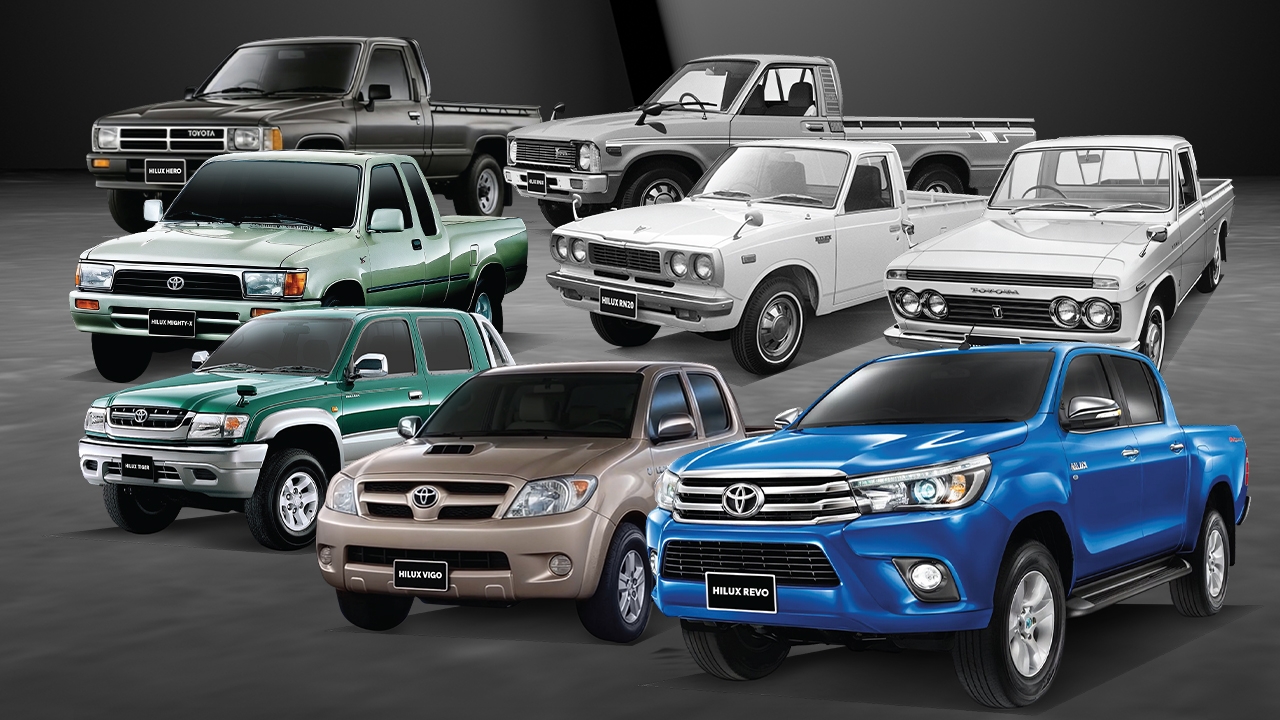
Let's revisit the origins of the TOYOTA HILUX, the popular pickup truck cherished by Thai people, developed collaboratively by Thais for domestic sale and international export.
The name Hilux comes from combining 'High' and 'Luxury,' representing the intersection of strength and elegance. Here is the timeline of its beginnings in Thailand.

In Thailand, the early era of the Hilux coincided with industrial and infrastructure development. The government focused on essential projects like roads, electricity, and water supply and began promoting industrial growth. However, the economy was still mainly agricultural, with most people living in rural areas. Pickup truck users were a specialized group.
They were mostly government agencies, construction contractors, and affluent rural residents. Pickup trucks served primarily as work tools rather than personal vehicles. The Hilux RN10 was Toyota’s first short-wheelbase pickup, imported fully assembled from Japan to Thailand.
It featured a small but powerful 1.5-liter gasoline engine with 77 horsepower, reaching a top speed of 130 km/h. It supported transporting goods and agricultural produce, becoming a familiar sight then. Its strong structure and smooth ride helped the Toyota Hilux gain recognition in Thailand.

The second-generation Hilux emerged during Thailand’s efforts to reduce rural poverty, promote diversified agriculture, and transition to an industrial economy. It gained popularity among traders, farmers, and agricultural transporters, becoming a trusted partner.
In 1972, there was a backlash against Japanese products in Thailand due to trade deficits, followed by the 1973 global oil crisis, where oil prices quadrupled in months. Diesel engines gained popularity for better fuel efficiency.
In 1975, the Thai government aimed to reduce import dependence. The Board of Investment (BOI) enhanced policies to encourage local manufacturing.
Besides other car models already locally assembled, Toyota began assembling the Hilux in Thailand, attracting Japanese parts suppliers to establish production bases locally, with over 25% of parts sourced domestically.

Known in Thailand as the Hilux “Superstar - Jumping Horse,” this generation updated its design for greater strength and responded to the growing diesel engine trend.
At the end of 1979, Toyota introduced the Hilux’s first diesel engine, a 2.2-liter L-series producing around 72 horsepower and 142 Nm of torque. Four-wheel drive versions were also introduced for the first time.
In manufacturing, Toyota adopted Cation Electro Deposit Painting (E.D.P.) technology to enhance rust resistance on the body, improving durability. Combined with good driving performance, load capacity, fuel efficiency, and toughness, the Hilux grew more popular, becoming a trusted pickup in many industries.

The Hilux HERO symbolized strength and durability. In the 1980s, Thailand developed better infrastructure and roads amid clear economic growth.
Following government policies promoting automotive investment, Toyota Motor Corporation partnered with Siam Cement Group to establish Siam Toyota Industry, producing engines domestically for local use and export.
Pickup trucks gained popularity for travel and small businesses, becoming more than just work vehicles—they became "family and business vehicles," reflecting users’ identities amid evolving market demands.
Toyota Thailand introduced the Extra Cab Hilux late in this generation. The Hilux’s strength, quality, durability, and reliability were clearly demonstrated in this generation.

A new definition of multipurpose pickup trucks emerged in the 1990s when Thailand’s economy grew rapidly, striving to become the "Fifth Tiger of Asia." Pickup trucks became vital for small businesses, trade, and transportation. Many Thais began owning private cars, and the Hilux became the first vehicle for many families due to its modernity, toughness, and versatility. The Extra Cab model was especially popular for its value and multipurpose use.
With modern styling, robust engine performance, and durability, the Hilux Mighty-X was favored nationwide, including in rural and remote areas requiring off-road capability. Thai manufacturing quality was widely recognized.
In 1992, Toyota began exporting the Hilux Mighty-X to ASEAN markets like Laos, the Philippines, and Cambodia. Toyota’s Thai factory became a pickup production hub, with domestic parts usage rising to 72%.

From a work vehicle to a lifestyle symbol: despite the 1997 Asian financial crisis, Toyota remained committed to Thailand, maintaining employment, production, and investment (Leave no one behind).
In 1998, Toyota launched the Hilux Tiger with a larger, more luxurious, and modern body designed for personal use. It featured GOA safety body structure, enhancing impact absorption and cabin safety, setting a new standard for pickups in Thailand.
Thanks to Thai assembly quality, locally produced Hilux was trusted for export to Australia in the same year.
The Prerunner model (2WD with lifted suspension) was introduced, aligning with lifestyle pickup trends, marking a shift from "work truck" to "vehicle for all occasions."
Also, the Hilux Tiger introduced the D-4D diesel common rail engine, enhancing efficiency, power, and reducing emissions, significantly advancing pickup performance.

From Thai hands to global strength: the Hilux Vigo was developed under the IMV Project initiated by Akio Toyoda, Chairman of Toyota Motor Corporation, marking a major milestone for Toyota in Thailand.
Thailand was chosen as the main production and export hub for the Hilux, using over 90% domestic parts, creating many jobs and making Thailand a key global Toyota production base.
The Hilux Vigo set new standards in Thailand’s pickup segment with a strong frame supporting multiple body styles, luxury design, large body size, powerful and fuel-efficient common rail engines, smooth suspension, and comprehensive safety features. It became the "people’s pickup truck," meeting needs of business, family, and lifestyle users.
Vigo achieved unprecedented popularity, breaking domestic sales records with over 15,000 units sold monthly in its first four months (Sept–Dec 2004).
In 2007, Toyota opened the Ban Pho plant to expand Hilux and IMV production, a modern, high-standard, environmentally friendly facility. The Hilux Vigo earned global recognition for quality and performance, with total exports reaching 1 million units in 2010 and 2.4 million in 2012.
The Hilux Vigo was continuously improved to meet Thai users’ lifestyle demands, including TRD Sportivo versions in 2012 and 2014.
For business use, Toyota introduced the Hilux CNG in 2012, factory-equipped with a bi-fuel system (gasoline and CNG) for enhanced value.
These factors made the Hilux Vigo one of the most successful Hilux generations in company history, with domestic sales totaling 1.65 million units.

A new definition of pickup trucks: the Hilux Revo combines toughness and comfort, targeting customers wanting premium pickups with advanced technology, full safety features, and smooth, car-like driving.
Besides product excellence, Hilux Revo contributed to Thailand’s industrial development, production, research, and enhancing local workforce capabilities, supporting Thailand’s role as a global production and export center.
By 2017, the IMV project had exported 3 million units, with Hilux produced in Thailand exported back to Japan for the first time. By 2022, total exports reached 4 million units, confirming the high production standards trusted worldwide.
Amid digital transformation, Hilux Revo remains a national car and people’s pickup, meeting young users’ lifestyle and leisure needs. Hilux users expanded into two main groups: work vehicles for agriculture, industry, parcel delivery, and lifestyle vehicles for tourism, camping, and outdoor activities, with widespread customization reflecting owners’ identities in both low and lifted styles.
Toyota introduced new variants like the ROCCO flagship lifestyle model with bold, rugged design enhancing leadership and confidence, and the Z-Edition for young, sporty low-rider style enthusiasts, extendable to Zaap or Zing custom styles.
Hilux’s development never stops: in 2020, it received a redesign with updated lineup and improved GD engines offering more power and better fuel efficiency.
In 2022, Toyota launched the first GR Sport Hilux with sportier performance and design. In 2024, the new flagship Hilux Revo GR Sport Wide Tread was introduced, featuring rally-inspired styling, premium sporty design, and outstanding engine power and suspension.
Throughout, Toyota and Hilux have been proud to stand with and listen to Thai people, continuously innovating while supporting Thailand’s economy and society to benefit future generations.
Hilux Generation 9 | TOYOTA HILUX TRAVO from 2025 to present.

Featuring a new exterior and interior design under the 'Tough & Agile' concept, it blends strength with agility. The front design is inspired by Cyber Sumo, representing a battle-ready Shikiri Pose, conveying stability, strength, and steadiness.
The interior design follows the 'Robust Simplicity' concept, emphasizing simplicity yet power. All functions are practical, with comprehensive modern amenities, including the latest Toyota Safety Sense technology and many additional safety features.
The HILUX TRAVO prioritizes handling and ride comfort, introducing 'Dynamic Cloud' technology to develop elements affecting driving, delivering smooth, precise control and excellent stability.
All TRAVO models come with a 2.8-liter GD Super Power engine, offering high power and improved fuel efficiency—up to 5.8% better than the 2.4-liter engine and 7.5% better than the previous 2.8-liter model.
Besides diesel engines, Toyota offers the HILUX TRAVO-e, an electric Body-on-frame pickup—the first of its kind from Toyota available for sale. It was developed based on Toyota's QDR (Quality-Durability-Reliability) principles.
Maintaining the performance and durability standards of the Hilux pickup, the TRAVO-e adds 'Diamond Guard' technology to protect the battery and electric drive system, ensuring safe use for personal, cargo, and off-road driving.
The IMV project transformed Toyota Motor Thailand from a domestic production base to a global pickup production and export hub. Today, Hilux trucks made in Thailand are exported to 133 countries, with over 4.6 million units shipped, using up to 95% domestic parts.
This has created jobs, livelihoods, and income for Thai people through employment of over 275,000 people, including corporate staff, 153 dealership employees, and over 290 parts manufacturers nationwide.
Hilux has played a key role in strengthening Thailand's automotive industry, accounting for more than 30% of the entire sector and contributing up to 3% of Thailand’s GDP annually, reflecting its immense economic value throughout the supply chain.