

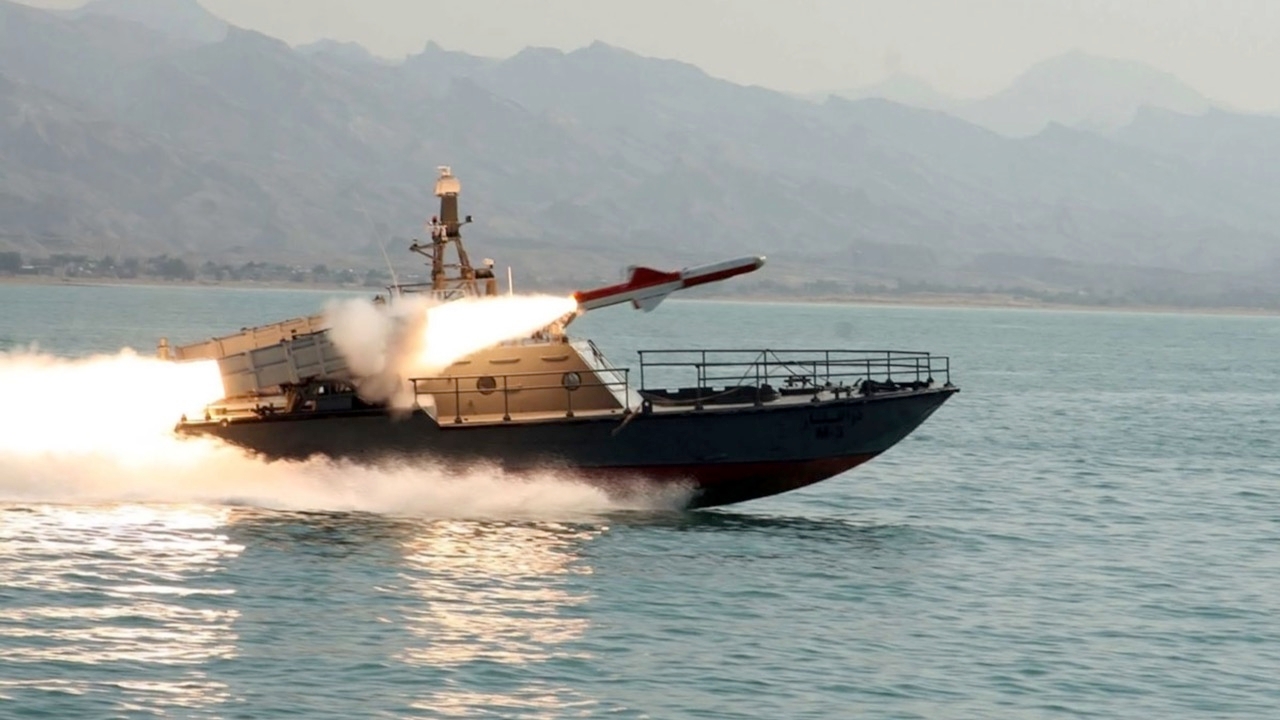
Iran's armed fast attack craft (FAC) are the cornerstone of the Islamic Revolutionary Guard Corps Navy's (IRGCN) asymmetric warfare strategy, emphasizing the use of numerous small boats attacking in 'swarm tactics' to confuse and overwhelm the defense systems of larger warships.


Technical details and weaponry of the fast attack boats that enforce the Strait of Hormuz blockade.
Regarding the engines, Iran has faced sanctions for over 46 years, lacking Western-made marine engines, especially high-quality German ones. Therefore, Iran has developed high-performance diesel engines domestically by modifying high-speed racing boat engines to achieve speeds that conventional warships cannot match.
Weaponry.
Guided missiles: such as the Nasr-1 (range 35-50 km) and Abu-Mahdi, a long-range missile.
Close-range weapons: multiple rocket launchers (MRLS) of 107 mm caliber, 12.7 mm heavy machine guns, and 20 mm Gatling guns for self-defense and attacking small boats.
Camouflage: newer vessels like the Shahid Soleimani and Seraj-1 classes use fiberglass or aluminum materials and feature catamaran (twin-hull) designs to reduce radar reflection (stealth).
Decisiveness and attack strategy.
Swarm tactics: deploying dozens of fast boats to encircle targets from multiple directions simultaneously, overwhelming enemy defense systems beyond their capacity (saturation attack).
Hit-and-run attacks: leveraging speeds up to 110 knots in some models to approach within 30-40 km, launch missiles, and swiftly retreat to minimize counterattack risk.
Geographical advantage: often operating in the Strait of Hormuz and along coasts with numerous islands, allowing small boats to hide from radar and launch ambushes easily.
Cost-effectiveness: these boats are inexpensive compared to large warships; losing a few fast boats to destroy or damage aircraft carriers or destroyers represents a strategic victory for Iran.


Heydar-110.
Top speed 110 km/h, main engine undisclosed, primary weapons: two anti-ship missiles (Nasr-1 family), operational range undisclosed.


Seraj-1.
Top speed 130 km/h, main engine modified from Bladerunner 51 racing boat, primary weapons: 107 mm multiple rocket launcher, 12.7 mm machine guns, operational range used as a fast coastal patrol attack boat.


Peykaap III.
Top speed 96 km/h, main engines: two diesel engines producing 2400 horsepower, primary weapons: Kowsar or two Nasr anti-ship missiles, torpedoes, operational combat range undisclosed.


Zolfaghar.
Top speed 60 km/h, main engine unspecified, primary weapons: anti-ship missiles, surface ship-destroying torpedoes; new 2025 models equipped with air-defense missiles.


Shahid Soleimani (Corvette).
Iran's newest warship, top speed 60 km/h, powered by four domestically produced turbo diesel engines. Equipped with various missiles (ASCM, SAM) and Gatling guns, with an operational range of 5,000 nautical miles. The IRGCN employs a 'Sea Denial' strategy to block the Strait of Hormuz using a combination of new warships and offshore weapons.


Main warships controlling the area (2026).
Shahid Soleimani-class corvette: a modern flagship warship recently introduced and used in the "Smart Control of the Strait of Hormuz" exercises in February 2026. It features a catamaran design with strong radar stealth and vertical launch systems (VLS) for anti-ship and long-range air-defense missiles (Sayyad-3G).
Shahid Abu Mahdi al-Muhandis-class: smaller fast attack boats (300 tons) emphasizing high maneuverability, equipped with 14 anti-ship missiles, designed specifically for patrol and area denial.


Tactics and supplementary weapons for closing the strait.
Fast Attack Craft (FAC): Iran has deployed hundreds of missile-equipped fast boats at 16 strategic points around Larak Island, prepared to launch swarm attacks if breached.
Drones and sea mines: reports indicate Iran has begun deploying sea mines and unmanned surface vessels (USVs) to attack oil tankers attempting to pass through the strait.
Land-based missiles: the blockade is enforced not only by boats but also by cruise missiles launched from coastal bases, striking maritime targets with precision.
Missiles installed on Iranian warships and fast boats vary in range and destructive power according to mission type. The latest 2026 data includes:


Anti-ship missiles.
Designed to destroy surface targets ranging from patrol boats to aircraft carriers.
Short-range (25–50 km): Nasr-1 and Nasir families, mounted on Heydar-110 boats, with warheads around 130 kg.

Medium-range (120–300 km): Noor, Ghader, and Ghadir missiles mounted on Shahid Soleimani-class corvettes, capable of sea-skimming to evade radar. Their range extends 700–1,000+ km, expanding strike capability to the Arabian Sea. The latest Ghadr-474 reportedly reaches up to 2,000 km.


Surface-to-air missiles (SAMs).
Equipped on new warships to defend against aircraft and drones. Sayyad-3G missiles are installed in VLS on Shahid Soleimani-class ships with an operational range of about 150 km.
Strategic and new weapons (2026).
Hypersonic missile (Fattah-1): Iran claims speeds of Mach 13-15, designed to penetrate air defense systems.
Iran is negotiating to purchase Chinese CM-302 supersonic missiles with a 290 km range to enhance strike capability against U.S. naval forces.
Latest situation (4 March 2026): Iran officially closed the Strait of Hormuz in response to attacks by the U.S. and Israel. Although physical blockade forces are not fully deployed, threats against all ships have caused most shipping companies to halt passage, reducing maritime traffic in the area by over 90% and immediately driving global oil prices upward.