

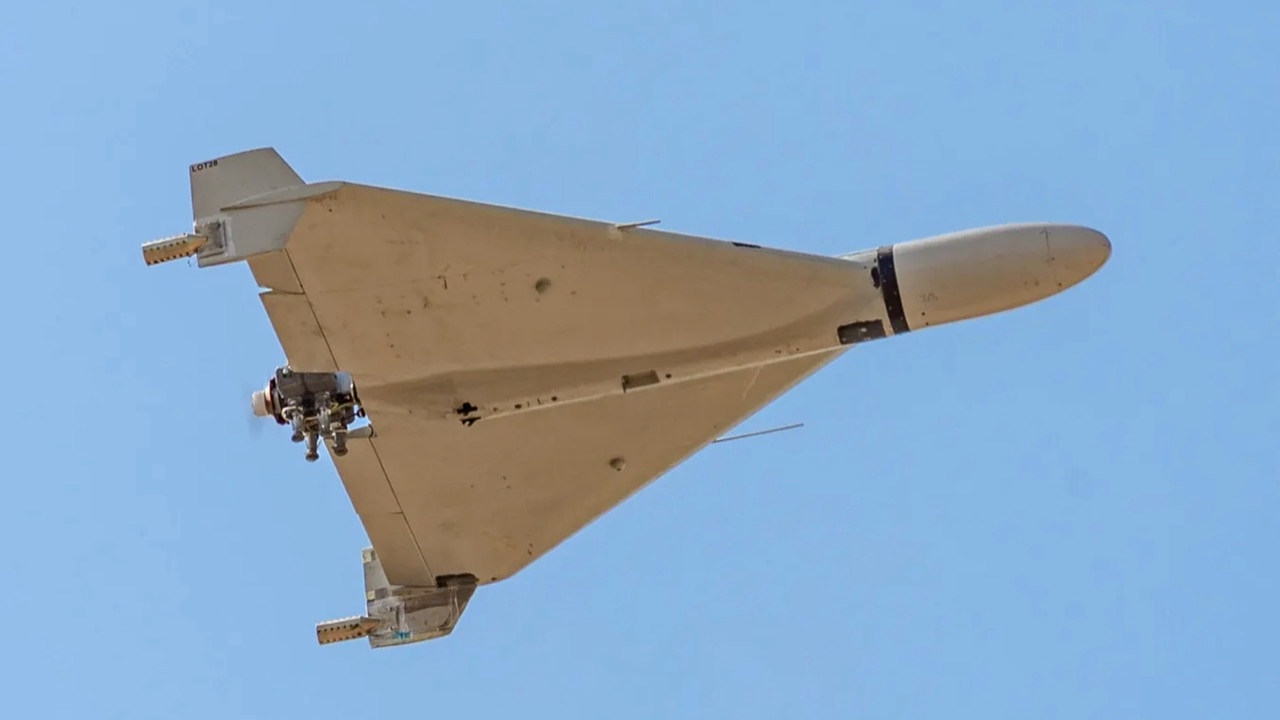
Iran's Shahed-136 (pronounced Shahed-136) is a one-way suicide drone launched like a kamikaze weapon that never returns once deployed. Nicknamed the "Poor Man's Cruise Missile," it is inexpensive, simple, and strategically effective in swarm attacks to overwhelm air defense systems, striking radar bases or enemy strongholds. Technical specifications follow.


Type: One-way loitering munition / kamikaze drone.
Length: 3.5 meters.
Wingspan: 2.5 meters.
Weight: Approximately 200 kilograms.
Warhead weight: 40–50 kilograms (some upgraded versions up to 90 kilograms).
Engine: MD-550 piston engine (4-cylinder, 2-stroke) producing about 50 horsepower.
Maximum speed: Approximately 185 kilometers per hour.
Operational range: Very long, between 1,000 and 2,500 kilometers, depending on model and configuration.
Navigation system: GNSS (GPS/GLONASS) combined with Inertial Navigation System (INS).

Key features that make the Shahed-136 a fearsome weapon.
Design and cost: The drone is built using commonly available materials (such as composite structures), resulting in very low production costs (about 20,000 to 50,000 USD per unit) compared to the expensive surface-to-air missiles the enemy must use to intercept it.
Swarm attack: Due to its low price, Iran often launches large numbers simultaneously to saturate enemy radar and air defense systems, overwhelming them so they cannot intercept all targets.
Stealth: The drone's small size and low flight altitude make radar detection difficult. Its small engine produces low heat, making infrared detection challenging as well.
Accuracy: Although it lacks complex real-time target tracking, pre-programmed target coordinates enable precise strikes on fixed ground targets.


Design and cost.
The drone uses widely available materials (e.g., composite structures), leading to very low production costs (about 20,000 to 50,000 USD each), far cheaper than the costly air defense missiles used to intercept them.

Swarm attack or asymmetric warfare.
Because the Shahed-136 costs less than 900,000 baht, Iran frequently launches many simultaneously to overwhelm enemy radar and air defenses, preventing full interception. Its small size, triangular wings, and near 200 km/h low-altitude flight make radar detection difficult. Its small engine emits low heat, complicating infrared detection. Despite lacking sophisticated real-time target tracking, the 136 II model uses pre-set coordinates to accurately strike fixed ground targets.


Usage.
Launch method: The 136 drone is launched from truck-mounted mobile launchers using rocket-assisted takeoff. After initial boost, the propeller engine powers flight to the target. The mobile launcher avoids enemy targeting; after firing, it hides, reloads, and fires again. The drone is designed to destroy ground targets like command centers, radar systems, fuel depots, or critical infrastructure, detonating its 50-90 kg high-explosive warhead on impact.
Iran's Shahed drone family includes not only kamikaze attack models like the Shahed-136 but also reconnaissance drones, multipurpose attack drones, and stealthy flying wing types.

Shahed drone family by primary mission type.
1. Suicide drone group (Loitering Munitions): Focused on "low cost and mass use." Shahed-131: an earlier, smaller model with shorter range (~900 km) and smaller warhead (~10-15 kg) designed to attack fixed targets similarly to the 136. Shahed-136 (Geran-2) is the most famous, with long range (over 2,000 km) capable of striking Israel comfortably. The second-generation 136 carries 40-50 kg warheads, aimed at infrastructure destruction.
2. Attack and reconnaissance drones (UCAV - Unmanned Combat Aerial Vehicle).
These drones are reusable, equipped with guided weapons, and have high performance comparable to Western drones like the MQ-1 Predator.
Shahed-129: A large drone with long endurance (up to 24 hours), high-performance surveillance cameras, and capable of carrying four guided munitions (e.g., Sadid guided bombs). Suitable for precise reconnaissance and attack missions.
Shahed-149 Gaza: A more modern, larger model with wider wings, developed to increase range and payload capacity. It is among Iran's high-end drones.


Iran's rapid drone development focuses on reverse engineering captured enemy drones or acquiring technology from black markets, then adapting it to their budget. Current research includes the Shahed-238, which replaces the piston propeller engine with a small jet engine, greatly increasing speed and making interception more difficult.


A comparison between Iran's Shahed-136 and the US military's Coyote drone offers an interesting case study. Although both are small drones, they are designed with entirely different philosophies and purposes: Shahed-136 emphasizes quantity and low cost for attack, while Coyote is a highly precise, technologically advanced, and more expensive anti-drone weapon.
Key differences.
Design philosophy.
The Shahed-136 is designed to saturate enemy air defenses with inexpensive drones, forcing the enemy to use costly missiles to shoot down cheap targets. This gives the user a long-term economic advantage in warfare.
Coyote: Developed specifically to counter drones like the Shahed-136, the US developed the LIDS (Low, slow, small-unmanned aircraft Integrated Defeat System) with Coyote as the main weapon, efficiently and cost-effectively hunting and destroying enemy drones compared to using larger guided missiles.
2. Interception capability.
Coyote Block 2 (Kinetic) carries a warhead to directly collide and destroy targets (similar to a small missile), ideal for dealing with swarm attacks.
Coyote Block 3 (Non-kinetic) is more advanced, using non-collision energy to stop enemy drones without collateral damage, and in some cases, can be reused.
3. Cost and usage.
Although cheaper than standard air defense missiles like the Patriot, Coyotes remain several times more expensive than Shahed-136s (costing hundreds of thousands of dollars each). Thus, Coyotes emphasize precision one-shot-one-kill use, while Shahed-136 relies on mass deployment to penetrate defenses.


The export of Shahed drones, particularly the Shahed-136, is geopolitically and militarily complex, often involving covert sales or intermediaries.
Summary of the current distribution status of these drones based on available information:
1. Main allies (with clear evidence): Russia is the largest and most important customer. Russia uses Shahed-136 drones under the name Geran-2 in the Ukraine war. Initially imported from Iran, technology transfer and joint production within Russia now allow mass production.
2. Proxy forces and conflict zones: Beyond nation-states, Iran supplies technology or drones to various forces in the Middle East for strategic use, including groups supporting Iran in Iraq and Syria. Recently, they have been used to attack US and allied bases and infrastructure. In Yemen, the Houthi group reportedly uses drones very similar to Iranian technology to strike maritime and energy infrastructure targets.
3. Reports concerning other countries.
Various news and analyses indicate interest from other regional countries such as Saudi Arabia, Qatar, the United Arab Emirates, and even Pakistan, regarding acquisition or technology study. However, these reports are mostly rumors or analyst observations rather than confirmed official purchases.