

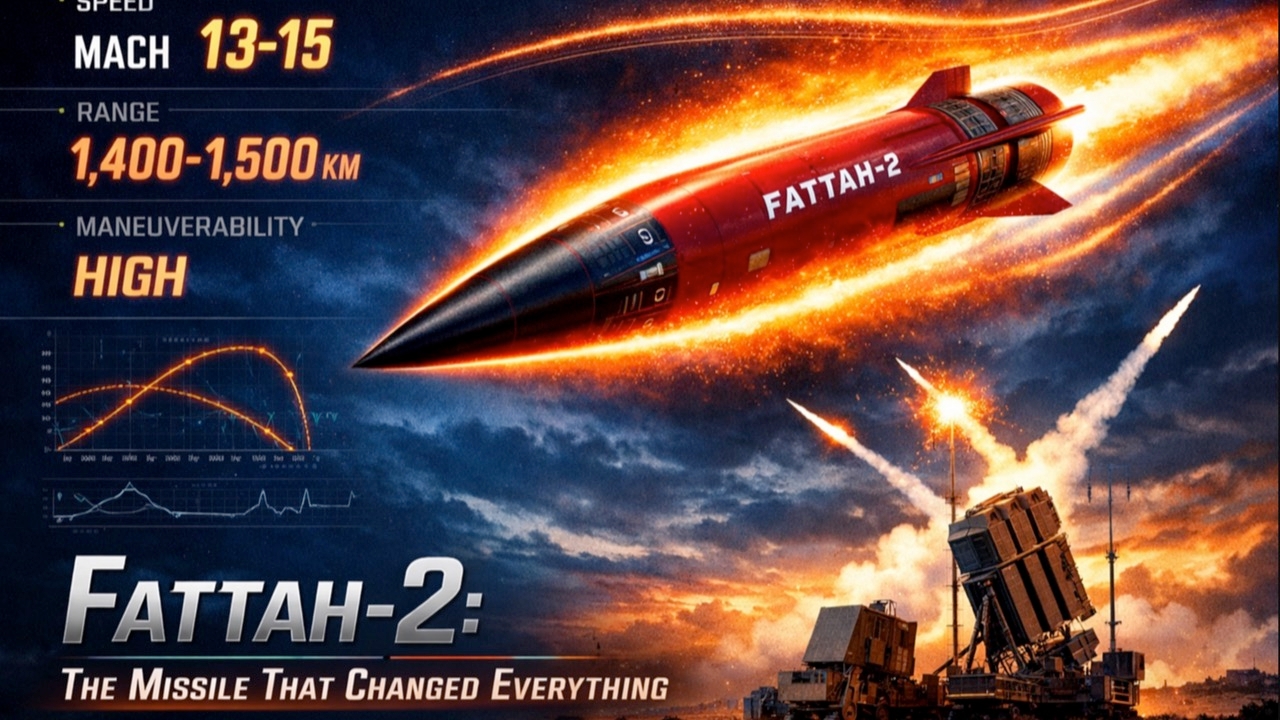
The term "dancing missile" in military news from 2024 to 2026 is commonly used by media or analysts to refer to missiles in the Hypersonic Glide Vehicle (HGV) category—missiles capable of maneuvering (gliding and evading) at very high speeds. The metaphor "dancing" arises because these missiles fly with angles and trajectories distinct from typical ballistic missiles, which follow a curved (parabolic) path.


Changing direction within the atmosphere
Conventional missiles fly along a predictable parabolic arc, making their impact point easy to estimate. However, Iran's newer missile models, Fattah-1 and Fattah-2, are designed to adjust their course (zig-zag) while in the atmosphere, making it extremely difficult for air defense systems to calculate interceptions. The Fattah missiles have small fins to adjust their flight angle. As the missile nears its target, it suddenly changes its angle at high speed before striking and detonating a high-explosive warhead.

Warhead technology of the Fattah missile (The Conqueror)
Fattah-1 debuted in mid-2023, featuring a warhead equipped with a scramjet engine and a movable nozzle that allows it to "wobble" or change direction at hypersonic speeds as it approaches the target.


Fattah-2 was developed further as a hypersonic cruise missile or glide vehicle that glides at lower altitudes than typical missiles to evade radar detection.
The strategic purpose behind inventing a missile capable of sudden directional changes—the ability to "dance" or glide evasively—is primarily to penetrate advanced missile defense systems such as Israel's Arrow 3 and the US's THAAD. These defenses rely on predictable trajectory calculations for interception. When within their defense range, Iran's new missiles rapidly alter their flight path, confusing the interceptors and causing them to miss their targets.
In summary, this term compares the maneuverability of Iran's Fattah hypersonic missile family, developed specifically to evade interception.
Specifications of Fattah, Iran's latest hypersonic missile family, can be divided into two main models:

1. Fattah-1, the pioneering model (introduced June 2023), is a medium-range ballistic missile (MRBM) equipped with a Maneuverable Reentry Vehicle (MaRV) warhead that can evade in the final stage. It reaches speeds of about Mach 13 to 15 (roughly 16,000 to 18,500 km/h) with a range of 1,400 kilometers. Both the booster and warhead use solid fuel. A key feature is a small engine with a movable nozzle on the warhead that allows in-atmosphere and exoatmospheric trajectory adjustments to deceive radar and interception computers.

2. Fattah-2, the upgraded model (introduced November 2023; reportedly operational by early 2026), marks a significant leap as a full Hypersonic Glide Vehicle (HGV). It maintains speeds at Mach 15 with a slightly extended range of 1,500 kilometers. The booster uses solid fuel, but the gliding vehicle uses liquid fuel, allowing finer thrust control. The warhead weighs about 200 kilograms, focusing on precision and evasion rather than wide-area destruction.
Special "dancing" capabilities:
Low Altitude Gliding: It can glide at low altitudes (approximately 12 to 30 km above ground), which is too low for high-level interceptors to operate effectively and too fast for lower-tier defenses to target accurately.
Unpredictable Path: It can freely perform horizontal maneuvers, making the missile's approach direction unknown until the last moment.