

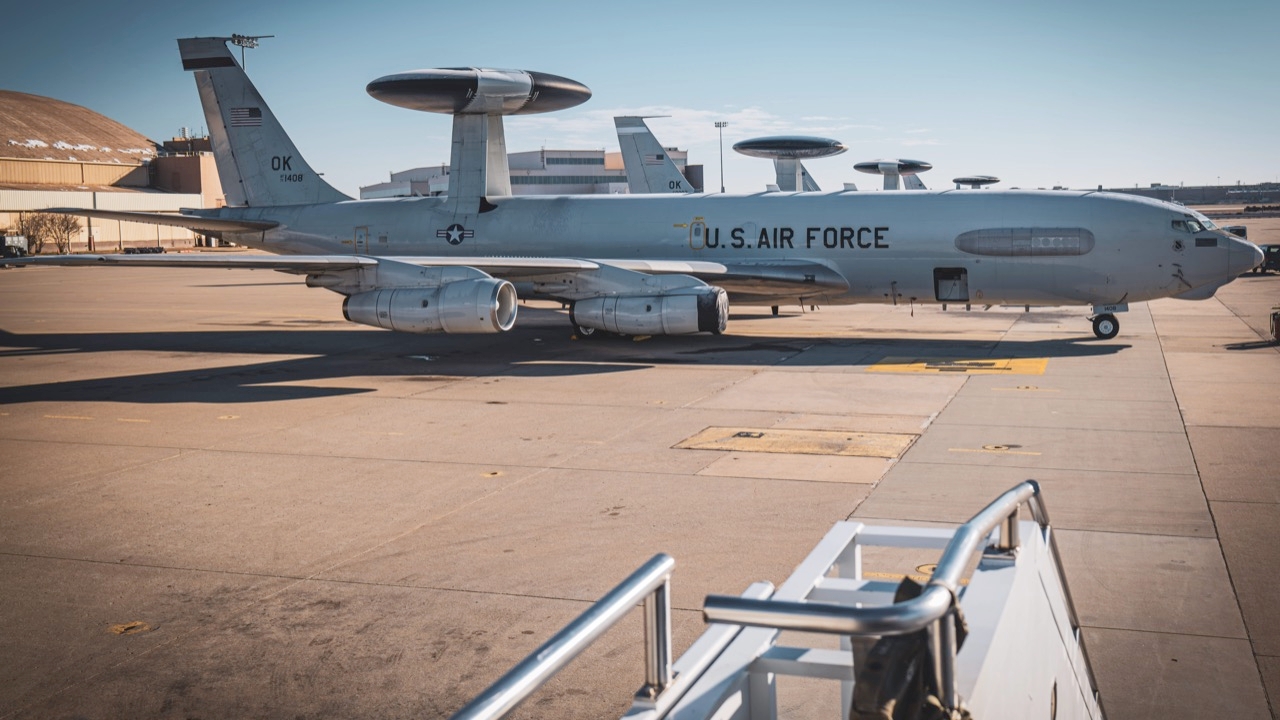
Leaked images from Prince Sultan Air Base show the complete loss of aircraft number 81-0005, an E-3G "Sentry" Airborne Early Warning and Control (AEW&C) plane assigned to the US Air Force's 552nd Air Control Wing, based at Tinker Air Force Base in Oklahoma. This occurred following an attack on Prince Sultan Air Base in Saudi Arabia yesterday by Iran, which used missiles and drones.

Iran's attack on the US aircraft was highly precise, deliberately targeting the most critical part of the plane—the rear section, which houses the rotating radar dome. This dome contains numerous sensitive components, including antennas for the aircraft’s AN/APY-2 surveillance radar system.
The loss of the E-3G Sentry aircraft (tail number 81-0005) at Prince Sultan Air Base in Saudi Arabia is a significant blow to the US Air Force, especially regarding its high-demand, low-density surveillance aircraft. However, Western media reports still describe the airframe as fire-damaged, despite images clearly showing a violent explosion at the rear, likely caused by a strike from a kamikaze drone rather than a medium-range missile, which would have caused more extensive damage.

Satellite imagery and initial reports indicate the aircraft sustained severe damage while parked on the ground, causing the upper structure and radar dome (Rotodome) to collapse entirely. The plane, tail number 81-0005, was among the fleet upgraded to the Block 40/45 standard (E-3G), featuring the most advanced computer and sensor upgrades for regional mission testing and operations. The E-3 Sentry fleet is limited in number and out of production for some time; the total loss of such an aircraft directly affects air surveillance capabilities in the Middle East.

The E-3G Sentry is the latest Airborne Warning and Control System (AWACS) aircraft in US Air Force service, representing a modernized upgrade from the earlier E-3C model to 21st-century standards. The Block 40/45 upgrade, which transformed the E-3C into the E-3G, focused on overhauling the computer and internal network systems—the largest electronic system upgrade in the unit’s history. It replaced legacy operating systems from the 1970s-80s with open architecture based on Windows and Red Hat Linux, enabling easier software updates similar to commercial computers. The new system processes data from multiple sensors (sensor fusion) and displays it on high-resolution screens, allowing battle controllers a clearer and faster overall battlefield picture.
Surveillance capabilities include the Rotodome radar housing the large AN/APY-1 or APY-2 radar rotating above the fuselage, capable of detecting low-flying aircraft (look-down) and targets more than 400 kilometers away. Using Link 16 and other data links, the E-3G acts as a "data hub," receiving information from ground units, naval vessels, and other fighter aircraft to relay accurate target data among forces.

Preliminary technical data
The airframe is modified from a Boeing 707-320B commercial aircraft.
Powered by Pratt & Whitney TF33 turbofan engines (US version).
Maximum operating altitude exceeds 29,000 feet for missions.
Mission duration allows for approximately 8 hours of continuous flight without aerial refueling, with the option to extend beyond 24 hours with in-flight refueling.

Although the E-3G has been modernized, the aging Boeing 707 airframe is increasingly difficult to maintain due to parts scarcity. Consequently, the US Air Force plans to replace the E-3 Sentry with the newer E-7A Wedgetail, based on the Boeing 737, in the near future.
The E-3G surveillance aircraft serves as the 'eyes in the sky,' coordinating with fighter jets and air defense systems. The loss of this aircraft at a frontline base will impact airspace management in the area. Such an event is rare for a strategic-level aircraft parked at a heavily secured base.