

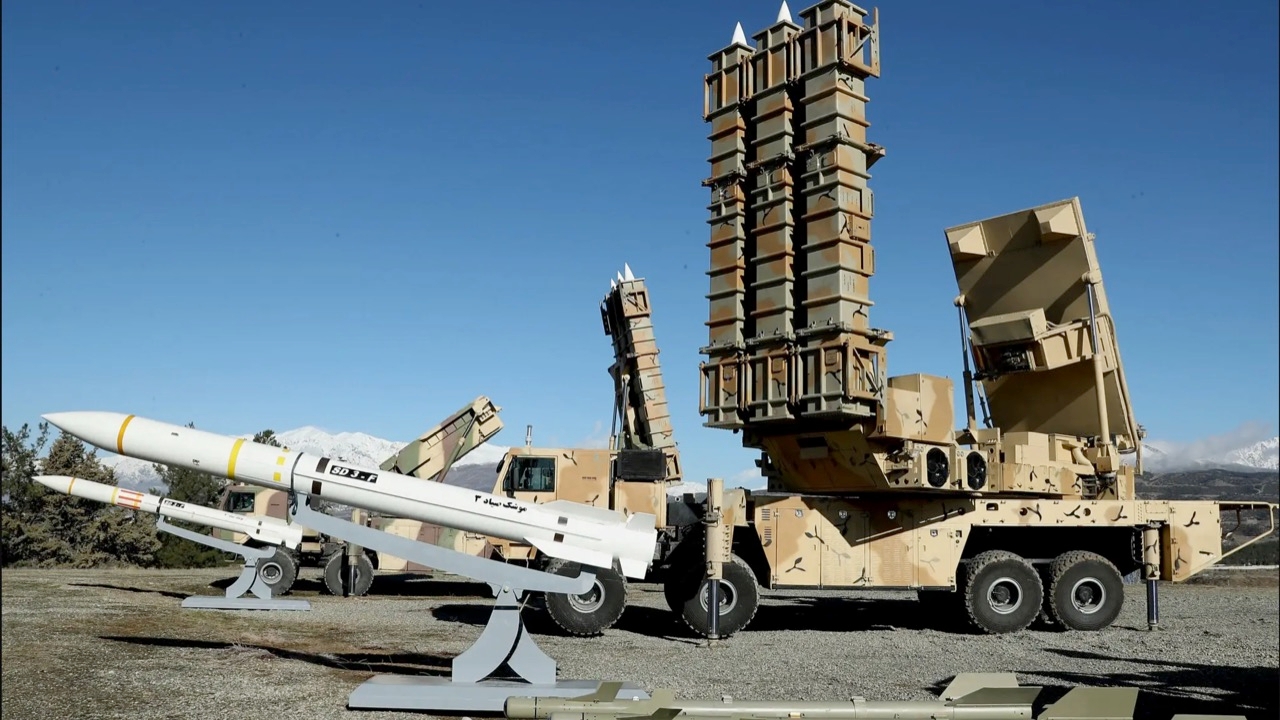
Certainly, the gateway to hell opened by Trump remains difficult to close despite his efforts. The simplistic expectation that a swift decisive victory over Iran could be achieved through mass strikes has become a nightmare for the U.S. and Israel. The latest situation involves a U.S. Air Force F-15E Strike Eagle shot down over Iran on 3 April 2026 during Operation "Epic Fury." The downed F-15E carried two crew members (one pilot and one Weapons Systems Officer, WSO). American media report that one crew member has been rescued by U.S. combat search and rescue (CSAR) teams, with Israeli sources confirming he is alive. The other crew member remains missing with uncertain status. Iranian sources: Tasnim News Agency claims to have detained one pilot, but the U.S. has not confirmed this. Photos of the wreckage and the ejection seat were released by Iran's Islamic Revolutionary Guard Corps (IRGC), confirming the authenticity of the incident. The missing crew member is presumed either killed or captured by IRGC forces. It is well known that downing U.S. warplanes is certain to happen again as Iran has been closely tracking enemy flight paths and preparing a comprehensive defense for over 20 years. Iran understands it cannot avoid attacks from the U.S. and Israel and anticipates provocations leading to strikes. Thus, their long-term defensive preparations are deliberate and thorough.

Details and analysis of the U.S. Air Force F-15E Strike Eagle shootdown over Iran on 3 April 2026 during "Operation Epic Fury" are emerging. The losses also extended to a Blackhawk helicopter shot down while attempting to rescue the two F-15 crew members.
Incident Overview
Date of incident: 3 April 2026
Location: Airspace over northern Iran (reports suggest near Qeshm Island in the Strait of Hormuz or central Iran)

The downed F-15E likely belonged to the 494th Fighter Squadron, 48th Fighter Wing, based at RAF Lakenheath, UK (based on the red stripe on the vertical tail fin in the wreckage photos).
Pilot status: The F-15E had two crew members—a pilot and a weapons systems officer (WSO).
One crew member was rescued by combat search and rescue (CSAR) teams.
The second crew member remains missing. Tasnim News Agency claims he was captured, but there is no official confirmation yet.

Technical and tactical analysis
Cause of shootdown: Iran claims to have used an advanced new air defense system to engage the intruding fighter jet. This system is believed to be either the Bavar-373 or the upgraded Khordad-15. Western media, primarily U.S. sources, have not confirmed the exact weapon system used. Much of the U.S.-based reporting is controlled and often contains misinformation, especially given President Trump's inconsistent statements since the start of attacks on Iran. Trump has claimed negotiations were underway, but Iranian authorities have firmly denied any talks.

Military significance: The loss of the older-generation F-15 marks the first U.S. manned combat aircraft shot down by opponents in this conflict. Earlier, the U.S. lost an MQ-9 Reaper drone, and an F-35 was damaged but managed an emergency landing in mid-March. Additionally, an E-3 Sentry AWACS was severely damaged on the ground, and a KC-135 aerial refueling tanker was downed, killing all six crew members. These losses underscore escalating risks.
Operational risk: The incident occurred shortly after U.S. Defense Secretary Pete Hegseth claimed the U.S. had achieved increased air superiority, enabling B-52 bombers to conduct deep strikes inside Iran. The F-15E loss serves as a reminder that Iran's air defense remains a serious threat.
On the same day, 3 April 2026, an A-10 Thunderbolt II (Warthog) crashed near the Strait of Hormuz but the pilot was rescued safely. Analysts suggest this may indicate coordinated air defense actions by Iran across multiple regions.


The downing of the F-15E highlights the limitations of 4th-generation fighters. Despite advanced electronic warfare upgrades, when confronted with dense, modern air defense networks, deep strike missions remain highly risky compared to stealth aircraft like the F-22 or F-35.

Bavar-373 is a strategic long-range road-mobile surface-to-air missile (SAM) system developed indigenously by Iran. Its main goal is to outperform the Russian S-300 system and rival aspects of the S-400.
Following the 3 April 2026 F-15E shootdown, the Bavar-373 system is widely analyzed as the primary candidate responsible due to its advanced technical capabilities.
1. Technical data and performance: As of 2025-2026, the system was upgraded to the Bavar-373 II version, enhancing its capability to destroy enemy combat aircraft.
Detection range: up to 450 km (up from 350 km previously).
Tracking range: approximately 400 km.
Engagement range: maximum 300–400 km when using new missile variants.
Maximum altitude: about 32 km (roughly 100,000 feet), covering the operational ceiling of current fighter jets.

2. Sayyad (Hunter) missile family
Bavar-373 employs Sayyad-4B missiles, which are key to its performance:
Solid fuel provides rapid readiness and high speed, estimated up to Mach 6.
Mixed guidance system uses active/semi-active radar homing and reportedly infrared search and track sensors in the terminal phase to reduce electronic countermeasures (ECM) vulnerability.

3. Radar and fire control systems
AESA radar with phased-array technology capable of detecting low radar cross-section (RCS) targets, including drones and cruise missiles.
Multi-target engagement capability allows simultaneous tracking of 100–200 targets and engagement of 6–9 targets at once, deploying two missiles per target to increase kill probability.

4. Why was the F-15E vulnerable?
Security analysts cite factors placing the F-15E at a disadvantage against Bavar-373.
Lack of stealth: Although a powerful multirole fighter, the F-15E's 1980s design results in a high RCS. Fully armed, it becomes highly visible on Bavar-373's radar from long range.
Electronic warfare battle: On 3 April, Bavar-373 may have employed frequency hopping to rapidly change frequencies, rendering F-15E jamming ineffective.
Network-centric defense: Iran integrates Bavar-373 with other systems like Khordad-15 and long-range radars, creating a dense, layered air defense network difficult to penetrate.
The success of Bavar-373 profoundly challenges Western air power doctrine, demonstrating that 4th-generation aircraft's claimed air superiority may be obsolete against Iran's new-generation SAMs.