

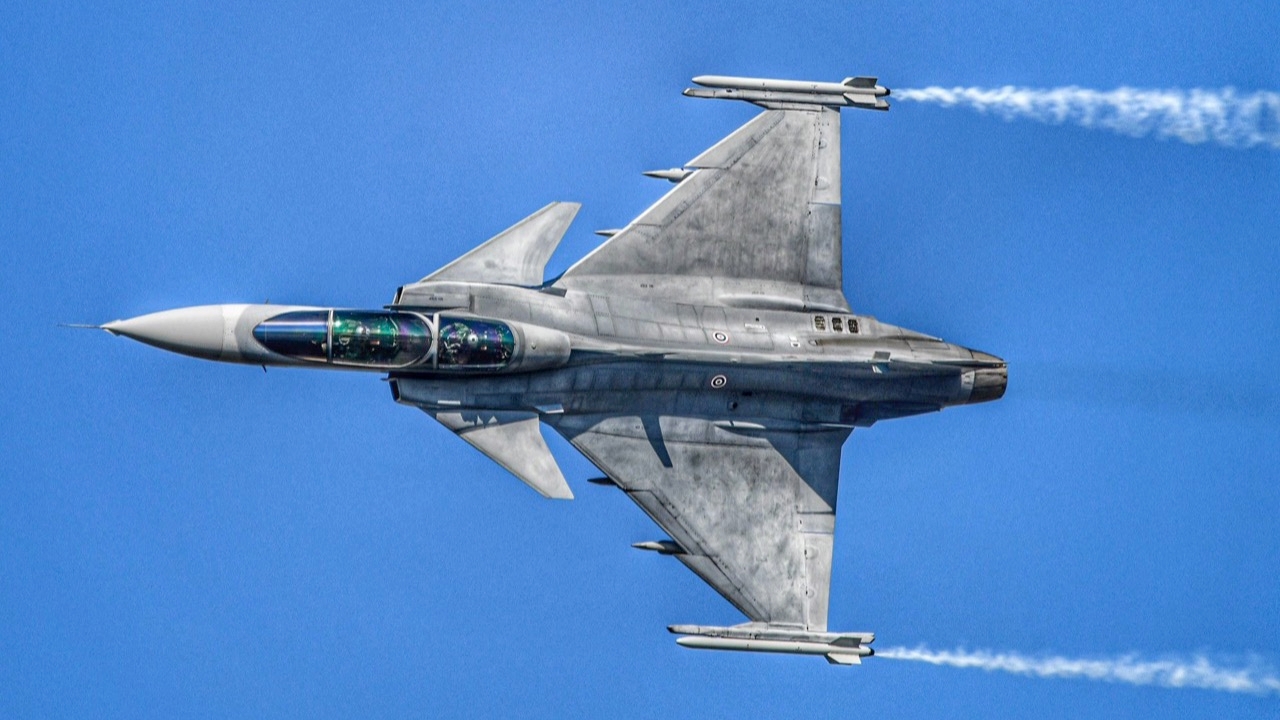
With its ability to meet strict requirements in flight safety, operational readiness, agility, training, and lifecycle costs, the Saab JAS-39 Gripen represents the pinnacle of advanced aerial performance. In summary, Gripen is a frontline fighter of the Royal Thai Air Force featuring excellent support systems, capable of fulfilling diverse roles—whether in solo operations or as part of a comprehensive national defense network. Utilizing modern technology, advanced materials, integrated computer systems, and sophisticated aerodynamics, Swedish aerospace engineers created a high-performance fighter with lifecycle costs lower than U.S. fighter jets.

Currently, the JAS-39 is the backbone of the Royal Thai Air Force and several other countries worldwide. To counter and surpass future advanced threats, Saab developed the Gripen E-series, a new fighter system. The E-series is designed for countries facing increasingly severe surrounding threats or with larger territories requiring security maintenance.
Gripen was built to operate fully compatible with NATO standards and has successfully participated in NATO-led operations, including numerous training exercises and air defense missions.
Battlefield exploits unseen by opponents


Stefan Englund, former aerospace engineer for the Swedish Air Force, explained on Quora that Gripen first took part in the Red Flag exercise in 2006 with the Gripen A model. Assigned to the Red Team (opposing side) with limited AWACS and ground support, the Gripen connected its systems to act as its own AWACS, greatly enhancing battlefield situational awareness. It evaded ground defenses, avoided detection by air defense units, and scored 10 kills on the first day—including advanced fighters like the Eurofighter Typhoon. All strikes were executed and withdrawn without losses due to being undetected.

Additionally, one Gripen pilot defeated five F-16 Block 50+ fighters in close-range combat during Red Flag Alaska exercises. To date, Gripen has never lost an air-to-air engagement or failed mission objectives. Furthermore, it is the only fighter to fly all planned sorties while others remained grounded awaiting weather improvements. This evaluation concluded that Gripen's capabilities needed to be fully reassessed.
In joint exercises with the Royal Norwegian Air Force, three Swedish Gripens faced five Norwegian F-16s, winning decisively with scores of 5-0, 5-0, and 5-1 across three flights.

During the Loyal Arrow exercise in Sweden, a Gripen acting as the attacker intercepted three U.S. F-15Cs, shooting down two and forcing one to flee due to its better thrust-to-weight ratio—although this occurred on Gripen's home turf.

Englund further explained, "Although the F-16 has a higher thrust-to-weight ratio, factors such as drag and wing loading must be considered. Gripen has much lower drag and wing loading, enabling it to achieve supersonic speeds with dry thrust even fully armed (carrying 4 AMRAAMs, 2 Sidewinders, and external fuel tanks). Despite less thrust than the F-16, Gripen achieves nearly the same climb rate due to its lower drag."

"Gripen is currently one of the most undervalued fighters. It began as a tactical resource but quickly rose to strategic importance. No missions have been canceled due to technical issues. While not invincible, it has been consistently underestimated. F-15s might avoid engagement and rely on beyond-visual-range (BVR) combat if they detect and evade Meteor missiles, but direct dogfighting against the JAS-39 is not a wise strategy for F-15 pilots."

E-series: redefining air power
The Gripen E-series features a more powerful engine, extended range, and increased weapons payload. It is equipped with a new AESA radar, infrared search and track (IRST) system, advanced electronic warfare and communications systems, and superior situational awareness. This redefines air power for the 21st century.

Englund summarized, "The only fighter comparable to the Gripen E is the F-35. While the F-35 is noted for stealth such that 'they won't even know what hit them,' the Gripen E looks similar externally but is an entirely new aircraft inside with capabilities on par with the F-35. Though not designed from the start for stealth, it has a radar cross-section (RCS) lower than most other fighters except the F-35 and F-22. With GaN (Gallium Nitride) technology in its electronic warfare suite, it could become a battlefield 'ghost.'"

Which countries operate the JAS 39 Gripen and why choose this fighter?
The JAS 39 Gripen fighter has undergone many performance upgrades. The latest variant is the E-series, which includes the multipurpose JAS 39E, the two-seat trainer JAS 39F, and the JAS 39 Gripen Maritime for carrier operations.
Currently, this fighter is in service with six countries:
Sweden operates 90 aircraft (including C and D models) with plans to procure an additional 60 E-series by 2030.
Brazil has about 10 Gripens and expects to receive 30 more by 2027.
The Czech Republic leases 14 Gripens.
Hungary has 14 aircraft and plans to acquire 4 more next year.
South Africa operates 26 Gripens.
Thailand operates 12 Gripens and has ordered an additional 12 to be delivered by 2035.


One advantage of partnering with SAAB is the willingness to transfer technology to Gripen operators, including establishing local production lines for some components. For example, in 2023, a Gripen E production line opened in Brazil. In February 2025, SAAB opened an office in Budapest aiming to complete an Aviation Development Centre by year-end, specializing in avionics, AI integration, virtual reality, and software development.

Thailand has intellectual property rights for the Link-T system—a specialized communication tool enabling smooth data exchange between aviation systems and equipment. In comparison, Lockheed Martin, which supplies F-16s to Thailand, has not agreed to transfer similar data link technology.
Thailand also plans to build local maintenance and inspection centers and upgrade two Saab 340 Erieye early warning aircraft. Furthermore, Thai companies have joined the Gripen supply chain, producing parts like rubber, bearings, clamps, and airframe structural components.
These steps not only provide customers with technology and new production bases but also develop the country's aerospace industry, promote innovation, scientific research, and education.

JAS 39 Gripen's first combat deployment
Although the first Gripen was produced in 1996, it saw real combat for the first time in July 2025 during a brief conflict between Thailand and Cambodia.
It is well known that after multiple attacks and rocket strikes on civilian areas by Cambodia, causing numerous Thai casualties, the Royal Thai Air Force successfully used Gripen jets to strike Cambodian positions. Brandon Wikert from U.S. magazine National Interest highlighted the Swedish aircraft's crucial role in Thailand's victory: "Support from Sweden's Erieye AWACS system, operated by Thailand, was key in threat reduction and mission coordination, providing real-time situational awareness that helped evade Cambodian air defense missiles."

Compared to the F-16, Gripen's simpler, less complex design was advantageous during the conflict. For instance, its smaller radar cross-section made it harder for Cambodian radars to detect. Additionally, Gripen's operating costs are significantly lower than other Western-produced fighters, making it a smart choice for countries with limited military budgets. It can also operate from shorter runways, ideal for rapid troop movements in Thailand's mountainous and forested terrain.
Gripen's effectiveness was confirmed when, after the four-day conflict ended, the Thai government approved purchasing four additional Gripen E/F aircraft for about $600 million, part of plans to acquire a total of 12 fighters. This decision came amid plans to gradually retire Thailand's F-16s, likely replacing them entirely with Gripens.
Based on real combat experience, it is expected that developing countries with limited military budgets but a need to upgrade their fleets may increasingly consider buying the JAS 39 Gripen—whether in Latin America, Asia, or even Europe.

A major issue for the JAS 39 Gripen is its reliance on parts from producing countries. Among European fighters of similar generations, Gripen depends most heavily on external technology, especially from the U.S. About one-third of its components come from America, including the General Electric F414G engine, Honeywell life support systems, and various electronic sensors. This dependence became problematic under U.S. International Traffic in Arms Regulations (ITAR), which require special U.S. approval before exporting weapons containing American parts to third countries.
During SAAB's negotiations with Colombia, reports surfaced that the U.S. threatened to withhold engines for aircraft destined for Colombia or even impose export bans to pressure Colombia into purchasing F-16s instead.
Although Colombian authorities and SAAB representatives did not officially confirm U.S. pressure, and Colombia eventually chose the Gripen, the mere theoretical possibility of U.S. interference limits SAAB's competitiveness against American firms.
In the 2010s, SAAB attempted to source European engines to replace American ones but was unsuccessful for undisclosed reasons.
Currently, SAAB's leadership acknowledges Europe's trend toward greater self-reliance in defense industries. On 6 March 2024, CEO Mikael Johansson told Bloomberg that Europe's defense spending, of which over 80% flows to the U.S., should be rebalanced so at least 70% remains within Europe.

In March 2025, Financial Times reported that SAAB proposed its GlobalEye surveillance aircraft to Scandinavian neighbors as an alternative to the U.S.-made Boeing E-7 Wedgetail, but these countries still opted for American planes.
Meanwhile, SAAB's executives cautiously avoid criticizing the U.S., likely aware of their reliance on American components and seeking to avoid future complications.

SAAB's Fifth-Generation Fighter Jet
Fifth-generation fighters represent the latest aviation technology. These aircraft feature advanced stealth against radar and detection, specialized sensors providing pilots with precise real-time operational views, robust communications, intelligent system diagnostics, and reliable networking that links multiple jets into a coherent, integrated battlefield picture for allied forces.
Currently operational fifth-generation fighters include the U.S. F-22 Raptor and F-35 Lightning II, and China's Chengdu J-20. Europe lacks its own fifth-generation fighters and depends mainly on U.S. aircraft. The question remains whether SAAB can advance to develop its own fifth-generation fighter.

The Swedish company began moving in this direction in 2023 when Sweden joined the Global Combat Air Programme (GCAP) with the UK, Italy, and Japan. However, Sweden later withdrew to focus on independently developing a new aircraft.
On 22 March 2024, SAAB announced that the Swedish Defence Logistics Agency tasked it with a Concept Study for Sweden's future fighter. This research, spanning 2024 to 2025, includes studying both manned and unmanned systems, technology development, and performance demonstrations.

In 2024, SAAB revealed concept images of this future aircraft. Peter Nilsson, head of SAAB's advanced projects, said, "The project focuses on low visibility, autonomy, and electronic warfare capabilities," priorities reflecting evolving requirements and threat environments faced by modern air forces.
On 12 December 2024, new details emerged that SAAB's future fighter will retain the Gripen's engine, airframe, and avionics but will introduce a stealthier airframe design, new digital processing systems, advanced communications, and AI integration.
Plans also include unmanned drones designed to operate alongside manned fighters, acting as decoys to absorb enemy attacks or conducting reconnaissance and precise strikes in high-risk environments.
Between 28 May and 3 June, SAAB and German defense tech startup Helsing tested AI-controlled Gripen E fighters against human pilots in "Project Beyond." While results couldn't conclusively determine whether humans or AI performed better, SAAB expressed satisfaction. On 11 June, the company stated: "During flight, Gripen E handed control to Centaur (Helsing's AI), which autonomously executed complex maneuvers in beyond-visual-range combat and successfully directed pilots to fire." Beyond-visual-range combat refers to air engagements where pilots attack at distances beyond visual sight, relying on radar and sensors.
This test indicates steady progress in next-generation fighter development. However, a key challenge for SAAB is the lengthy timeframe before industrial-scale production, potentially extending to the 2040s or even 2050.
This delay risks lost opportunities, as happened with the Gripen E, since competitors have already marketed fifth-generation fighters while Sweden continues to offer fourth- or 4.5-generation jets (some with partial fifth-gen features). If development extends to 2050, competitors may have introduced sixth-generation fighters by then.
Nonetheless, SAAB is not without customers. Besides Sweden, likely to procure from its own manufacturer, many countries consider sixth-generation fighters too costly and overly complex. Those with sufficient budgets tend to choose the latest jets, as seen in some European nations, despite an overall trend toward strategic self-reliance.