

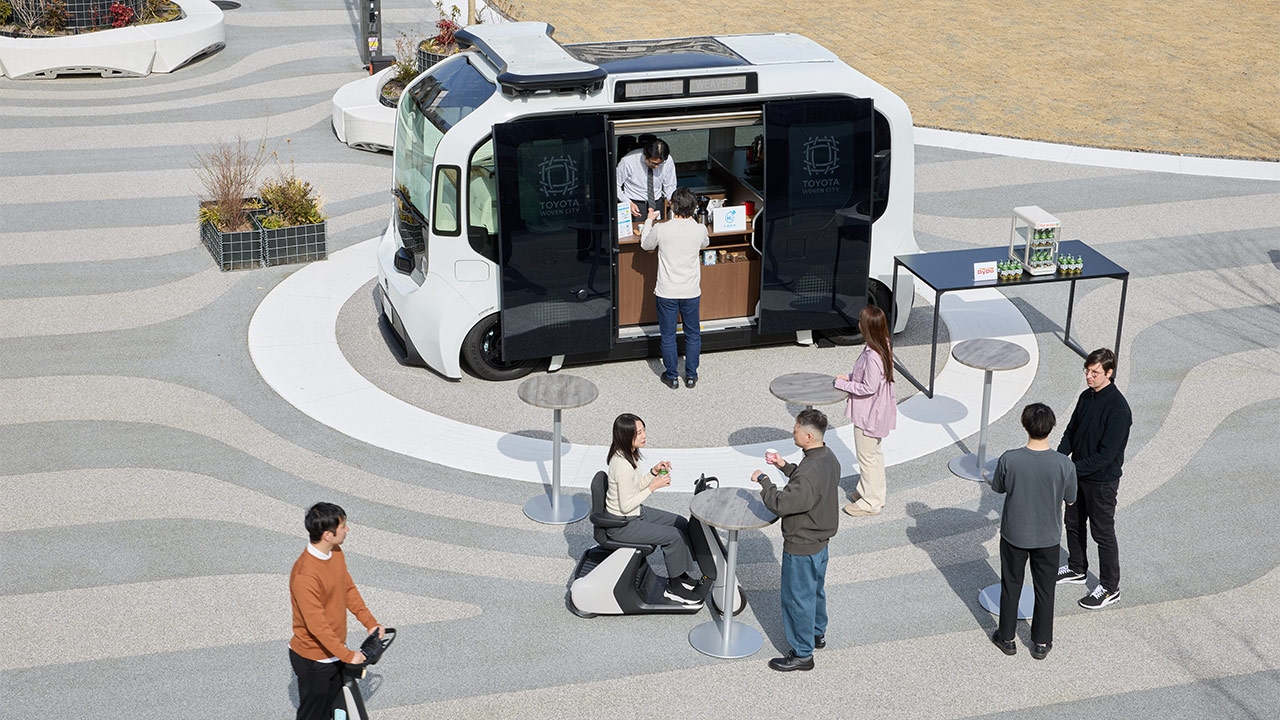
Introducing Woven City, Toyota’s experimental metropolis focused on people, featuring the new AI technology Woven City AI Vision Engine designed to drive the Kakezan concept.
Toyota Motor Corporation, known as Toyota, together with Woven by Toyota, Inc. (WbyT), launched a new technology today (22 April 2026 GMT+7).That technology is the Woven City AI Vision Engine, created to accelerate innovation and advance the Kakezan concept within Toyota’s Woven City, officially launched in September 2025.
Regarding the Kakezan concept, which means“multiplication” in Japanese,it represents WbyT’s approach to creating solutions with broader social impact by combining diverse strengths from multiple industries.
These include Toyota’s extensive mass production experience, WbyT’s software development expertise, as well as the unique capabilities of innovators (Inventors) and partners.Various partners.

WbyT applies advanced in-house developed artificial intelligence (AI) models throughout Woven City to support co-creation of products and services that improve people’s quality of life, based on the belief that AI should enhance human intuition and potential rather than replace humans.
The latest AI developed by WbyT is the Woven City AI Vision Engine, a leading Vision Language Model combined with other advanced AI technologies, introduced to support applications across diverse industries.

which is a large foundation AI model that enables the city to perceive and respond to real-world environments in real time—a prime example of these efforts.
This technology integrates image data, behavioral patterns, and environmental information from sources such as cameras, mobility systems, and user data to identify patterns, detect potential risks, and support coordinated actions within connected systems to enhance safety. It is among the world’s leading Vision Language Models.
The technology supports diverse real-world applications; currently, Woven City is running proof-of-concept projects with UCC Japan Co., Ltd., one of the city’s Inventors, alongside Toyota and WbyT, who plan to expand its use beyond Woven City in the future.

At the same time, the Woven City Integrated ANZEN System builds upon the AI Vision Engine’s capabilities by integrating it with other AI technologies, including
This system analyzes vehicle camera images and traffic signal data to understand movements, predict behavior, and relay information to both pedestrians and drivers, enhancing safety on and off the road.
All these technologies work together so people, mobility technologies, and infrastructure operate seamlessly as one system, resulting in improved safety.
Additionally, Toyota and WbyT have launched the Woven City Infra Hub, an integrated data platform that consolidates citywide information, along with the Woven City Data Fabric, a data governance framework that enables effective use of data while respecting individual privacy and needs.

Inventor Garage opened in April to further support innovation among the Inventors group.
Inventor Garage serves as a comprehensive development hub, featuring co-creation spaces where Inventors can build prototypes, testing areas to verify innovation performance, and residential plus communal areas designed to help Inventors focus on development and engage fully with residents (Weavers).

Within this space, Toyota and Toyota Motor East Japan (TMEJ) continuously contribute their longstanding technical and engineering expertise.
Inventor Garage is located in the former stamping factory building of TMEJ’s Higashi-Fuji plant, which had produced passenger cars for over 50 years.
This site preserves the monozukuri spirit of the original factory while reflecting the link between industrial heritage and Woven City’s innovation.

Inventor Garage plays a key role in completing Woven City’s unique three-stage development cycle:
● Inventor Garage: agile development and prototyping of products and services,
● Inventor Field: testing and validation in controlled environments,
● Phase 1 Residential Area: real-world testing with approximately 100 residents (Weavers) currently living there.
By cycling through these three environments, new mobility products and services can be developed from concept to practical use while maintaining safety and security standards at every step.

The AI Robot Association (AIRoA), DAIICHIKOSHO CO., LTD., Joby Aviation, Inc., and Toyota Financial Services Corporation have joined Woven City as the latest Inventors, bringing the total number of Inventors to 24.
The final pitch event for the Toyota Woven City Challenge, an accelerator program announced in August 2025, is scheduled for Thursday, 23 April 2026 GMT+7.

Winners are expected to join Woven City as Inventors, and the inclusion of startups alongside leading companies marks an important step in expanding the Woven City Inventor community.
Furthermore, Mr. Akio Toyoda, Chairman of Toyota’s Board, continues to drive innovation in Woven City as part of the Inventor community, serving as a Master Weaver.
He recently contributed to developing Akio Toyoda AI, an AI model reflecting his unique leadership and decision-making style, designed to promote AI adoption and support goal-driven collaboration within the Toyota group.

Toyota and WbyT will jointly advance the Kakezan concept with Inventors and partners from diverse industries to accelerate innovation through the technologies and developments announced today, aiming to create lasting positive impacts on society and future generations.
Related news