

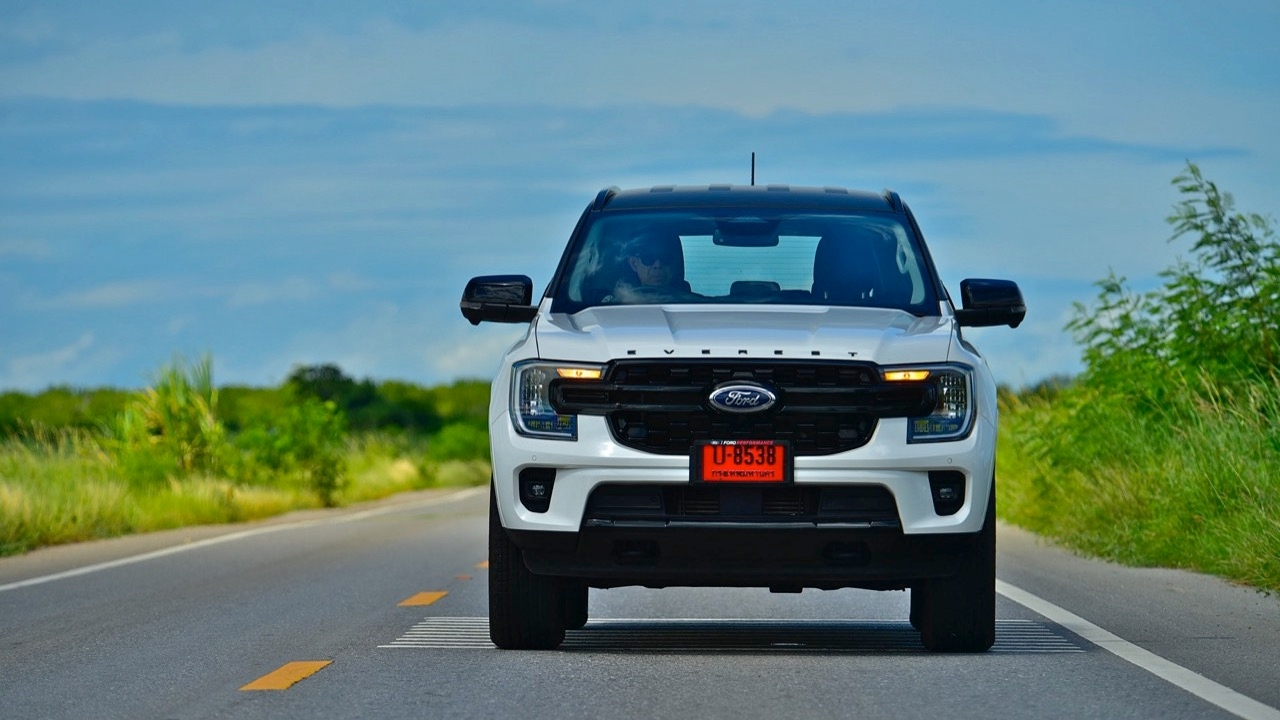
After launching the latest Ford Everest lineup at the recent Bangkok International Motor Show, what continues to win over users is the solid foundation laid by the engineering team. They began with a key question: should the Everest be developed as a multipurpose vehicle with smooth driving like a typical passenger car, or as a robust vehicle ready for every adventure? Ford's engineers answered, "We want both." This philosophy has become a core standard embodied in every Everest today.


Design Foundation
From the start of developing this model, automotive dynamics engineer Chris O’Shannessy said, "Our answer was clear from the beginning because we knew this vehicle had to handle every situation a modern family faces—from school runs and holiday trips to challenging off-road routes." The engineers chose to build the vehicle on a ladder-frame chassis, fine-tuning the suspension system for precise, driver-responsive handling. This reduces body roll, lessens nose dive during braking, and sharpens steering response. This design DNA prioritizes driver control and passenger comfort.
Choosing to develop the Everest on a strong foundation marked the start of defining the SUV’s identity and remains the key basis for ongoing development up to the newest Everest model, featuring an upgraded engine and driving-enhancing features.


Suspension Tuning
Many large SUVs tend to have overly soft suspensions, causing a bouncy or swaying feeling over bumps and a disconnect from road feedback, often leading to rear passengers feeling motion sickness. The Everest’s suspension tuning, wheel size, and tire selection focused on 'control' above all. The result is significantly reduced body roll in corners, less nose dive when braking, and a tangible tire response, boosting driver confidence. Handling this large, high-performance vehicle becomes both enjoyable and assured.


Passenger Cabin
Using a ladder-frame chassis offers more than just strength; it also creates a safer passenger cabin for you and your family. Building an SUV on this structure has significant advantages over using a standard passenger car frame.
Driving over dirt roads in a typical SUV built on a passenger car frame transmits all road vibrations directly into the cabin. In contrast, Everest’s robust steel frame absorbs road impacts, preventing them from reaching the cabin. The cabin, mounted on the chassis with specially designed body mounts, filters vibrations and road noise, keeping the interior quiet even on rough terrain.

Watt Link Rear Suspension
Some SUVs feel unstable over bumps or holes, with a rear end that’s hard to control. Most pickups use leaf spring rear suspensions, which are good for heavy loads but compromise cabin comfort. The engineers chose a Watt Link rear suspension with modern coil springs and a Watt Link mechanism to keep everything steady.
The Watt Link system is a clever rear suspension design that restrains lateral movement of the rear axle when driving over rough surfaces. This means rear passengers don't feel a swinging sensation, and the driver can maintain straight control with less effort. The system works quietly behind the scenes but delivers clear benefits.


Ultimate Engineering Goal
The Ford Everest isn’t just built for driving; it’s designed for real-world use—whether navigating city traffic or taking adventurous families to unexplored paths they never thought possible. Chris O’Shannessy said the goal was to create a vehicle that delivers both driving confidence and travel comfort, so drivers and passengers alike experience excellent performance in every situation. This reflects the design’s heart: the strength of a pickup blended with family vehicle comfort.


All new Everest models feature a newly tuned 2.0-liter turbo diesel engine paired with a 10-speed automatic transmission. Comprehensive safety systems come standard from the base model. The exterior design has been updated for a tougher, more aggressive look. The lineup includes four variants: Ford Everest Platinum 3.0-liter V6 priced between 2,279,000 and 2,284,000 baht.
Ford Everest Platinum 2.0-liter turbo 4x4 priced at 1,779,000 baht.
Ford Everest Sport 2.0-liter turbo priced between 1,299,000 and 1,379,000 baht.
Ford Everest Active starting at 1,299,000 baht.