

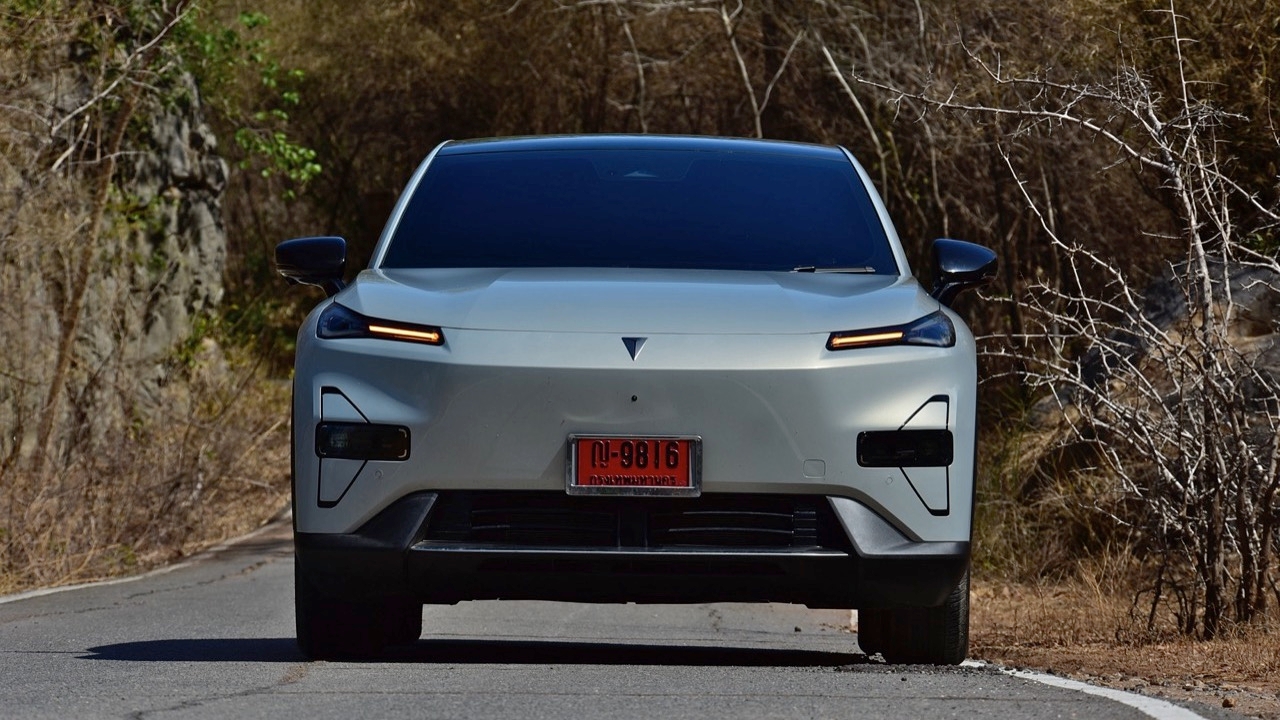
Changan is one of China's legendary automotive brands, unlike newer brands that have only recently emerged but sold millions of cars. Changan has been in the automotive industry for 45 years, starting with vans in the 1980s before shifting to passenger cars in the 1990s. After selling 30 million units, this Chinese automaker now operates in 117 markets but only entered Thailand three years ago with the Deepal L07 and S07 models—large electric sedans/SUVs in the D-segment featuring large screens and luxurious interiors. The Deepal S05 is available as both a pure electric vehicle and a combustion engine extended-range electric vehicle (REEV) in the C-segment, offering a large screen and similarly luxurious interior but with greater efficiency and range, thanks to its engine acting as a generator to charge the battery.


Changan’s standout features are its build quality, drivability, and safety. It is a Chinese brand that places significant importance on design, with an office in Turin, Italy, similar to Pininfarina, involved in development. Naturally, Elon Musk’s electric Model Y is one of the key comparison vehicles for the Deepal S05, although the Model Y is larger. Other electric vehicles compared include the VW ID.5 and Hyundai Ioniq 5. With dimensions close to a Honda CR-V but slightly smaller, the S05 REEV offers adequate interior space. Thanks to tax incentives, Thailand’s market is highly competitive, and Changan has made a strong entry with appealing price and performance, with the rear-wheel-drive version priced at 999,000 baht (test unit).

The official price of the Deepal S05 in Thailand ranges from 799,000 to 999,000 baht, including first-class insurance and a Home Charger.
The prices are broken down by model as follows:
LITE model: 799,000 baht
PLUS model: 849,000 baht
MAX model: 899,000 baht
MAX Long Range model: 999,000 baht
REEV Plus model: 949,000 baht
REEV Max model: 999,000 baht (test unit)
The vehicle and battery are covered by an 8-year or 160,000-kilometer warranty.


Regarding styling and design—who exactly designed it? The Deepal S05’s design team emphasized flowing lines under the leadership of Klaus Zyciora, former head of design at Volkswagen Group and now Vice President of Changan Design. The car’s lines were refined at the Changan Design Center in Turin, Italy, earning the global iF Design Award. The exterior adopts a minimalist, futuristic style with an aerodynamic body boasting a drag coefficient of 0.25 Cd.


At the front, the design resembles Iron Man’s flat face, similar to its bigger sibling the S07 but smaller. The front fascia is smoothly curved without pronounced lines like the S07. It features Smart Wing LED headlights (some markets or options include Huawei xPixel intelligent headlights capable of projecting a 120-inch, 1.3-million-pixel resolution image). The REEV test model has an Active Grille Shutter to manage airflow for engine cooling, which closes when the engine temperature is low. On the sides, notable features include frameless windows and flush hidden door handles. At the rear, there’s a Star Wing LED taillight stretching across the tailgate with a V-shaped spoiler. The LED tail lights connect centrally where the Deepal badge is located.


The Changan Deepal S05 REEV is a compact-sized hybrid crossover. Its length, width, and height are just slightly smaller than the S07, placing it in the B-SUV/Compact Crossover segment. However, the Deepal S05’s dimensions and wheelbase are impressively large compared to competitors in the same class: overall length 4,620 mm, width 1,900 mm, height 1,600 mm, and a long 2,880 mm wheelbase (comparable to larger vehicles). Wheel track measures 1,625 mm front and 1,640 mm rear, with 169 mm ground clearance. Cargo space is 464 liters, slightly less in the REEV version than the BEV due to exhaust system and a 45-liter fuel tank, and the REEV lacks a front trunk (frunk) unlike the fully electric model.


Suspension setup is tailored for the hybrid drivetrain, balancing road grip and comfort for versatile driving. The Changan EPA1 platform uses rear-wheel drive (RWD), with front independent MacPherson struts and rear multi-link suspension. It features electric power steering that adjusts weight with speed; the steering feels relatively firm, offering confidence at higher speeds. Braking uses four disc brakes, with ventilated discs in front, electronic parking brake (EPB), and Auto Vehicle Hold. Standard factory wheels are 18-inch alloys with 225/60 R18 tires, while top trims or option packages offer sportier 20-inch alloy wheels with Goodyear Electric Drive tires sized 245/45 R20 for improved grip and a sportier stance. The tailgate is power-operated for convenience.Sporty 20-inch alloy wheels.Low-profile Goodyear Electric Drive tires sized 245/45 R20 enhance grip and sporty look, with an electrically powered tailgate for easy access to the cargo area.


The interior design of the Changan Deepal S05 REEV marks a clear departure from the older S07 and L07 models. It embraces a fresh, futuristic, yet user-friendly concept tailored for the digital lifestyle. The cabin design concept, called Deepal S05 Smart Living Room, emphasizes openness and a minimalist, modern luxury feel. Nearly all physical buttons have been removed, which is regrettable since controls like side mirror adjustments are now managed via the central touchscreen, which consolidates all settings in a two-tone cabin.


The dashboard and controls showcase modern European styling, eliminating traditional buttons for a clean, wide horizontal layout. The driver’s view is unobstructed by a speedometer hump. Soft-touch layered materials cover the upper and middle dashboard areas with synthetic leather featuring double stitching. The lower section uses dark metallic trim (champagne gold or dark chrome depending on interior color), while hard plastics are hidden at the bottom where contact is minimal.


Front seats are integrated sport seats, ergonomically shaped to support shoulders and waist, upholstered in perforated synthetic leather for ventilation. The driver’s seat offers 6-way power adjustment with electric lumbar support, memory function, ventilation, heating, and a Welcome Seat feature that automatically slides the seat backward upon door opening for easier entry and exit. The top-trim passenger seat is a power-adjustable Queen Seat with electric recline, leg rest, massage, ventilation, and heating functions.
Front seats feature semi-bucket sport styling with ventilated synthetic leather and integrated climate control. The driver’s seat adjusts electrically in six directions, while the front passenger seat (top trim) is a Queen Seat with 4-way electric adjustment, leg rest, and ventilation/heating. Thanks to the 2,880 mm wheelbase, rear passengers enjoy spacious legroom, a flat floor without a central tunnel, and a comfortable middle seat. Rear seats have a 60:40 split fold for expanded cargo space.


The driver’s display and HUD system eliminates the traditional instrument cluster, replacing it with a large Augmented Reality Head-Up Display (AR-HUD) projecting onto the windshield, equivalent to a 54-inch screen at 7.5 meters distance. The display offers sharp resolution with automatic brightness adjustment. Graphics overlay the real road, showing 3D navigation arrows, ADAS warnings, turn signals, and vehicle speed.

The infotainment system features a 15.4-inch ultra-HD 2.5K touchscreen called the Sunflower Screen with ultra-thin bezels. It electrically tilts 15 degrees left or right, automatically orienting toward the driver upon startup or can be set to face the front passenger. All vehicle functions—including air vent direction, tailgate operation, side mirror adjustment, and driving mode selection—are controlled through this screen.


The S05’s display layout is unconventional, lacking a traditional instrument cluster and instead relying on the AR-HUD to project critical driving info onto the windshield, reducing driver distraction. The 15.4-inch touchscreen runs on a high-speed Qualcomm Snapdragon 8155 processor supporting Deepal OS, offering smooth performance. The Sunflower Screen swivels to face the driver or passenger automatically or can be manually configured.
Powered by a 7nm Qualcomm Snapdragon 8155 chip paired with high-speed internal memory, the infotainment system runs Deepal OS with a card-style user interface and a quick-access dock bar for easy function navigation. It features intelligent voice control supporting continuous dialogue and spatial voice recognition, allowing, for example, temperature adjustments only on the speaking passenger’s side, as well as deep vehicle command control such as partially lowering the driver’s window or opening the panoramic sunroof’s sunshade.
Software updates are supported over-the-air (OTA) for both the infotainment system and vehicle control software.
The floating center console is raised to a comfortable hand level with a large open storage compartment beneath, including 12V, USB-A, and USB-C ports. A 50W wireless charger with active air cooling is installed atop the console to rapidly charge smartphones while preventing overheating.


The audio system includes up to 14 high-quality speakers throughout the cabin with a dedicated amplifier and subwoofer for rich bass. Headrest speakers embedded in the driver’s seat provide isolated audio that can be independently configured—for example, playing music through cabin speakers while routing GPS navigation or phone call audio solely to the driver’s headrest, enhancing privacy and avoiding music interruption for other passengers.


Thanks to the long 2,880 mm wheelbase, the rear passenger cabin offers generous legroom suitable even for tall occupants with comfortable seat recline angles. The flat floor eliminates a central tunnel, allowing the middle passenger natural foot placement. A central armrest with cup holders, dual ISOFIX child seat anchors, and a 60:40 folding rear seatback enhance practicality. Orange synthetic leather upholstery contrasts with dark gray for a modern, bright, and spacious feel, complemented by soft-touch materials and black chrome trim on the dashboard, door panels, and common touchpoints.
The intelligent automatic climate control system features concealed front air vents with electronically controlled airflow direction via the touchscreen, similar to Tesla’s system. Rear air vents are located at the rear of the center console along with an additional USB charging port. A high-efficiency PM2.5 air filtration system with in-cabin air quality monitoring is included. The panoramic sunroof measures 1.46 square meters, stretching to the rear seats, and is equipped with an electrically operated sunshade featuring heat- and UV-resistant glass with factory-installed blackout curtains.


Interior convenience features include a newly designed multifunction D-shaped steering wheel with two spokes, offering a sporty grip and controls for adaptive cruise and audio. Ambient lighting surrounds the cabin with 64 color options that can pulse to music or change with driving modes.


Powertrain and transmission details.
The S05 REEV is a rear-wheel-drive range-extended electric vehicle. The electric motor drives the wheels 100%, while the gasoline engine is not mechanically connected to the drivetrain but serves solely as a generator to recharge the battery and supply power to the motor when battery charge is low. It uses a single-speed automatic transmission with a fixed gear ratio, controlled via an electronic column shifter, providing smooth, EV-like response.

The gasoline engine is a 1.5-liter inline-4 naturally aspirated unit from Changan’s Blue Whale family (model JL469Q1) with port fuel injection, designed specifically for efficiency and thermal management while generating electricity. It produces 97-98 horsepower at the engine block but delivers no torque to the wheels.


The electric motor is a permanent magnet synchronous motor (PMSM), model XTDM38, located on the rear axle, producing a maximum 218 horsepower (160 kW) and 320 Nm of torque. The S05 REEV accelerates from 0 to 100 km/h in 7.9 seconds, with a top speed electronically limited to 175 km/h.

Battery and charging details.The battery is a lithium iron phosphate (LFP) Golden Shield unit produced by CATL with liquid cooling, meeting IP68 water and fire protection standards.Battery capacity is 27.28 kWh, providing a pure electric driving range of 170 km (NEDC) or 200 km (CLTC). AC charging supports up to 6.6 kW, taking approximately 6 hours for a full charge. DC fast charging supports up to 54.5 kW, charging from 30% to 80% in 20 minutes. The vehicle supports Vehicle-to-Load (V2L) technology, supplying up to 6.6 kW power output to external devices.


Fuel consumption with the 45-liter fuel tank is claimed at 4.35 liters per 100 km under CLTC (about 23 km/liter). Combined range with full tank and battery exceeds 1,000 km (NEDC) or up to 1,234 km (CLTC). Real-world tests show fuel consumption varies greatly based on driving style. The vehicle weighs approximately 1,835 kg. In city or normal driving with sufficient battery charge, fuel consumption is effectively zero. When the battery depletes and the engine runs at low to moderate speeds to generate electricity, fuel economy is around 16-18 km/liter. At sustained high-speed driving, consumption drops to about 10.7 km/liter.


Comfort levels are acceptable. Changan’s R&D base in Birmingham tailored the suspension to be firmer to suit Thai preferences. When driving at high, continuous highway speeds, the 27.28 kWh battery is rapidly drained by the 218 hp motor, forcing the 1.5-liter gasoline engine (with 98 hp) to run at high rpm constantly to maintain battery charge. This small, naturally aspirated engine operates beyond its optimal efficiency zone, resulting in fuel consumption similar to larger SUVs, around 10.7 km/liter.


The Changan Deepal S05 REEV has all the ingredients for success: an understated yet modern and sleek design, attractive C-pillar reminiscent of a sporty hatchback, beautiful rear lighting and tail design, spacious and meticulously upholstered interior, comprehensive technology, and a 1,000 km driving range from battery and engine-generated electricity. With a five-star Euro NCAP safety rating and a promise of spare parts delivery within 24 hours via an expanding dealer network in the UK, it offers compelling reasons for potential buyers to consider the brand. The fact that it drives well is an added bonus. The combined range from a full tank and battery is a key selling point for its target audience. However, inflation, rising living costs, and global crises are pushing consumers towards affordable Chinese cars like Changan, which aims to attract attention with new models unmatched by established brands.


Western media often unfairly underestimate Chinese cars. Simply put, the arrival of vehicles from China has challenged nearly every Japanese and European automaker, causing them to lose market share dramatically. The Deepal S05 REEV is not a bland hybrid. With over 20 years of automotive media experience, I can say the S05 REEV is a very capable vehicle. Its 0-100 km/h acceleration in just over 7 seconds shows it is no sluggish car. With 218 horsepower and 320 Nm torque, the motor provides ample power for instant overtaking, comparable to electric vehicles.
It may not be as fast as pure electric vehicles that do 0-100 km/h in 5.5 to 6.5 seconds, but 7 seconds from standstill to 100 km/h is quicker than any Japanese car at a similar price. The rear-mounted motor makes the S05 REEV a rear-wheel-drive vehicle with easy handling, stable even at top speed without noticeable body roll. Acceleration feels stronger than typical HEV engines. The brake pedal feels overly sensitive at first but becomes familiar within five minutes. Being a range-extended EV with a generator engine (similar to Nissan Kicks e-Power), it uses regenerative braking without paddle shifters to adjust deceleration, but the touchscreen offers braking force settings. For drivers accustomed to combustion cars, the transition between lifting off the accelerator and regenerative braking can feel less smooth.


The Deepal S05 handles rough and uneven road surfaces well, requiring no post-drive massage after long trips. At low speeds, it is quiet and smooth. The vehicle may sway slightly over uneven roads or bumps but overall body control is strong and quiet until reaching top speeds. Aerodynamic design reduces noise. The hybrid rear-wheel-drive vehicle claims a 1,060 km range under gentle driving conditions, not aggressive testing. At high speeds, fuel consumption rises. To maximize efficiency, highway speeds should be 70-80 km/h and city speeds no more than 60 km/h, enabling 1,000 km range on one tank and full charge—a good return for a 27.28 kWh battery. It will go farther when driven gently.


With a drag coefficient of 0.25 Cd, Changan employs multiple aerodynamic measures to extend range. These include an active grille, aerodynamic body shaping, an effective rear diffuser, and aerodynamic wheel covers, all reducing air resistance efficiently.
Strengths (What it does well)
The cabin space is exceptionally roomy for the vehicle’s size. Despite a compact exterior, the long 2,880 mm wheelbase and flat rear floor provide generous rear legroom, offering comfortable seating without feeling cramped.
Interior build quality is premium beyond its price point. Soft-touch materials are finely executed. The console and synthetic leather stitching look better than many competitors at this price. Features like the Queen Seat with electric leg rest, premium audio, and electrically operated panoramic sunroof sunshade are impressive.
Innovative features include a 2.5K central touchscreen powered by Snapdragon 8155, responsive and equipped with the Sunflower Screen that pivots toward occupants, and a clear, bright AR-HUD navigation display that performs well under Thailand’s sunlight.
Smooth, electric-vehicle-like driving: Since the motor directly drives the wheels, acceleration and overtaking feel seamless and responsive without gear shifts or engine start lag.


Weaknesses and limitations
At sustained high-speed highway driving, fuel consumption "guzzles" fuel. The physics of a nearly 1.9-ton REEV with a 218 hp motor drawing heavily from the battery forces the small 1.5-liter, naturally aspirated engine to run at high rpm continuously to supply electricity, dropping fuel economy to about 10.7 km/liter. This is less efficient than many C-SUVs with pure combustion or hybrid engines from Japanese brands. However, steady driving at 80 km/h improves economy.
The suspension is firm but still behind that of the Honda CR-V. The steering is relatively heavy. The suspension focuses on family car comfort. At high-speed cornering or over Thai speed bumps, body roll and bounce are present but not severe. Overall, suspension tuning remains inferior to similarly sized Japanese models.
A downside is relocating all controls to the touchscreen (zero physical buttons). Traditional physical buttons for side mirror adjustment and air conditioning are removed. While minimalistic and futuristic, this requires the driver to look away from the road to adjust airflow, mirrors, or driving modes via the 15.4-inch screen, potentially distracting.
Because the REEV system requires an exhaust and a 45-liter fuel tank, rear cargo space is shallower and smaller than the 100% electric BEV model. Importantly, the REEV lacks a front trunk (frunk) present in the BEV version.


The Deepal S05 REEV is ideal for drivers seeking an electric driving experience but living in condos or avoiding charger queues during peak times. It’s perfect for city stop-and-go driving paired with home charging. However, for fast drivers who frequently travel long distances expecting fuel efficiency of 20 km/liter while the engine is running, buying this vehicle means adjusting driving habits—drive moderately like a typical consumer, not aggressively as automotive journalists do, to achieve the desired economy.