

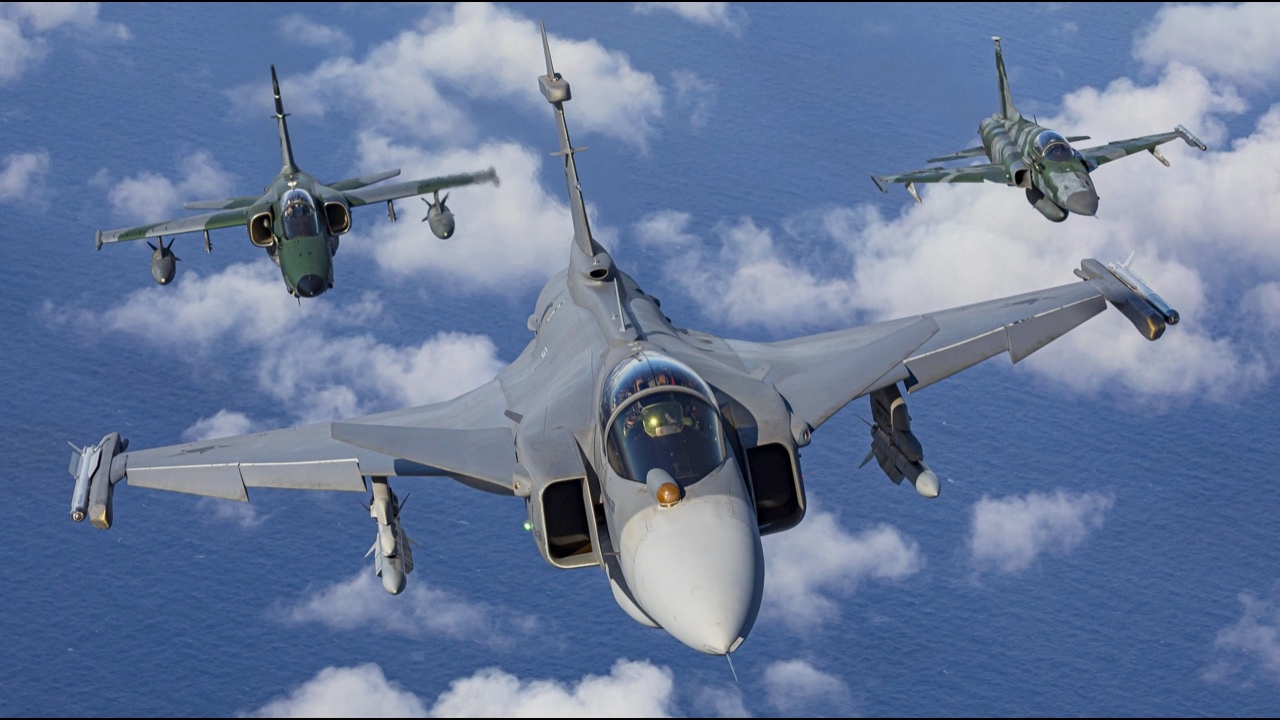
To understand the strengths of the Gripen E, one must first grasp Saab's origins. Saab, short for Swedish Aircraft Company, was founded over 80 years ago by the Swedish government to produce aircraft solely aimed at defending Sweden’s land and people. Facing overwhelming numerical inferiority against Russia’s strategic nuclear-capable fighter jets and bombers stationed in Kaliningrad, just south of Sweden’s border, Sweden relied on superior tactics to maximize combat effectiveness. It pioneered early integration of datalink communications and electronic warfare systems on fighter jets starting with the Saab 35 Draken and later the 37 Viggen. The combination of combat performance, pilot tactics, cost, and operational readiness has been embedded in the JAS 39 Gripen from the start.

This philosophy continues with the Gripen E, which features a more intelligent integrated architecture. Currently, the main customers are Sweden, ordering 60 units initially, and Brazil, ordering 36 units (including 8 two-seat F variants). Thailand has ordered 8 E models and the Gripen E/F remains a contender in fighter replacement programs worldwide.

Compared to competitors like the F-16, F-18, and F-35, the Gripen E stands out by enduring 9G forces, breaking speed records set by the Gripen C/D in level flight, offering stable flight control software, the latest sensors and electronic warfare systems, including an Electronic Attack Jammer Pod. It is armed with the new MBDA Meteor beyond-visual-range air-to-air missile and short-range IRIS-T missiles.
The Gripen E/F (Next Generation) is an evolution of the Gripen C/D, featuring an expanded airframe and a completely re-engineered design paradigm, moving from a lightweight fighter to a full-fledged 4.5+ generation combat aircraft.

Landing gear repositioning.
Addressing the challenge of limited fuel capacity in small fighters, Saab engineers relocated the main landing gear from the mid-fuselage to the wing root. This structural modification freed up internal fuselage space to increase internal fuel capacity by 40%, significantly extending the Gripen E’s combat range without relying on external fuel tanks.

Modular software architecture (Avionics 2.0).
The software engineering in the Gripen E is a key highlight, separating flight-critical software (safety and flight control) from mission-critical software (weapons, radar, and combat systems). This allows immediate updates to weapon systems and combat algorithms, similar to smartphone app updates, without needing to re-certify the entire aircraft’s flight safety, unlike older models.

AESA radar on a Swashplate mount and IRST.
The Gripen E’s ES-05 Raven AESA radar is mounted on a Swashplate (repositioner) allowing a ±100-degree field of view, compared to typical AESA radars limited to ±60 degrees. Pilots can launch missiles and immediately maneuver away while the radar continues tracking the target and guiding the missile. This works in conjunction with the Skyward-G IRST sensor that passively detects and tracks stealth targets by their heat signatures without emitting radar signals that reveal the aircraft’s position.

Arexis Electronic Warfare System (GaN Technology).
The Gripen E’s electronic warfare system uses Gallium Nitride (GaN) semiconductors, significantly boosting jamming power compared to previous technologies. It provides 360-degree electronic deception, creating decoys and masking the aircraft’s true position from enemy radar.

Engine.
Gripen C/D uses the Volvo RM12 engine (based on the GE F404) with approximately 80 kN thrust.
Gripen E/F uses the GE F414G engine, delivering about 98 kN thrust (+22%).
Internal fuel capacity.
Gripen C/D carries about 2,270 kilograms internally.
Gripen E/F carries approximately 3,180 kilograms internally (+40%).
Maximum takeoff weight (MTOW).
Gripen C/D has an MTOW of about 14,000 kilograms.
Gripen E/F has an MTOW of around 16,500 kilograms.

Weapon hardpoints.
Gripen C/D has 8 hardpoints.
Gripen E/F has 10 hardpoints (including 2 under-fuselage mounts).
Radar system.
Gripen C/D uses the PS-05/A mechanically scanned radar.
Gripen E/F employs the Selex ES-05 Raven AESA radar on a Swashplate mount.
Infrared Search and Track (IRST) system.
Gripen C/D lacks an internal IRST and requires external pods.
Gripen E/F integrates the Skyward-G IRST sensor embedded in front of the cockpit.
Supercruise capability.
Gripen C/D cannot supercruise and must use afterburners to exceed the speed of sound.
Gripen E/F can supercruise at about Mach 1.2 without afterburners.
Software architecture (Avionics).
Gripen C/D combines flight control and mission software into a single system.
Gripen E/F strictly separates flight-critical software from mission-critical combat software.

Engine details.
Gripen C/D’s Volvo RM12, derived from the GE F404, produces about 80.5 kN thrust with afterburner (18,100 lbf).
Gripen E/F’s General Electric F414G produces about 98 kN thrust with afterburner (22,000 lbf), a 22% increase.
Flight range and combat radius.
Gripen C/D has a combat radius of approximately 800 km and a ferry range of about 3,200 km with external tanks.
Gripen E/F’s combat radius is around 1,500 km—nearly double due to increased internal fuel capacity—and ferry range about 4,000 km with external tanks.

Top speed.
Gripen C/D reaches Mach 2.0 (~2,125 km/h at altitude) but lacks supercruise capability.
Gripen E/F also reaches Mach 2.0 and supports supercruise at about Mach 1.25, flying supersonic without afterburners.
Service ceiling.
Gripen C/D has a service ceiling near 15,240 meters (50,000 feet).
Gripen E/F’s service ceiling is approximately 16,000 meters (52,500 feet).
Weapons systems and payload capacity.

Gripen C/D’s maximum payload is about 5,300 kg, with 8 hardpoints and a 27mm Mauser BK-27 cannon (single-seat C variant only). Main armaments include IRIS-T, AIM-9 Sidewinder, AIM-120 AMRAAM, Meteor missiles, RBS-15F anti-ship missiles, and laser-guided bombs like the GBU-12.

Gripen E/F’s maximum payload increases to around 7,200 kg (+35%), with 10 hardpoints due to relocated main landing gear allowing 2 additional under-fuselage mounts. The 27mm Mauser BK-27 cannon is standard on the single-seat E variant. Weapons include modern NATO-standard armaments such as Meteor BVR missiles, IRIS-T, SPEAR 3, extended-range RBS-15F ER, satellite-guided bombs like GBU-39 SDB and JDAM, and Taurus KEPD 350 cruise missiles.

The Gripen E’s sensor suite is redesigned to integrate an active AESA radar and a passive IRST system, providing tactical advantage for beyond-visual-range detection and engagement.
The AESA ES-05 Raven radar (active detection).
Using Swashplate (roll-repositioner) technology, conventional AESA radars fixed on the antenna dish are limited to about ±60° detection angles. The ES-05 Raven mounts T/R modules on a mechanically tilted rotating dish, enabling a ±100° scanning angle (200° total sweep).
Tactical advantage: When launching long-range Meteor missiles, pilots can maneuver up to 100° off the target line while the radar continues tracking and updating missile guidance, allowing the aircraft to escape enemy missile engagement zones immediately.
Operating modes and LPI (Low Probability of Intercept) features allow simultaneous multi-target tracking across air, land, and sea by rapidly switching frequencies and waveforms, making enemy radar warning receivers less effective.

Skyward-G IRST sensor (passive detection) is mounted in the nose ahead of the cockpit, operating in two infrared bands to detect heat signatures from engine exhaust, air friction, and other sources without emitting electromagnetic waves.
Counter-stealth capability: Fifth-generation stealth fighters reduce radar cross-section but cannot hide thermal signatures caused by air friction. Skyward-G detects stealth targets at long range without revealing its own position.

Data fusion: Directional and thermal data from Skyward-G integrates with ES-05 Raven radar and Arexis electronic warfare systems into a unified combat display, enabling precise weapon targeting even amid heavy electronic jamming.

The Royal Thai Air Force selected the JAS 39 Gripen E/F to replace the F-16 A/B Block 15 fleet of Wing 102 at Korat Air Base. The decision was based on tactical capabilities, network technology, budget, and offset policies, offering a better strategic fit than competitors like the F-16 Block 70/72 in multiple areas.
Tactical capabilities and sensors.
Equipped with the AESA ES-05 Raven radar on a rotating mount and the Skyward-G IRST sensor, the Gripen E/F provides first-look, first-shot capability with 360-degree passive target locking, integrated advanced electronic warfare systems, and supports high-performance MBDA Meteor BVR missiles.
Autonomy in network development.
Sweden permits the Royal Thai Air Force full access to develop and upgrade their own National Datalink (Link T), essential for tactical data exchange with Saab 340 AEW early warning aircraft and the Royal Thai Navy’s network, without source code restrictions common in U.S. defense equipment purchases.
Offset policy.
The Swedish government and Saab fully support technology transfer, including scholarships, engineer training, and defense industry support in Thailand—a key factor in assessing the economic return on investment.
Cost efficiency and logistics.
The Gripen was designed from the outset for significantly lower hourly operating costs than the F-16 (around 200,000 baht per flight hour versus about 300,000 baht). It features shorter turnaround times and requires fewer ground support personnel, aligning with limited defense budgets.
Operational independence.
Purchasing from Sweden imposes fewer operational restrictions than U.S. arms export regulations, granting the Royal Thai Air Force greater flexibility and autonomy in mission planning.
The Royal Thai Air Force’s decision reflects a military philosophy focused on achieving tactical and informational superiority through an open system architecture rather than adherence to familiar platforms, optimizing performance within a tight procurement budget.
Arkom Rumsuwan.
E-Mail.chang.arcom@thairath.co.th
Facebook.https://www.facebook.com/chang.arcom
https://www.facebook.com/ARCOM-CHANG-Thairath-Online-525369247505358/