

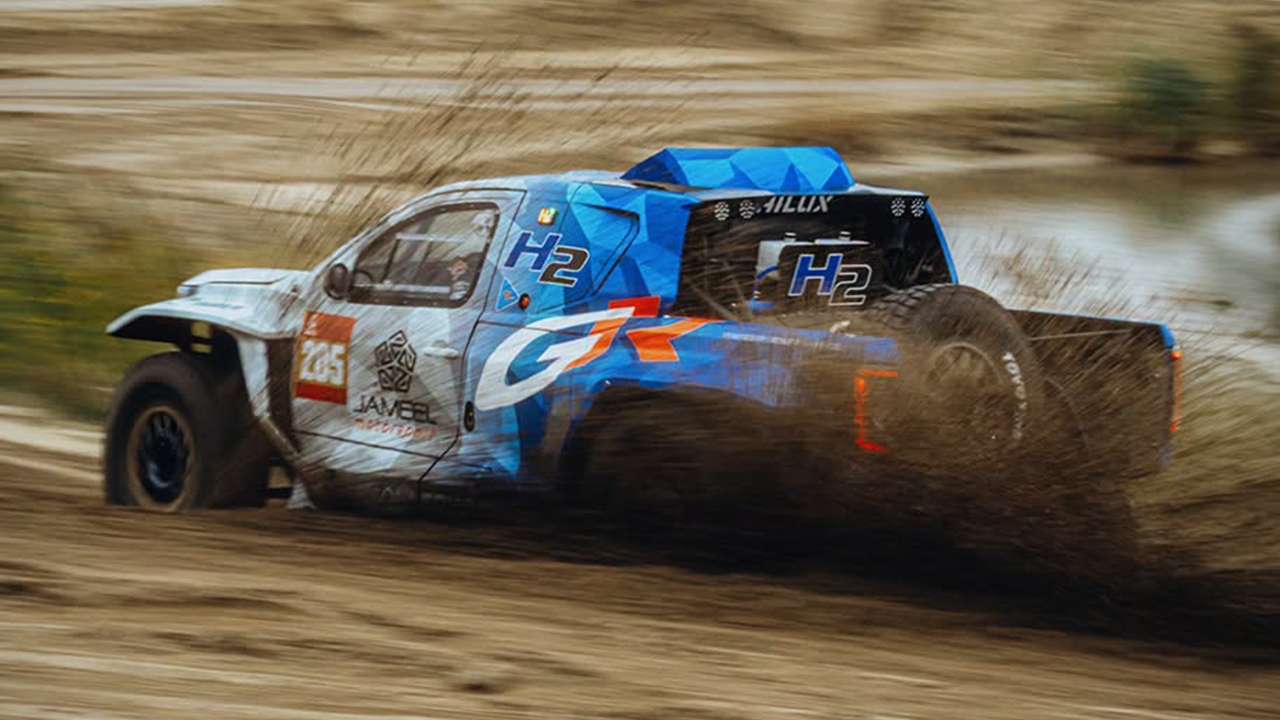
GAZOO Racing has completed building the "DKR GR FC Hilux" race car and is preparing to compete in the 2027 Dakar Rally under the Dakar Future Mission 1000 category. It uses two hydrogen fuel cells delivering a combined 400-kilowatt power output. Saudi driver Dania Akeel has been selected to test and race the vehicle.
GAZOO Racing revealed progress in preparing to compete in the 2027 Dakar Rally with the DKR GR FC Hilux, a hydrogen fuel cell electric vehicle (FCEV). The car is fully built and currently undergoing test runs to prepare for competition.
This model will participate in the Dakar Future Mission 1000 category, which allows new technology vehicles to test performance under extreme conditions. It marks Toyota’s first full-scale entry of a hydrogen fuel cell electric vehicle in motorsport.
The project is conducted under the concept "Making ever-better cars by starting from motorsports." It is part of Toyota’s multipathway approach, focusing on developing multiple alternative powertrain technologies alongside nurturing personnel through racing experience.
The DKR GR FC Hilux produces zero carbon dioxide (CO₂) emissions at the tailpipe while driving. Toyota aims to gather knowledge from this project to help reduce CO₂ emissions in both motorsports and future commercial vehicles.

European development team collaboration completes car, testing underway before competition.
Development of the DKR GR FC Hilux is an intensive short-term project involving close collaboration among Toyota’s European R&D center near Brussels, Belgium; Overdrive Racing, operator of the TOYOTA GAZOO Racing W2RC team and developer of the DKR GR Hilux; TOYOTA RACING GmbH in Cologne, Germany; and Toyota Motor Corporation. The vehicle is now complete and undergoing testing to prepare for its debut race.
Dania Akeel selected as test and Dakar driver.
GAZOO Racing has chosen Saudi rally driver Dania Akeel to pilot the DKR GR FC Hilux during testing and in the 2027 Dakar Rally’s Dakar Future Mission 1000 category.
Akeel began rally racing in 2021 and quickly gained experience with notable achievements. Her first Dakar Rally finished in the top 10 of the T3 class, and in 2025 she secured a stage win in the Challenger category.
Additionally, she won multiple stages in the W2RC 2025 and 2026 seasons and claimed the Challenger class championship at the Abu Dhabi Desert Challenge, part of the W2RC. She also drove a Toyota Hilux entered by Overdrive Racing to win the FIA Middle East Baja Cup in 2024 and 2025, achieving two titles.
Akeel said the project is a great opportunity to learn how new automotive technologies develop. Experiencing pioneering efforts from the driver’s seat is invaluable, an honor and pleasure. Her driving feedback will directly support technology development.
"In rally raid, a driver’s greatest strength is competing across diverse terrains and environments while adapting flexibly and precisely to changing conditions. I believe this is an ideal arena to test the reliability and durability of vehicles and new technologies to their limits."
She also believes that adapting to evolving technology will enhance her skills and help her grow as a driver.

Equipped with two fuel cells producing a combined 400 kilowatts.
Structurally, the DKR GR FC Hilux uses the same basic platform as the DKR GR Hilux, featuring a tubular chassis, safety cell protecting the cabin, suspension, and braking systems.
The powertrain includes two fuel cell stacks working together as a high-performance system delivering a total output of 400 kilowatts, controlled by an IAV ECU. It uses four high-pressure hydrogen tanks identical to those in the MIRAI, storing a total of 8.4 kilograms of hydrogen.
The vehicle also features a model-specific electric drive e-Axle, IAV Dragoon ECU control unit, new electronics, and a new cooling system for the high-voltage electric components.
Additionally, natural fiber panels replace some carbon fiber parts, and TOYO TIRE OPEN COUNTRY M/T-R tires are selected for competition use.
Key specifications of the DKR GR FC Hilux.
Chassis : Tubular frame structure.
Body : Carbon fiber and natural fibers.
Powertrain : Twin fuel cell stacks controlled by IAV ECU.
Combined power output : 400 kilowatts.
Fuel : Compressed hydrogen gas.
Fuel capacity : Four high-pressure hydrogen tanks from MIRAI, totaling 8.4 kilograms.
Cooling system : For high-voltage electric components.
Suspension : Double wishbone with 350 mm travel.
Length : 4,500 millimeters.
Width : 2,300 millimeters.
Height : 2,100 millimeters.
Vehicle weight (total) : Under 2,500 kilograms.
Tires : OPEN COUNTRY M/T-R.
Using racing to advance commercial vehicles and fuel cell technology.
GAZOO Racing states that combining parts from production vehicles with advanced technology allows testing components in the challenging Dakar Future Mission 1000 environment. Experience and knowledge gained will support development of commercial vehicles and future fuel cell applications.
The project is officially supported by Jameel Motorsport, with partners including DENSO, TOYO TIRE, and IAV, aiming to explore the potential of hydrogen and fuel cell technology in motorsports.