

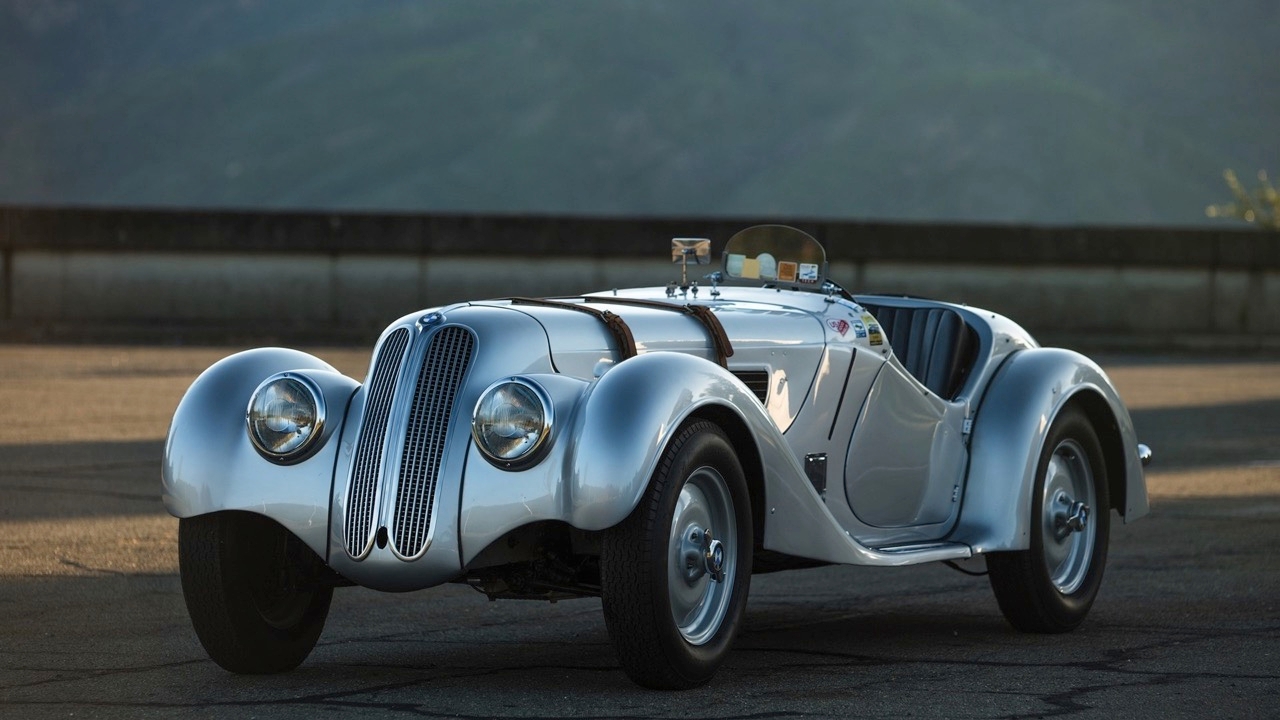
Rewinding to June 1936, a car unknown to most appeared quietly at the Nürburgring track. Its presence surprised all competitors without any announcement or motor show debut—a small silver roadster made by BMW from Germany, weighing 830 kilograms with a 2.0-liter, 80-horsepower engine, arrived in the paddock area one day before its first race. Subsequently, the 1936 BMW 328 won continuously, becoming a part of BMW’s history.


Ninety years have passed since its quiet debut and successive racing victories. Almost every principle BMW adheres to—inline six-cylinder engines, lightweight cars designed for drivers—originated from this roadster. In May 2026, at the Concorso d’Eleganza Villa d’Este by Lake Como, BMW will highlight the 328 Roadster to celebrate the model’s 90th anniversary. This pre-World War II sports car was produced in only 464 units, with fewer than 200 remaining today. Well-preserved 328s now fetch prices exceeding one million US dollars. Despite their rarity and history, the 328 remains one of the most overlooked vintage vehicles in BMW’s long legacy.

The BMW 328 story began with almost nothing. BMW released a small brochure in late 1935 hinting at a new 2-liter sports car called the “Typ 328.” Only insiders knew of its existence. Journalists first spotted the BMW 328 Roadster at Nürburgring on 13 June 1936. Ernst Henne, a motorcycle world record holder, was in the car ready to race the next day. Henne won the race with an average speed of 101.5 km/h. Competitors using supercharged Kompressor engines, expected to dominate, were easily overtaken by the naturally aspirated 2-liter engine. The 328 was designed by two men: Rudolf Schleicher, responsible for the engine, and Fritz Fiedler, who created the chassis. Together, they built a car ahead of its time—not just theoretically, but proven by superior lap times over rivals.


Fiedler’s chassis design differed from typical production cars of the era. Instead of the heavy rectangular steel frames common in 1936, he developed and patented a lightweight A-frame structure that tapered toward the rear. This resulted in superior torsional and bending stiffness while significantly reducing weight compared to traditional chassis designs.
BMW called this philosophy Leichtbau, meaning lightweight construction, which had been applied since the early 1930s. For the 328, it became a vital weapon in building a true racing car rather than just a design principle. The rack-and-pinion steering system, very advanced for its time, gave drivers precise control that heavier, more powerful rivals could not match in cornering speed. The engine was a key attraction: a 1,971 cc inline six-cylinder designed by Schleicher. Though it appeared conventional on paper—with a cast-iron block derived from the BMW 319 and a side-mounted camshaft—the cylinder head was innovative. Instead of a traditional camshaft directly operating valves, Schleicher used slender pushrods and rocker arms to control inclined valves in an aluminum hemispherical combustion chamber. This arrangement delivered breathing performance comparable to a dual overhead cam engine, using only one camshaft, a technique so advanced BMW patented it in 1939. Three downdraft carburetors fed the naturally aspirated 2.0-liter gasoline engine producing 80 horsepower. At a time when high power usually required forced induction, this was a significant achievement. The ready-to-drive weight was 830 kilograms, and top speed reached 155 km/h, making the 328 one of the fastest production cars globally at the time. Compared to today’s M5 weighing 2.5 tons, the difference is stark.

What made the BMW 328’s racing record remarkable was not just a single victory but its relentless success. In 1937 alone, its first full production year, the 328 won over 100 events in various categories, including the RAC Tourist Trophy, Österreichische Alpenfahrt, and the La Turbie hill climb. This small sports car from Munich quietly defeated more powerful, better-funded, and more famous competitors. The formula was simple: when rivals are faster on straights, ensure corners decide the outcome and guarantee your car’s lighter weight allows superior agility.

In 1938, the 328 scored victories at the RAC Tourist Trophy, Alpine Rally, and Mille Miglia; in 1939, it finished fifth overall and first in class at Le Mans, a race usually dominated by much larger cars. By the end of the pre-World War II era, the BMW 328 had competed in 172 races and won 141, a record unmatched by any other pre-war sports car. All this was achieved without superchargers, forced induction, or factory budgets aimed solely at beating competitors. The 328 Roadster was a car you could drive to the track, race hard, and then drive home normally. In 1940, it achieved a victory that cemented its status as a classic.


The Mille Miglia had been banned once for being too dangerous. In 1940, the race was compromised to reduce hazards by running nine laps on a 167-kilometer triangular circuit between Brescia, Cremona, and Mantua on open roads. Among 70 Italian cars competing, five silver BMWs stood out amid a sea of red Italian racers. The public’s reaction to the German cars was lukewarm. BMW had prepared something special in collaboration with Carrozzeria Touring of Milan, building three special cars: two sleek roadsters and two hardtop coupes. The coupes used Touring’s Superleggera technique—a delicate tubular steel frame covered with thin aluminum panels—resulting in a 780-kilogram body. Tuned racing engines produced 135 horsepower, enabling speeds over 220 km/h. The third car, the Kamm Coupé, developed with aerodynamic researcher Wunibald Kamm, was made from Electron alloy (80% magnesium), weighed only 760 kilograms, and was BMW’s most technologically advanced racing car ever.


Fritz Huschke von Hanstein and Walter Bäumer designed the Touring Coupé with a simple idea: drive fast and don’t break anything. The drivers raced aggressively, and when Bäumer crossed the finish line, BMW had won, beating second-placed Alfa Romeo by 15 minutes. The average speed over nine laps was 166.7 km/h, an unprecedented record for the Mille Miglia that has never been surpassed. The 328 took first, third, fifth, and sixth places; only the Kamm Coupé retired due to mechanical issues in the seventh lap. This speed record stands forever, as the Mille Miglia never again ran on public roads in this form after World War II. The 166.7 km/h mark is a permanent testament to the 328’s potential when BMW committed fully to racing. Notably, in 2004, the original Touring Coupé competed in the modern Mille Miglia Storica and won again, becoming the only car in history to win both the original and the classic re-enactment 64 years apart in the same class—2.0 liters without forced induction.

The BMW 328 Mille Miglia Roadster was essentially a production car designed with aerodynamic bodywork that was lighter and sleek yet unmistakably a 328. The Touring Coupé was far more advanced, featuring the Superleggera tubular frame for very low weight, designed through instinct and empirical automotive engineering testing, as Carrozzeria Touring lacked a wind tunnel. Finally, the Kamm Coupé was named after Wunibald Kamm, whose aerodynamic research created the Kammback tail shape still used today. This was the most advanced of the three, built from Electron alloy with a tubular frame and the most powerful 328 engine. The car retired from the 1940 race and disappeared in 1953. In 2010, BMW Classic spent two years fully reconstructing it from original drawings and photos. Today, this 328 is exhibited at the BMW Museum in Munich, its fitting home.

When the BMW 328 launched in 1937, it cost 7,400 Reichsmarks—equivalent to three years’ salary for a skilled BMW technician. Its buyers were not weekend racers but wealthy gentleman drivers seeking a car capable of serious competition and elegant enough for dinner outings. Production ran from spring 1937 until 1940, when World War II and Germany’s invasion halted everything. BMW made 464 units in total, about 200 of which survive today, with approximately 120 remaining in Germany. In the UK, the model was sold under the Frazer Nash-BMW brand, partly for commercial reasons and partly to ease growing anti-German sentiment in the British market.

Today, prices vary widely depending on condition, history, and body style. Well-maintained standard roadsters trade for roughly 400,000 to 600,000 US dollars. In August 2022, Gooding & Company auctioned a 1937 BMW 328 at Pebble Beach for as high as 874,000 US dollars. The highest recorded price for a roadster remains just under one million US dollars.
Cars with well-documented racing histories from that era command even higher prices. Restored Mille Miglia racers—both Touring Coupé and Kamm Coupé—are considered priceless, as owners are unlikely to sell at any reasonable price. With only 200 units worldwide, price trends are predictable, likely exceeding one million US dollars for well-maintained, original-condition cars.

After World War II, with Germany defeated and BMW’s Munich factory destroyed, British Army officials connected to AFN—the pre-war BMW importer in the UK—visited the bombed BMW plant remains. They obtained technical blueprints for the 328’s engine, chassis, and suspension. Fritz Fiedler was persuaded to come to England. This led to one of automotive history’s most remarkable technology transfers. Bristol Aeroplane Company used these blueprints to establish Bristol Cars. The 1947 Bristol 400 featured an inline six-cylinder M328 engine directly developed from the BMW 328, a chassis based on the BMW 326, and body proportions from the BMW 327. Even the kidney grille survived a narrow interpretation, reimagined in British steel.
This Bristol-derived engine was used in various postwar Fraser Nash cars and later appeared in AC sports cars, Lotus racing cars, and Cooper single-seat racers throughout the 1950s until 1961, when all Bristol cars produced employed versions of the 328 engine.
The 2026 Concorso d’Eleganza Villa d’Este will take place from 15 to 17 May at Villa Erba in Cernobbio on Lake Como. BMW Group Classic has organized this event for 20 years. This edition celebrates several milestones: the 90th anniversary of the 328, 40 years of the M3, 50 years of the 6 Series, and 60 years of the 02 Series. Four generations of BMW high-performance cars will gather in one place.
Around 50 classic cars will compete in six categories for the prestigious BMW Trophy. The Best of Show winner will receive an 18-carat white gold A. Lange & Söhne 1815 Chronograph watch, a fitting prize for the event. Broad Arrow Auctions will conduct car auctions on Saturday, 16 May, and Sunday, 17 May 2026.


BMW enthusiasts wonder if the company will unveil a concept car during the event. Past history suggests it is possible: the BMW Skytop debuted at the 2024 Concorso and was sold to only 50 customers, followed by the BMW Speedtop in 2025, limited to 70 units. If any time is right to showcase a car inspired by the 328 on Villa Erba’s lawn, this is it. The public day to view the cars is Sunday, 17 May 2026.