

This column delves into "5 popular hybrid vehicles (HEV) in Thailand," focusing on extracting every drop of fuel efficiency—practically minimizing fuel consumption. Given current fuel prices that remain high, affecting living costs without corresponding income increases, HEVs appear well-suited for 2026 use. The selection covers frequently asked models across City Cars, Sedans, and family MPVs. Electric vehicles (EVs) are more efficient but often face congestion at long-distance charging stations during extended holidays, especially around 300-400 km range, where many EVs queue for charging. Choosing HEVs with fuel consumption rates of 20-25 km/l can ease travel difficulties considerably.


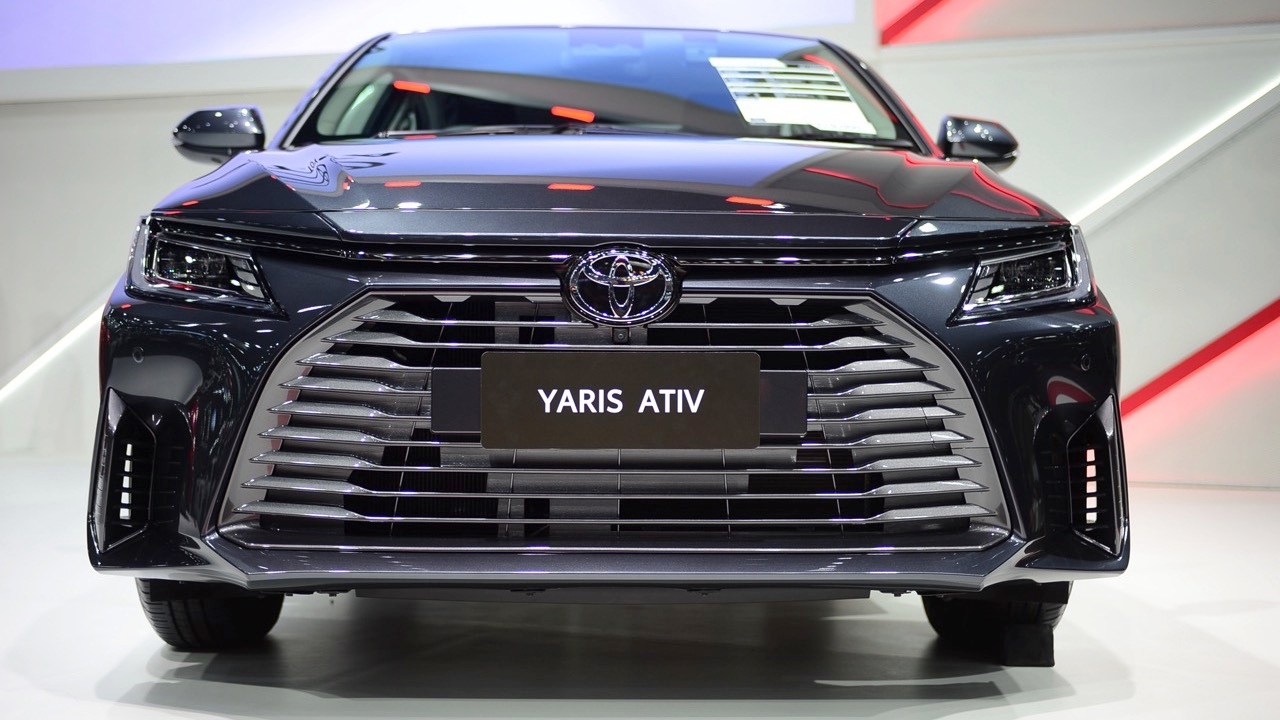
1. Toyota Yaris ATIV HEV
This is the most awaited car in the Entry-level Sedan category, building on the success of the standard Ativ by adding an ultra-fuel-efficient hybrid system achieving 25-26 km/l. It features the full suite of Toyota Safety Sense and a user-friendly cabin design.
The 1.5-liter hybrid engine (working with electric motor and lithium-ion battery) in the Toyota Yaris ATIV HEV (2025-2026 model) is an upgrade from the previous 1.2-liter engine to a full hybrid 1.5-liter system. It uses engineering derived from the Yaris Cross HEV, retuned for the sedan body. The new engine code is 2NR-VEX: a 1,496 cc (1.5L) 4-cylinder inline DOHC 16-valve gasoline engine with Dual VVT-i, producing 91 horsepower and 121 Nm of torque.
The electric motor and battery, the heart of the hybrid system that makes this ATIV drive more engaging than the gasoline-only version, deliver 80 horsepower and 141 Nm of torque. Combined system power totals 111 horsepower. The lithium-ion battery has a capacity of 0.76 kWh at 177.6 volts.
The transmission is a front-wheel-drive E-CVT automatic. The fuel consumption is officially claimed to reach up to 29.4 km/l (ECO Sticker standard), the highest in its segment, but requires a very gentle driving style. Three driving modes are offered: ECO, NORMAL, and POWER, plus an EV Mode button for short-distance pure electric driving.
The Toyota Yaris ATIV HEV is priced approximately between 729,000 and 799,000 baht.


2. Honda City e:HEV Hatchback / Sedan
This leading City Car is renowned for its exciting torque from a dual-motor system and the versatile Ultra Seat in the 5-door version. All trims come with Honda SENSING safety features, quick electric-like acceleration, and rear air conditioning vents for added comfort.
The 1.5-liter Atkinson-cycle engine (paired with two electric motors) in the Honda City e:HEV (both Sedan and Hatchback) uses the i-MMD (intelligent Multi-Mode Drive) technology. Unlike traditional hybrids, it emphasizes electric motors as the primary drive source most of the time. The engine mainly generates electricity to power the motors and assists in driving directly only at steady high speeds.
The 1.5-liter Atkinson-cycle engine, code LEB-MMD, is a 1,498 cc (1.5L) 4-cylinder inline DOHC 16-valve i-VTEC with Atkinson cycle cylinder head technology for fuel efficiency. It produces 98 horsepower and 127 Nm of torque. Honda claims 27.8 km/l fuel economy, although real-world driving at higher speeds yields 18-20 km/l.
The system includes two electric motors (Motor Generator and Motor Drive), with a maximum driving motor output of 109 horsepower and 253 Nm of torque. The lithium-ion battery is located in the rear cargo area.
Powertrain uses an e-CVT electric transmission without traditional gear sets, transferring power via an engine-linked clutch. In EV Drive Mode, the car runs 100% on electricity from the battery powering the motor. In Hybrid Drive Mode, the engine generates electricity for the motor to drive the wheels. In Engine Drive Mode, at steady high speeds, the clutch connects the engine directly to the wheels, as the engine is more efficient than the motor in this range.
The Honda City e:HEV Hatchback / Sedan is priced between 769,000 and 839,000 baht.


3. MG 3 Hybrid+
This new 5-door hatchback shakes up the market with the highest horsepower in its segment and an accessible price. Its Hybrid+ system features a large electric motor capable of multiple modes (EV, Series, Parallel) and rapid 0-100 km/h acceleration for this class.
The MG 3 Hybrid+ (2024-2026 model) pairs a 1.5-liter hybrid gasoline engine with an electric motor. It emphasizes electric motor power. The gasoline engine is a 1,498 cc (1.5L) 4-cylinder inline DOHC 16-valve producing 102 horsepower and 128 Nm torque. The electric motor delivers 136 horsepower and 250 Nm torque, totaling 194 horsepower combined. The lithium-ion battery capacity is 1.83 kWh, larger than typical hybrids which range around 0.7-1.1 kWh.
MG 3 Hybrid+ uses a 3-speed Electric Drive Unit (EDU) automatic transmission designed to optimize power delivery across speed ranges. It achieves 0-100 km/h acceleration in about 8 seconds, among the fastest in its class, and claims fuel economy up to 26.2 km/l.
The MG 3 Hybrid+ is priced between 579,900 and 619,900 baht.


4. Mitsubishi Xpander HEV / Xpander Cross HEV
This 7-seat family favorite upgrades to a hybrid system, making long-distance travel more fuel-efficient and enjoyable to drive.
Key features include a full hybrid drive system tuned for torque under load, seven selectable driving modes, and Active Yaw Control (AYC) technology for confident cornering.
The 1.6-liter MIVEC Hybrid engine is central to the Mitsubishi Xpander Cross HEV, employing the full hybrid Mitsubishi e:MOTION system derived from the Outlander's PHEV technology. It prioritizes electric motor drive. The redesigned engine works specifically with the hybrid system for fuel efficiency. Engine code 4A92 is a 1,590 cc (1.6L) 4-cylinder inline DOHC 16-valve MIVEC with Atkinson cycle head for higher combustion efficiency. It uses an electric water pump to reduce engine load, producing 95 horsepower and 134 Nm torque. The electric motor delivers 116 horsepower and 255 Nm torque, providing instant torque at launch. The lithium-ion battery is about 1.1 kWh, mounted under the front seats. The powertrain uses an e-CVT connecting engine, motor drive, and generator.
EV Mode drives the car 100% on battery power for short distances or low speeds.
In Series Hybrid mode, the engine generates electricity to power the motor driving the wheels; the engine is not mechanically connected to the wheels.
In Parallel Hybrid mode, both engine and motor drive the wheels simultaneously, typically at high speeds for maximum efficiency.
There are seven driving modes: Normal, Eco, Gravel, Tarmac, Mud, Wet, and EV Priority/Charge.
Although the engine horsepower appears smaller than the previous 1.5L 105 hp model, combining it with the 116 hp electric motor results in significantly higher torque (255 Nm versus 141 Nm previously), yielding noticeably better acceleration and responsiveness.
The Mitsubishi Xpander HEV / Xpander Cross HEV is priced between 912,000 and 946,000 baht.


5. Changan Deepal S05
The Changan Deepal S05 is an interesting new model that runs mostly on electric power with minimal fuel use. It is offered in Thailand as a fully electric (BEV) and range-extended electric vehicle (REEV), the latter functioning similarly to a hybrid but focusing on electric motor propulsion.
The REEV version of the Deepal S05 operates like a hybrid, using fuel to generate electricity.
Highlights include a futuristic high-end SUV design, Huawei’s autonomous driving technology (ADS), and a luxurious interior akin to a mobile living room.
Its drivetrain uses an electric motor with a gasoline engine functioning solely as a generator, eliminating range anxiety about charging stations.
Pricing for Deepal S05 REEV models:
Deepal S05 REEV Plus is priced at 949,000 baht.
Deepal S05 REEV Max is priced at 999,000 baht.
The Deepal S05 REEV is powered by a 1.5-liter 95-horsepower engine acting only as a generator, while a 218-horsepower electric motor drives the rear wheels.The battery capacity is 27.28 kWh, significantly larger than typical hybrids like the City or Ativ, whose batteries are usually around 1-2 kWh. Japanese hybrids have historically used very small batteries and resisted increasing their size for various unclear reasons.
The S05 can travel up to 170 km on pure electric power (EV Mode) according to NEDC standards.
With a full fuel tank and battery, it can cover a total distance of 1,000 to 1,180 km (NEDC), the longest range among the five hybrid models presented here.
It is the only model listed that supports DC Fast Charging (charging from 30% to 80% within 20 minutes), allowing it to operate like an EV but without range anxiety thanks to fuel-powered electricity generation.


6. BYD SEAL 5 DM-i
This is a fuel-sipping sedan, comfortably driven from Chiang Rai to Bangkok on just over one tank of fuel (about 40 liters). It is a plug-in hybrid vehicle (PHEV) focusing on fuel efficiency and long-term usability. BYD's DM-i (Dual Mode intelligence) powertrain uses the electric motor as the main drive and the gasoline engine to assist torque delivery or generate electricity. The 1.5-liter gasoline engine (Xiaoyun-PHU) is a 4-cylinder producing 72 kW (approximately 101-110 hp) and 122 Nm torque. The electric motor outputs up to 145 kW (about 197-218 hp) and 300 Nm torque. The BYD Blade Battery (LFP) comes in Standard/Dynamic variants with 13.08 kWh capacity, enabling 85 km electric range, and a Premium variant with 18.3 kWh capacity for 120 km electric range. Acceleration from 0-100 km/h takes 7.5 to 7.9 seconds.The claimed fuel economy is 26.3 to 28.6 km/l (NEDC standard).With a full 45-liter fuel tank and fully charged battery, it can travel over 1,100 to 1,200 km. Driving modes allow switching between pure electric (EV) and hybrid (HEV) as desired.
Pricing details:
BYD SEAL 5 DM-i Thai-assembled models:
Standard model priced at 599,900 baht.
Dynamic model priced at 659,900 baht.
Premium model priced at 699,900 baht.
The BYD SEAL 5 DM-i excels in fuel efficiency. Being a PHEV, regular home charging can greatly reduce fuel costs, especially for city driving where pure electric operation is possible most of the day. The Vehicle-to-Load (V2L) system can supply up to 2.2 kW of power to external devices. The car is classified as a C-segment vehicle (similar size to a Civic or Altis) but is priced in the B-segment range, making it a competitor to Japanese HEVs at significantly lower prices.