

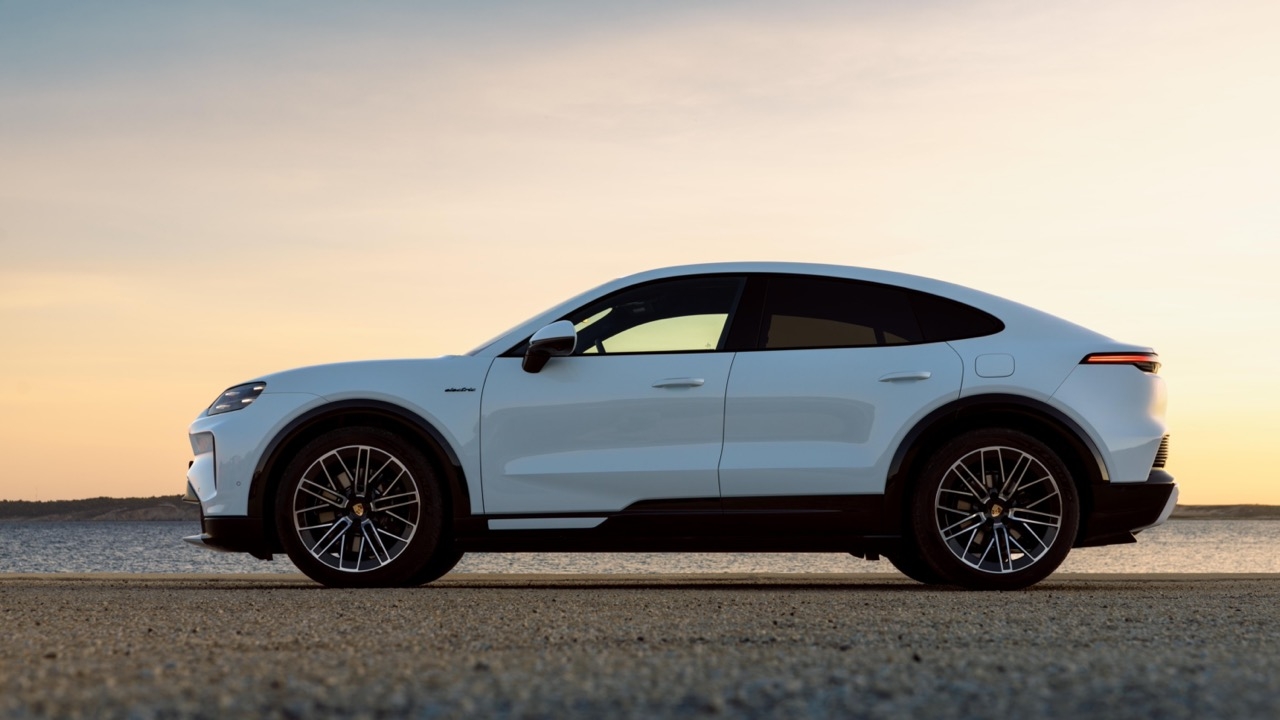
If you're still puzzled or curious about the popularity of sloping-roof SUVs, known as Coupe SUVs, since the BMW X6 shook up the automotive industry in 2008, these oddly shaped SUVs have steadily eroded sports car sales. At the 2026 Beijing Auto Show, I was surprised that despite Porsche's sales in China plummeting—frustrating brand executives—the newly launched car attracted so much attention that it was hard to see the actual Cayenne Electric body amid the crowd. At the world’s largest auto show, Porsche unveiled the latest Cayenne Coupe Electric, leveraging mathematical arguments to persuade wealthy Chinese buyers to spend heavily on this coupe SUV instead of the standard Porsche SUV with more usable space. This indicates that affluent Chinese customers still prefer expensive luxury imports over cheaper domestic vehicles.


Of course, the reason for spending such a large amount is not about headroom. Porsche calls the smoothly sloping roofline that sweeps over the car’s muscular shoulders—claimed to be inspired by the 911’s shape—something that cannot provide the spacious headroom of a boxy SUV. Rear visibility is likely more restricted as well. So why does this type of car continue to sell well?

In terms of power, owners don’t get any more horsepower than before, but the electric Cayenne is hardly short on strength. It might even be excessively powerful, making it harder to control and brakes less effective, especially since electric vehicles are heavy and require more front braking distance than internal combustion engine cars. Those who have driven a 2,500-kilogram electric car and had to brake hard to slow down know it doesn’t stop as precisely as a combustion car, which brakes faster.
The standard Cayenne Coupe features dual motors on the front and rear axles, producing 402 horsepower. When Launch Control is activated, power jumps to 436 horsepower, propelling the car from 0 to 100 km/h in just 4.8 seconds. And this is only the entry-level Cayenne Coupe Electric.

For more power, the Cayenne S offers twin motors producing 537 horsepower, surging to 657 horsepower when accelerating hard. It achieves 0-100 km/h in 3.8 seconds, matching the performance of the 911/991 GT3. Apparently, Porsche executives felt this wasn’t powerful enough, as they prepared an even more potent Turbo version for wealthy, aggressive drivers.

The top-tier Cayenne Coupe Turbo Electric boasts the highest power Porsche has ever produced, with 1,140 horsepower. During casual driving, it delivers 845 horsepower—enough to make rear passengers, packed closely together, shift from fear to nausea. With extraordinary acceleration, this SUV transforms into a hypercar, reaching 0-100 km/h in just 2.5 seconds. Rumor has it an even more extreme Turbo GT model is coming, with over 1,200 horsepower. Why make such cars? It’s akin to Jurassic Park scientists resurrecting man-eating dinosaurs. Porsche’s engineers are focused on outperforming Chinese electric cars and proving they can build such powerful vehicles. Both Chinese and German sides are racing to produce these machines, seemingly forgetting to question whether selling such insanely powerful cars is wise.


In reality, we rarely use such torque in daily driving. Power and versatility aren’t reasons this car surpasses the absurdity of the Coupe SUV segment. Nor is it about the curved touchscreen-laden dashboard or the price jump—from £86,200 (about 3.77 million baht, excluding import tax) for the base model to £133,000 (around 5.82 million baht) for the Turbo, plus roughly £6,000 (about 270,000 baht) extra for a high-powered SUV that looks like a cross between a Porsche 911/992.2 and a dwarf hippopotamus.

Looking at the body dimensions, you might be surprised that the Cayenne Coupe Electric is more aerodynamic than the standard Cayenne. The front looks bulky, like the Great Wall of China, and weighs about the same, but the coupe’s drag coefficient is only 0.23Cd—0.02Cd lower than the standard model—reducing air resistance. This small difference increases the driving range by around 18 kilometers. The trade-off for the coupe’s sloping rear is reduced rear headroom and about 200 liters less cargo space. In summary, wealthy buyers may worry slightly about cargo capacity (Cargo Anxiety) but gain peace of mind about battery range (Range Anxiety) with a maximum range of 667 kilometers per charge.

It took more than two decades to understand why people like sloping-roof SUVs. The existence of coupe SUVs has brought Porsche enough profits to fund the development of pricey but consistently selling two-door sports cars like the GT3. If you prefer a spacious trunk and real versatility, I’d suggest buying the more affordable standard Cayenne Electric—the best e-SUV you can find at the 2026 Beijing Auto Show!
Let’s look at the car’s details. This is an all-electric Cayenne with a massive 113 kWh battery (108 kWh usable), claiming a driving range of 580–667 kilometers. The Turbo version can unleash up to 1,140 horsepower and an immense 1,490 Newton-meters of torque, making it Porsche’s most powerful road car ever. Independent electric motors on both axles drive all four wheels, combined with new traction control and stability systems. This top model accelerates from zero to 100 km/h in just 2.5 seconds, matching the 911 Turbo S record, despite weighing 2,650 kilograms. To be frank, launching with full Launch Control makes the pull feel like your bones are being ripped from your flesh.


The interior is impressively spacious and suitable for daily use. It also has a robust thermal management system with dual-sided battery cooling, supporting ultra-fast charging—from 10% to 80% in less than 16 minutes (if you don’t mind faster battery degradation). Testing with high-voltage chargers during development showed Porsche’s charging system even outperforms its claimed speeds.
This might sound exaggerated, but in normal driving, the Turbo model delivers "only" about 850 horsepower, which is still more than enough. The car features precise power management under the right foot. For sudden overtakes, just press the 'Push to Pass' button on the right side of the steering wheel to summon an extra 175 horsepower. For full-throttle tire-burning power, you must stop and activate Launch Control. Many local media often do this, but I wonder why, since such explosive acceleration is extremely dangerous.


The standard Cayenne Electric carries 400 horsepower, rising to 442 in Overboost mode, accelerating from 0 to 100 km/h in just over 5 seconds, with a maximum range of 640 kilometers. Though it has nearly half the power and lower speed than the ferocious Cayenne Coupe Turbo, it costs £47,700 (about 2.1 million baht) less. In reality, the base model isn’t sluggish at all.
Porsche says this electric Cayenne excels all around: easy to drive, comfortable for long trips, and highly versatile, with a "heart" of a sports car delivering acceleration as a main feature on every journey.

You can easily see the design philosophy here: “Nothing too futuristic will ever become outdated.” Yet, many remain ambivalent about its looks. The Turbo model gets a more aggressive styling with air intakes and small "blades" that pop out from the rear wheel arches at speed, resembling chunky cement mixer handles, combined with massive wheels. But if you choose muted colors, this Porsche will quietly pass by unnoticed.

The long rear light strip spanning the tailgate, with a glowing Porsche logo in the center, bears resemblance to large SUVs from sibling brand VW. Porsche might have done better to distinguish this feature more clearly.


If you add bright colors and stylish wheels, the car looks more confident and lively, though it’s still not the type you'd frame and hang in your bedroom. Interestingly, Porsche now categorizes color themes by "moods" (Teams), ranging from Contrasts, Shades, Dreams, Legends, to custom Paint-to-Sample options.
I would boldly recommend to wealthy buyers considering this car the Oak Green Metallic from the ‘Legends’ group—it looks classy. As for the 'California Gold' wheels, unless you have sky-high confidence or work closely with wealthy gray-market Chinese clients, I’d advise skipping that choice!