

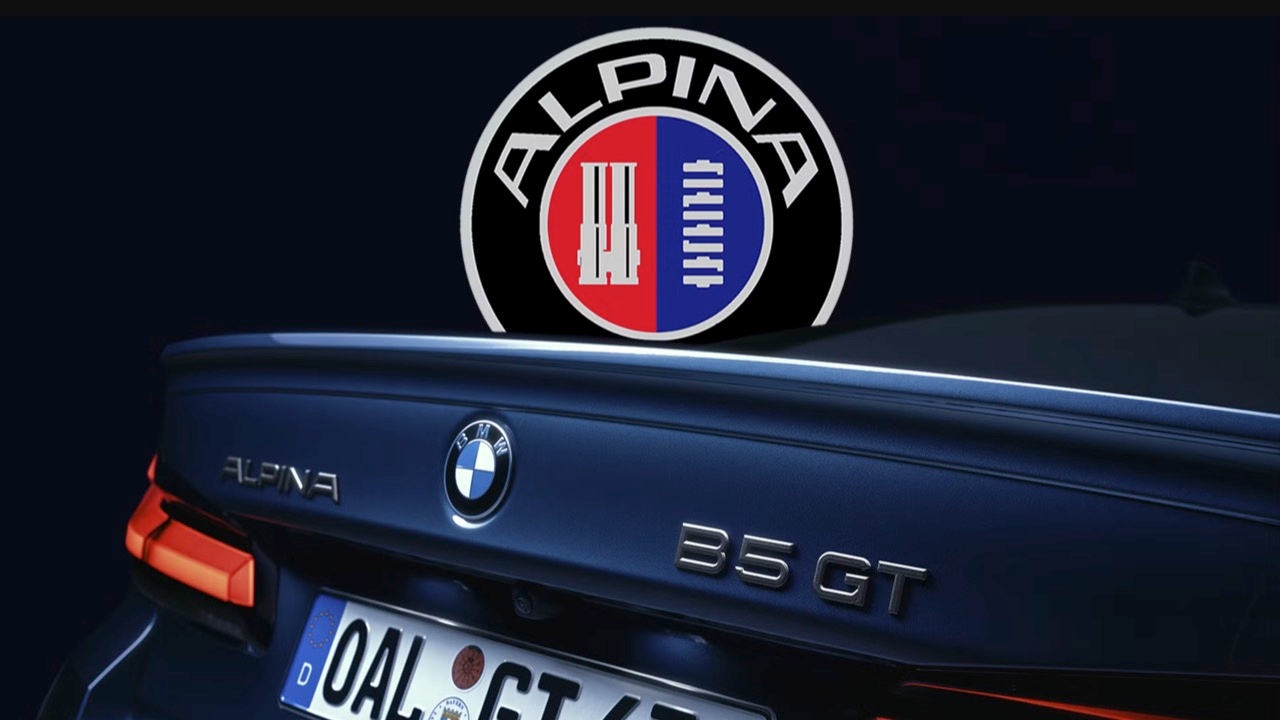
Alpina is a company that produces special upgrade kits for BMW cars, creating luxurious and high-speed vehicles by building upon the structure of BMW models released in each respective year. It is a brand for genuine car enthusiasts with a long history, akin to brands like Ruf and Dallara. Alpina embodies the distinctive German commitment, top-tier expertise, and limited production volume, making it a beloved choice among elite drivers.


Formally, Alpina began producing road-legal cars officially in 1983. However, the difference between official and actual practice explains the term "de facto." In reality, Alpina started modifying cars in the mid-1960s, built race cars in the late 1960s, and produced road vehicles from the late 1970s onward. Now, under the BMW Group umbrella, exciting developments are underway. BMW acquired Alpina and introduced the new BMW Alpina brand, guiding the Bovensiepen family’s company toward new paths, including collaboration with design house Zagato. Despite changes, the core spirit of BMW remains deeply embedded in every part of these cars.

Before BMW took over operations, Alpina cars were assembled in Buchloe, a small town in southern Bavaria. While not the southernmost point of Bavaria, the factory—Alpina’s home—is located deep enough to witness the traditional Krampus celebrations during Christmas.

In an era of constant change, Alpina’s production will be integrated into selected BMW Group factories. These plants will be comprehensively upgraded to meet the high standards expected from the new, highly exclusive brand. Meanwhile, the original Alpina factory in Buchloe will be repurposed as a service and parts center for classic Alpina vehicles.


Before BMW took the helm, Alpina produced vehicles in such limited numbers that even Ferrari or Rolls-Royce appeared mass-produced by comparison. Alpina’s annual production was around 1,700 cars, reflecting meticulous assembly processes. BMW intends to maintain this exclusivity, focusing on crafting uniquely special vehicles in small quantities, built to bespoke customer specifications—clients who pay premium sums for personalized BMW models.


Prior to the merger, Alpina produced both petrol and diesel models based on BMW Series 3, 4, 5, and 8, as well as X3, X4, and X7. Petrol Alpina models start with ‘B’ for Benzin, German for gasoline, while diesel models use ‘D’ after Rudolf Diesel, the German inventor of the compression ignition engine. Model names follow BMW series numbers, adding ‘X’ for SUVs. For example, the late 1980s B11 was based on the Series 7. Diesel models often have an additional ‘S’ suffix.

Recently, while the "old era" Alpina turned to designing Zagato-styled coupes, the "new era" Alpina fully joined the BMW family. Most BMW fans remain uncertain about the brand’s future under BMW’s control. Rumors suggest Alpina will debut a special luxury Series 7—akin to a "Maybach version" of BMW—with hopes the design will surpass Maybach’s.

The most affordable option is the BMW Alpina D3S, priced at £63,500 (about 2.9 million baht), excluding import taxes. While substantial, this is the brand’s entry-level car. The high-end BMW Alpina XB7 costs £149,500 (around 6.8 million baht) before import duties. Though few customers choose the top XB7 trim, it is extremely popular in the U.S., selling very well.

Alpina’s expertise lies in creating exclusive executive vehicles that deliver effortless high speed. Throughout its history, the brand has consistently produced extremely fast cars. All recorded top 10 fastest Alpina models exceed 322 km/h. Furthermore, many Alpina cars have held segment speed records over the years. Interestingly, the fastest Alpina titles are jointly held by the B5, B6, and B7 models.
The good news (or not, depending on perspective) is that the older 6 Series used for the B6 has been discontinued, and Alpina seems set to end the B7 line due to poor sales. This leaves only the B5, based on the 5 Series with a 4.4-liter twin-turbo V8, capable of 329 km/h top speed. Buyers face a tough choice between the B5 and BMW’s M5. Wealthy enthusiasts are divided, except that the B5 is available as an estate (wagon) with a slightly reduced top speed of 325 km/h—a compromise customers readily accept, knowing that reaching such speeds safely requires exceptionally long straight roads.


Has the golden era truly passed? BMW’s acquisition confirms Alpina’s meticulous craftsmanship and its reputation for precision. Since its inception in road car production, Alpina has possessed an elusive charm—an unmistakable and unique identity. It offers understated elegance and smoothness concealing immense power, like a heavy right hook ready to strike when provoked.

Alpina has proven that genuine identity continues to yield profits, even in a world rife with superficiality that might cause stress to many. Alpina shows that the path to automotive nirvana is not singular. It’s too soon to judge Alpina’s future under BMW’s leadership, but some of the brand’s former quirky charm and rebellious spirit have faded. Once a creative outsider doing its own thing, Alpina is now a disciplined leader adhering to formal rules.

The Bovensiepen family’s swift departure to pursue their own new path—launching a project even before BMW unveiled its first in-house Alpina model—is a strong indicator of their belief in their traditional working methods. Fans have long expected Alpina to deliver massive speed without sacrificing comfort. Remember, in its early days, Alpina achieved more motorsport success than many automakers that merely proclaimed themselves "sporty."


Legendary drivers like Niki Lauda and James Hunt were among the talented, heavy-footed racers who drove Alpina cars. Alpina’s strongest mark of excellence is its endurance racing success. Driving the Spa-Francorchamps circuit at race speed without missing corners is impressive; doing so for 301 laps with 1970s tire and brake technology was nearly miraculous. The BMW-Alpina 2800CS covered over 4,248 kilometers in 1970, beating the second-place Alfa GTAm by more than 11 kilometers. It’s no surprise that wealthy drivers worldwide trust Alpina for fast and safe performance.

Like many top-tier car brands, Alpina avoids frivolous concept cars aimed at future design directions. Any Alpina design or creation you see is likely to become a road-legal version soon—at least theoretically—though these cars are even rarer than Ferraris.

Alpina’s definition of a concept car might need revising. With that understanding, one can confidently say Alpina’s coolest concept was marrying the current BMW M5’s speed with the utility of the 5 Series estate body, wrapped in the brand’s signature refined elegance. This is the high-performance family wagon known as the B5 Touring.

Finally... What exactly is Alpina?In fact, Alpina has been officially recognized by Germany’s Ministry of Transport as a full-fledged car manufacturer since the 1980s, thanks to its meticulous assembly and deep ties with BMW.
Alpina’s trusted role in building, refining, and selling vehicles based on BMW engineering distinctly separates it from ordinary tuners. No matter how talented or capable other global tuning houses might be, Alpina’s status is unique.