

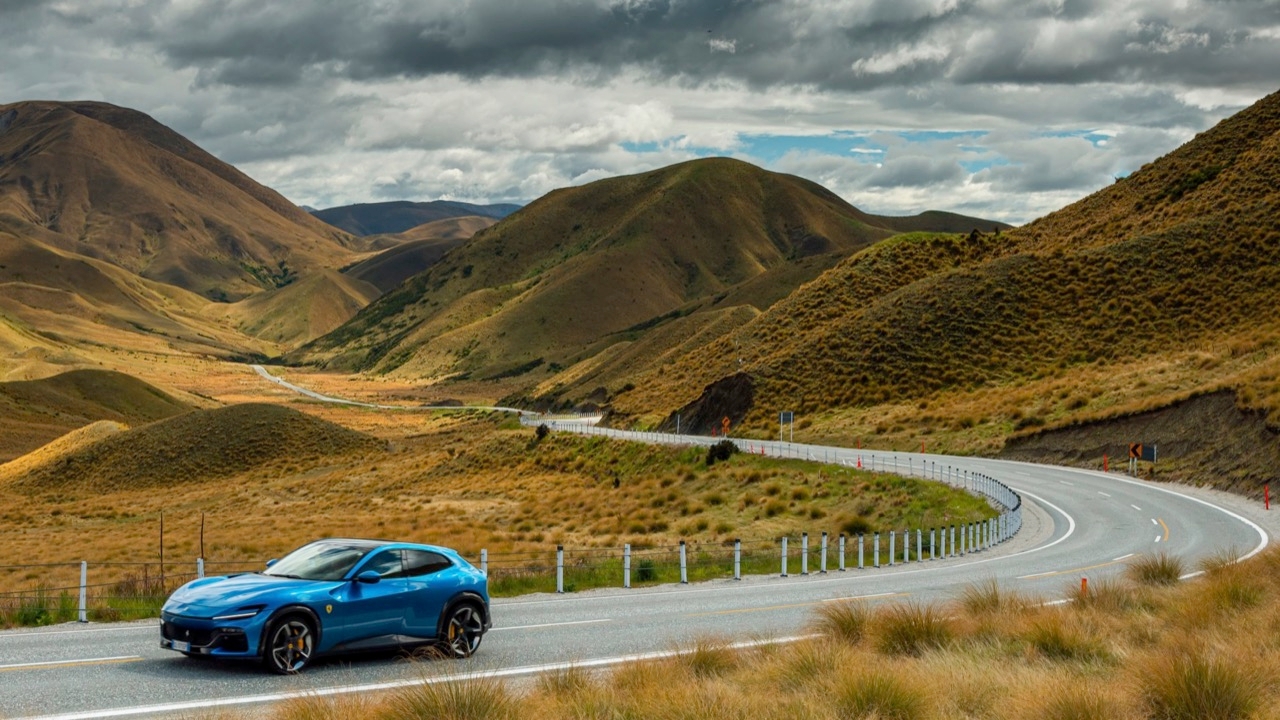
Purosangue literally means 'pure blood,' but when interpreted according to Italian linguistic principles, it translates roughly to 'thoroughbred horse,' a fitting name for the brand known as the elegant horse. This marks a major change for the supercar manufacturer, especially since it's Ferrari's first effort to build a practical vehicle with higher ground clearance: a four-door, four-seat, all-wheel-drive SUV powered by a 6.5-liter V12 engine under the hood. However, Ferrari does not consider the Purosangue merely an SUV. People in Maranello claim it redefines the brand's vehicle category and stands out as a unique car. Subsequently, there was intense debate about its somewhat duck-like appearance.


The popularity of high-performance SUVs from competitors like the Lamborghini Urus and Aston Martin DBX 707 sparked debate about the true meaning of 'sports.' Mostly, these cars use electronics and power to challenge physics. While fun to drive, they are not sports cars in the traditional sense. The Purosangue breaks the mold; arguably, as a true SUV by name, it is the purest and most genuine SUV. It is sporty, seats only four, and the rear seats (accessed through rear-hinged doors) are as luxurious as the front.


It houses a 6.5-liter V12 engine producing 715 horsepower—a cylinder layout unique since the discontinuation of the Lamborghini LM002 and Audi Q7 V12 TDI. It incorporates parts from Ferrari's extensive parts inventory, a valuable resource. The engine is set deep behind a bulkhead so that the last two cylinders might warm the driver's knees. The car has a front-mounted engine, positioned as close to the center as possible. An 8-speed paddle-shift gearbox is located behind, next to the rear drive shaft, with a dual-clutch transmission system borrowed mostly from the GTC4 Lusso, sending power to each front wheel. Although the all-wheel-drive system feels more like assistance than for off-roading, under varying conditions, this car is mostly rear-wheel drive, rarely distributing torque to all four wheels simultaneously.
While not entirely new, the interior has been redesigned with different system controls. The much smarter suspension allows the Purosangue to handle excellently like a low Ferrari while offering the GT comfort SUV buyers expect.
Certainly, it lacks a hybrid system, so nothing helps reduce its very high fuel consumption. The figures are among the worst seen in recent times: carbon dioxide emissions at 393 grams per kilometer and an average fuel economy of 6.1 kilometers per liter. However, compared to a gasoline V6 Ford Ranger Raptor, it's not considered very thirsty.
Other notable figures include acceleration from 0 to 100 km/h in 3.3 seconds and a top speed of 335 km/h. The starting price is £313,360, and due to Ferrari's options policy, most Purosangue models cost under £400,000.
This is a deliberate move. Ferrari is trying—and succeeding, with reports of a two-year waiting list—to position itself above other competitors. The only car that can compete on price is from a giant like Rolls-Royce.


Regardless of cost, the Purosangue clearly surpasses competitors like the Urus and DBX. First, it does not rely on parts shared with other brands. The Urus shares its platform, engine, and other components with Bentley, Audi, and Porsche, while Aston Martin borrows drivetrain technology from Mercedes-Benz. Both brands—and all competitors—stick to traditional SUV designs focusing on comfort and space. The Purosangue prioritizes being a Ferrari first, then plans space allocation without losing the car's essence.
However, the price is very high for a car not significantly faster than the DBX 707 or Urus Performante, although it drives better than both. The purity of the V12 engine, the astonishing driving quality, precision, and balance are things high-performance SUVs have never had before.


In practice, the Purosangue is useful. It looks very expensive on the road and is extremely rare, but it has some limitations. It has a hatchback-style rear door and 473 liters of cargo space. Though not large, it expands with electrically folding seats. The cargo area isn't perfectly flat or large but enough for a few boxes. There are incredibly expensive carbon fiber accessories to carry bikes and skis. It's as practical as possible while retaining Ferrari's character. Contextually, it feels like a midpoint between a large GT car and an SUV.


The Purosangue offers something Ferrari buyers have never had before: a truly usable everyday Ferrari. Ferrari seems somewhat unsure about the Purosangue, possibly because Maranello was initially proud and declared it would not enter this market. Additionally, the price is very high—even in the luxury car segment. The Purosangue's starting price of 40.5 million baht is a significant sum for a mass-produced car, no matter how lavish the buyer. But technology has advanced greatly, the market has grown, and the Purosangue offers what Ferrari buyers have never had: a Ferrari practical for daily use, with four easily accessible seats. Its strength lies in focusing on Ferrari's core qualities while adding usability comforts. Rather than just a revamped SUV, it drives impressively and is arguably the most authentic 'SUV' ever. Oddly, it might be the only car deserving that name.


The Purosangue's suspension employs a system called TrueActive spool valve (TASV) from Multimatic. Essentially, it's an active—almost proactive—suspension using two independent spool valves per wheel: one for compression and one for rebound. Each shock absorber has its own control module, governed by the car's dynamic brain, allowing completely independent operation. A 48-volt electrical system assists the springs. Electric motors (one per wheel) apply force to the shock absorber shaft through a small gear set—yes, each wheel has its own gear.
What's best about this? It reduces weight, installation space, and rotational inertia, while providing a suspension system that responds faster and has a much wider range of motion, eliminating the need for anti-roll bars. What does this mean? Better body control, ride comfort, and no need to adjust ride height. This cutting-edge technology was previously seen only in racing cars. In fact, the only cars we've driven with spool valve suspensions were the Ford GT and Aston Martin One-77, and they weren't as advanced as this. The key question: does it really work? The short answer: yes, and very well. The longer answer requires some explanation.


The steering system is interesting because good steering depends on the relationship between the wheel and the car's immediate response. Poor body control and suspension can quickly cause loss of control. Ferrari sports cars are easier to control than almost all others, except some Lotus and race cars. They respond mainly to wrist movements—a gentle flick communicates intent and tends to maintain grip on almost any road, no matter how aggressively driven. 'Precise' sums it up. If you haven't driven one before, despite Purosangue's excellence, it requires more arm strength due to its mass and heavier steering effort. You must position the Purosangue as you would a 296 GTB. This is not a negative critique; if the Purosangue were too light or too responsive, it would feel unrealistic and possibly cause slight dizziness. Your inner ear usually senses when electronics provide false feedback.
The Purosangue handles rough roads well at low speeds and climbs steep slopes sharply, aided by wide 23-inch rear tires (size 315/30) and front tires sized 255/35 R22, which is expected.


Actually, the Purosangue feels soft, quiet, comfortable, and easy to drive. Unlike other Ferraris, the steering is not overly sensitive, providing stability over long distances and at steady speeds. There's no urge to adjust the wheel constantly in this large Ferrari, even in 'sport' mode, where it still drives precisely. The main challenge on long drives might be avoiding other road users trying to film every steering input. This car attracts more attention than expected.
Overall, it's a large GT sports car that can easily compete with others. Rear visibility is poor. The V12 engine lacks the low-end grunt of a V8. The cabin is quiet, and the suspension is incredibly smooth despite limited travel.


Basically, while other SUVs are running out of ideas, the Purosangue elevates itself further. The slight surge in V12 revs reveals deeper performance. It becomes a giant rally car eager to tackle challenges when conditions allow. It is a tall V12 sports car, naturally aspirated with over 700 horsepower. It offers precise control and an almost supernatural connection, gliding smoothly without fighting resistance. One reason for this special feeling is the all-wheel-drive system heavily biased toward the rear wheels. On dry roads and under heavy load, such as accelerating out of tight corners, the rear wheels spin briefly before the front wheels realign.


Similarly, it's not an off-roader. Imagine it as a rear-wheel-drive car with front axle assistance rather than one with locking differentials. It might be an exciting (and expensive) raised race car with rear-wheel steering for parking in luxury hotel garages. Additionally, it is the first SUV to offer optional front lift, priced at £4,109. If fuel costs worry you, after a day’s use, this Purosangue running on pure 95-octane gasoline consumes super unleaded fuel. Its 100-liter tank allows about 450 kilometers of range.